Ventura-Silva Ana P, Melo António, Ferreira Ana C, Carvalho Miguel M, Campos Filipa L, Sousa Nuno, Pêgo José M
Life and Health Sciences Research Institute (ICVS), School of Health Sciences, University of Minho Braga, Portugal ; ICVS/3B's - PT Government Associate Laboratory Braga/Guimarães, Portugal.
Front Behav Neurosci. 2013 Apr 19;7:32. doi: 10.3389/fnbeh.2013.00032. eCollection 2013.
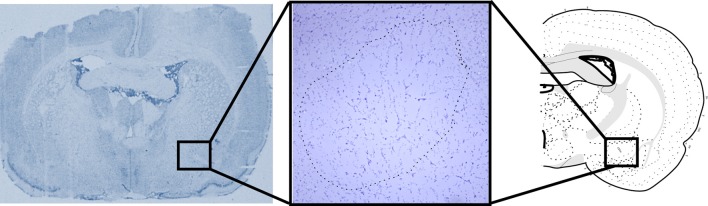
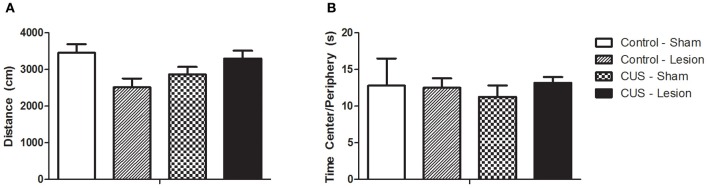
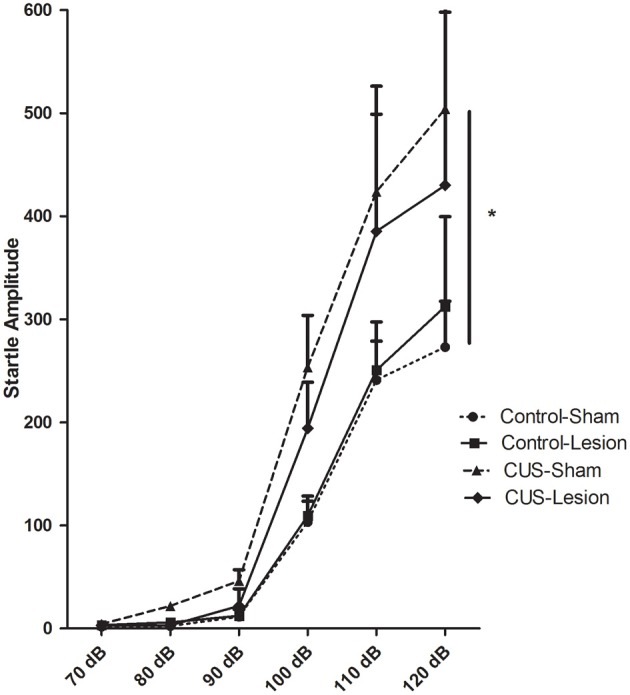
The extended amygdala, composed by the amygdaloid nuclei and the bed nucleus of the stria terminalis (BNST), plays a critical role in anxiety behavior. In particular, the link between the central nucleus of the amygdala (CeA) and the BNST seems to be critical to the formation of anxiety-like behavior. Chronic unpredictable stress (CUS) exposure is recognized as a validated animal model of anxiety and is known to trigger significant morphofunctional changes in the extended amygdala. Quite surprisingly, no study has ever analyzed the role of the CeA in the onset of stress-induced anxiety and fear conditioning behaviors; thus, in the present study we induced a bilateral excitotoxic lesion in the CeA of rats that were subsequently exposed to a chronic stress protocol. Data shows that the lesion in the CeA induces different results in anxiety and fear-behaviors. More specifically, lesioned animals display attenuation of the stress response and of stress-induced anxiety-like behavior measured in the elevated-plus maze (EPM) when compared with stressed animals with sham lesions. This attenuation was paralleled by a decrease of stress-induced corticosterone levels. In contrast, we did not observe any significant effect of the lesion in the acoustic startle paradigm. As expected, lesion of the CeA precluded the appearance of fear behavior in a fear-potentiated startle paradigm in both non-stressed and stressed rats. These results confirm the implication of the CeA in fear conditioning behavior and unravel the relevance of this brain region in the regulation of the HPA axis activity and in the onset of anxiety behavior triggered by stress.
由杏仁核和终纹床核(BNST)组成的扩展杏仁核在焦虑行为中起关键作用。特别是,杏仁核中央核(CeA)与BNST之间的联系似乎对焦虑样行为的形成至关重要。慢性不可预测应激(CUS)暴露被认为是一种有效的焦虑动物模型,已知会引发扩展杏仁核显著的形态功能变化。相当令人惊讶的是,从未有研究分析过CeA在应激诱导的焦虑和恐惧条件行为发作中的作用;因此,在本研究中,我们在随后接受慢性应激方案的大鼠的CeA中诱导了双侧兴奋性毒性损伤。数据表明,CeA损伤在焦虑和恐惧行为中产生不同结果。更具体地说,与假损伤的应激动物相比,损伤动物在高架十字迷宫(EPM)中测量的应激反应和应激诱导的焦虑样行为有所减弱。这种减弱与应激诱导的皮质酮水平降低同时出现。相比之下,我们在听觉惊吓范式中未观察到损伤有任何显著影响。正如预期的那样,CeA损伤阻止了非应激和应激大鼠在恐惧增强惊吓范式中出现恐惧行为。这些结果证实了CeA在恐惧条件行为中的作用,并揭示了该脑区在调节HPA轴活动以及应激引发的焦虑行为发作中的相关性。