Berhan Yifru, Berhan Asres
Hawassa University College of medicine and health sciences, Hawassa, Ethiopia.
BMC Public Health. 2013 Apr 30;13:409. doi: 10.1186/1471-2458-13-409.
Literature review has shown that some years back the fertility desires of people living with HIV was low but in the recent years, it was reported as increasing. However, little is known about the strength of association of fertility desire of HIV positive people with antiretroviral therapy (ART) experience, age, sex, education level, and number of children.
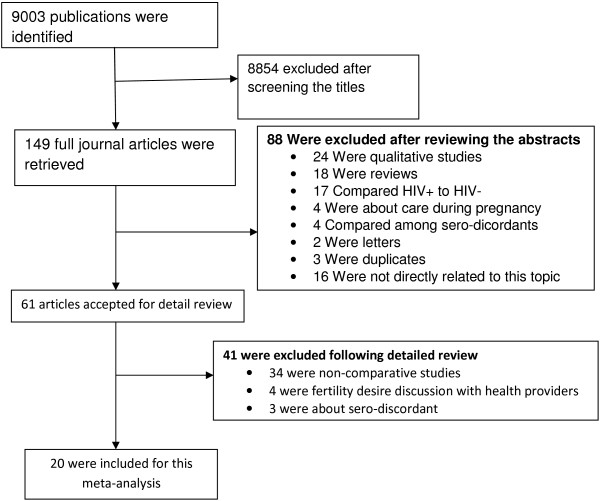
In these meta-analyses, twenty studies from different parts of the world were included. The odds ratios of fertility desires were determined using the random-effects model. Heterogeneity among the studies was assessed by computing values for Tau(2), Chi-square (Q), I(2) and P-value. Sensitivity analysis and funnel plot were done to assess the stability of pooled values to outliers and publication bias, respectively.
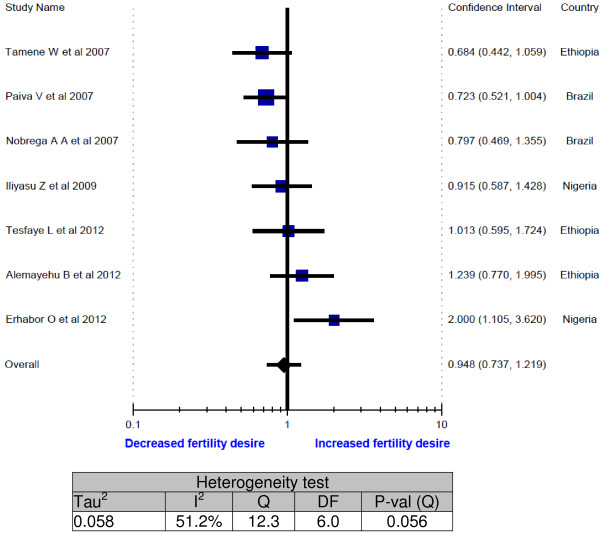
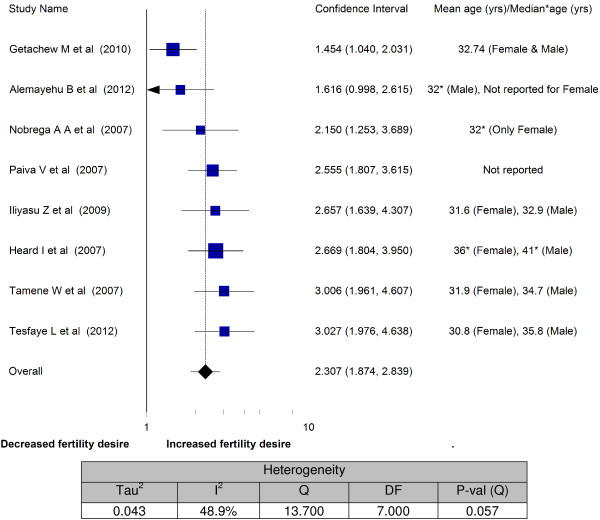
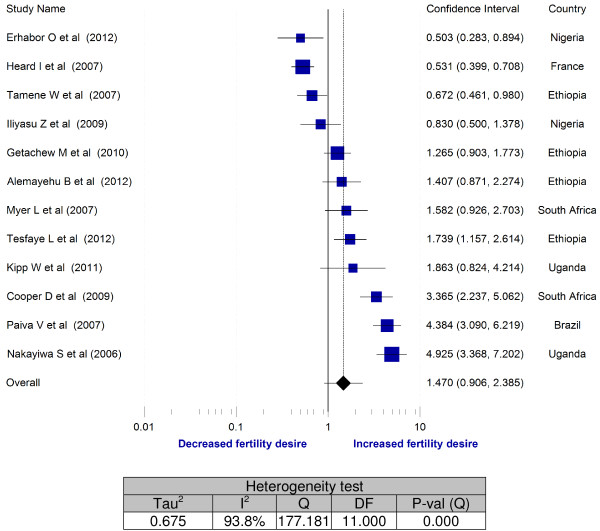
The pooled analysis demonstrated that fertility desires of study participants had no association with ART. Similarly, the overall odds ratio did not show statistically significant association of fertility desires with sex and educational attainment of study participants although forest plots of some studies fall on increased and some others on decreased sides of fertility desires. The two variables that demonstrated a strong association with fertility desires were age less than 30 years and being childless. The lowest heterogeneity was found in a meta-analysis comparing ART experienced and ART naïve HIV positive people. In all meta-analyses, the sensitivity analyses showed the stability of the pooled odds ratios; and the funnel plots did not show publication or disclosure bias.
Although the fertility desires among childless and younger age group was very strong, we realized that quite a significant segment of HIV-infected people have desire for fertility. Therefore, including fertility issue as integral part of HIV patient care may help several of them in their reproductive decision making (letting them know the risks and methods of prevention while anticipating pregnancy).
文献综述表明,几年前,感染艾滋病毒者的生育意愿较低,但近年来,据报道其生育意愿有所上升。然而,关于艾滋病毒呈阳性者的生育意愿与抗逆转录病毒疗法(ART)经历、年龄、性别、教育水平和子女数量之间关联的强度,人们知之甚少。
在这些荟萃分析中,纳入了来自世界不同地区的20项研究。使用随机效应模型确定生育意愿的比值比。通过计算Tau(2)、卡方(Q)、I(2)和P值来评估研究之间的异质性。分别进行敏感性分析和漏斗图分析,以评估合并值对异常值的稳定性和发表偏倚。
汇总分析表明,研究参与者的生育意愿与抗逆转录病毒疗法无关。同样,总体比值比并未显示出研究参与者的生育意愿与性别和教育程度之间存在统计学上的显著关联,尽管一些研究的森林图显示生育意愿有所增加,而另一些则显示有所下降。与生育意愿显示出强烈关联的两个变量是年龄小于30岁和无子女。在比较有抗逆转录病毒疗法经历和无抗逆转录病毒疗法经历的艾滋病毒阳性者的荟萃分析中,发现异质性最低。在所有荟萃分析中,敏感性分析显示合并比值比具有稳定性;漏斗图未显示发表或披露偏倚。
尽管无子女和较年轻年龄组的生育意愿非常强烈,但我们意识到相当一部分艾滋病毒感染者有生育意愿。因此,将生育问题纳入艾滋病毒患者患者患者护理的整体部分,可能有助于他们中的许多人做出生殖决策(让他们在预期怀孕时了解风险和预防方法)。