TOPS Obesity and Metabolic Research Center, Department of Medicine, Medical College of Wisconsin, Milwaukee, Wisconsin, USA.
BMC Med Genomics. 2013 Apr 29;6:14. doi: 10.1186/1755-8794-6-14.
Metabolic syndrome (MetS) is an aberration associated with increased risk for cancer and inflammation. Adiponectin, an adipocyte-produced abundant protein hormone, has countering effect on the diabetogenic and atherogenic components of MetS. Plasma levels of adiponectin are negatively correlated with onset of cancer and cancer patient mortality. We previously performed microsatellite linkage analyses using adiponectin as a surrogate marker and revealed two QTLs on chr5 (5p14) and chr14 (14q13).
Using individuals from 85 extended families that contributed to the linkage and who were measured for 42 clinical and biologic MetS phenotypes, we tested QTL-based SNP associations, peripheral white blood cell (PWBC) gene expression, and the effects of cis-acting SNPs on gene expression to discover genomic elements that could affect the pathophysiology and complications of MetS.
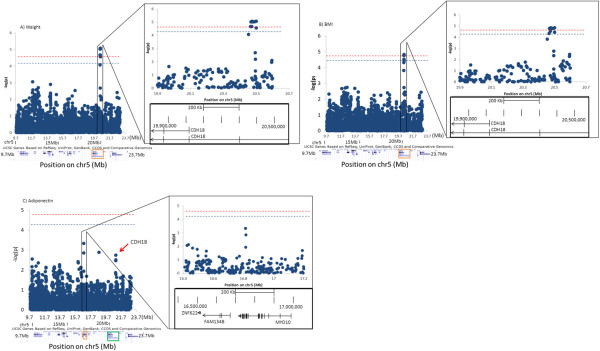
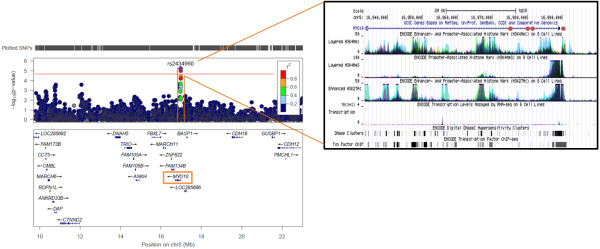
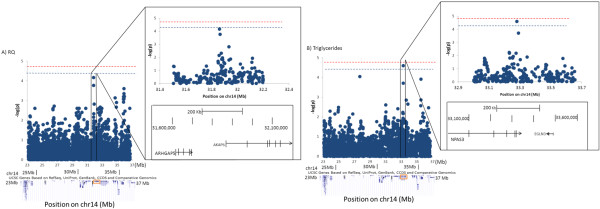
Adiponectin levels were found to be highly intercorrelated phenotypically with the majority of MetS traits. QTL-specific haplotype-tagging SNPs associated with MetS phenotypes were annotated to 14 genes whose function could influence MetS biology as well as oncogenesis or inflammation. These were mechanistically categorized into four groups: cell-cell adhesion and mobility, signal transduction, transcription and protein sorting. Four genes were highly prioritized: cadherin 18 (CDH18), myosin X (MYO10), anchor protein 6 of AMPK (AKAP6), and neuronal PAS domain protein 3 (NPAS3). PWBC expression was detectable only for the following genes with multi-organ or with multi-function properties: NPAS3, MARCH6, MYO10 and FBXL7. Strong evidence of cis-effects on the expression of MYO10 in PWBC was found with SNPs clustered near the gene's transcription start site. MYO10 expression in PWBC was marginally correlated with body composition (p = 0.065) and adipokine levels in the periphery (p = 0.064). Variants of genes AKAP6, NPAS3, MARCH6 and FBXL7 have been previously reported to be associated with insulin resistance, inflammatory markers or adiposity studies using genome-wide approaches whereas associations of CDH18 and MYO10 with MetS traits have not been reported before.
Adiponectin QTLs-based SNP association and mRNA expression identified genes that could mediate the association between MetS and cancer or inflammation.
代谢综合征(MetS)是一种与癌症和炎症风险增加相关的异常。脂联素是一种由脂肪细胞产生的丰富蛋白激素,对 MetS 的致糖尿病和动脉粥样硬化成分具有拮抗作用。脂联素的血浆水平与癌症的发生和癌症患者的死亡率呈负相关。我们之前使用脂联素作为替代标志物进行微卫星连锁分析,在 chr5(5p14)和 chr14(14q13)上发现了两个 QTL。
使用为连锁分析做出贡献并测量了 42 种临床和生物学 MetS 表型的 85 个扩展家族的个体,我们测试了基于 QTL 的 SNP 关联、外周血白细胞(PWBC)基因表达以及顺式作用 SNP 对基因表达的影响,以发现可能影响 MetS 病理生理学和并发症的基因组元件。
脂联素水平与大多数 MetS 特征在表型上高度相关。与 MetS 表型相关的 QTL 特异性单倍型标记 SNP 注释到 14 个基因,这些基因的功能可以影响 MetS 生物学以及肿瘤发生或炎症。这些被分为四个机制组:细胞-细胞粘附和迁移、信号转导、转录和蛋白质分类。四个基因被高度优先考虑:钙粘蛋白 18(CDH18)、肌球蛋白 X(MYO10)、AMPK 的锚蛋白 6(AKAP6)和神经元 PAS 域蛋白 3(NPAS3)。仅检测到具有多器官或多功能特性的以下基因的 PWBC 表达:NPAS3、MARCH6、MYO10 和 FBXL7。在 PWBC 中,发现 MYO10 表达的顺式效应证据很强,SNPs 聚集在基因转录起始位点附近。PWBC 中 MYO10 的表达与身体成分呈边缘相关(p=0.065),与外周脂联素水平呈边缘相关(p=0.064)。以前使用全基因组方法报道了基因 AKAP6、NPAS3、MARCH6 和 FBXL7 的变体与胰岛素抵抗、炎症标志物或肥胖有关,而 CDH18 和 MYO10 与 MetS 特征的关联以前没有报道过。
基于脂联素 QTL 的 SNP 关联和 mRNA 表达鉴定了可能介导 MetS 与癌症或炎症之间关联的基因。