Center for Infectious Disease Dynamics, Department of Biology, The Pennsylvania State University, University Park, PA 16802, USA.
Infect Genet Evol. 2013 Jul;17:260-8. doi: 10.1016/j.meegid.2013.04.025. Epub 2013 Apr 27.
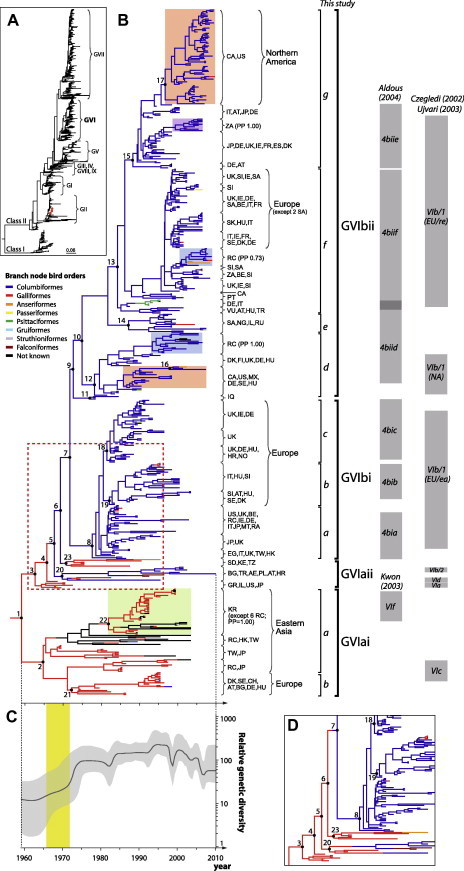
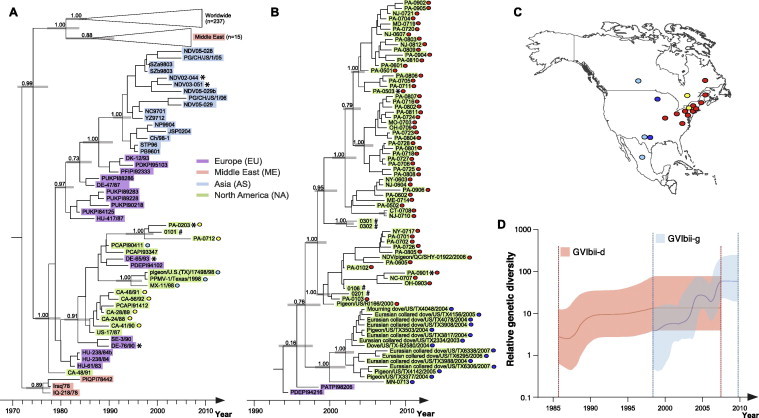
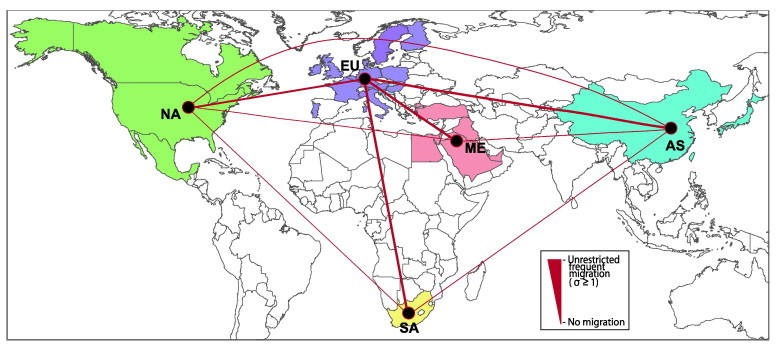
The evolutionary history of avian paramyxovirus serotype 1 (PMV1), which includes the agents of Newcastle disease (ND), is characterized by a series of strain emergence events since viruses in this family were first recognized in the 1920s. Despite the importance of ND to the poultry industry, little is known about PMV1 strain emergence events and the subsequent dispersal and evolution of new strains. The genotype VI-PMV1 was first identified in the 1980s and has been named pigeon paramyxovirus-1 (PPMV1) because of unusual host specificity with Columbiformes (Collins et al., 1996); it has been responsible for panzootics in both chickens and pigeons during that time. Here, we used evolutionary analyses to characterize the emergence of this contemporary PMV1 lineage. We demonstrate that GVI-PMV1 arose through cross-species transmission events from Galliformes (i.e. chicken) to Columbiformes, and quickly established in pigeon populations. Our studies revealed a close association between the time of viral emergence and panzootic events of this virus. The virus appeared first in Southeastern Europe and quickly spread across the European continent, which became the epicenter for global virus dissemination. With new viral gene sequences, we show that GVI-PMV1 viruses currently circulating in North America resulted from multiple invasion events from Europe, one associated with an exotic European Columbiformes species, and that extant lineages have diversified locally. This study extends our understanding of successful viral emergence subsequent to cross-species transmission and dispersal patterns of newly emerged avian viruses, which may improve surveillance awareness and disease control of this and other important avian pathogens.
禽副黏病毒血清型 1(PMV1)的进化史以一系列的毒株出现事件为特征,自该科病毒于 20 世纪 20 年代首次被发现以来,这些事件一直在发生。尽管新城疫(ND)对家禽业很重要,但对于 PMV1 毒株出现事件以及新毒株的随后传播和进化却知之甚少。VI 型-PMV1 于 20 世纪 80 年代首次被鉴定,由于与 Columbiformes(Collins 等人,1996)的异常宿主特异性而被命名为鸽副黏病毒-1(PPMV1);在此期间,它一直是鸡和鸽子的泛发性疾病的罪魁祸首。在这里,我们使用进化分析来描述这一当代 PMV1 谱系的出现。我们证明,GVI-PMV1 是通过跨物种传播事件从 Galliformes(即鸡)到 Columbiformes 产生的,并在鸽子种群中迅速建立。我们的研究表明,病毒的出现时间与该病毒的泛发性事件之间存在密切关联。该病毒首先出现在东南欧,并迅速传播到整个欧洲大陆,欧洲成为全球病毒传播的中心。通过新的病毒基因序列,我们表明目前在北美循环的 GVI-PMV1 病毒源自欧洲的多次入侵事件,其中一次与外来的欧洲 Columbiformes 物种有关,并且现存的谱系在当地已经多样化。这项研究扩展了我们对跨物种传播后成功出现新出现的禽病毒的认识,这可能会提高对这种和其他重要禽病原体的监测意识和疾病控制。