Department of Gastroenterology, Graduate School of Medicine, University of Tokyo, Tokyo, Japan.
Am J Gastroenterol. 2013 Aug;108(8):1305-13. doi: 10.1038/ajg.2013.109. Epub 2013 Apr 30.
The combination of computed tomography with hepatic arteriography and arterial portography (CTHA/CTAP) can detect additional hepatocellular carcinoma (HCC) nodules undetected by conventional dynamic CT.
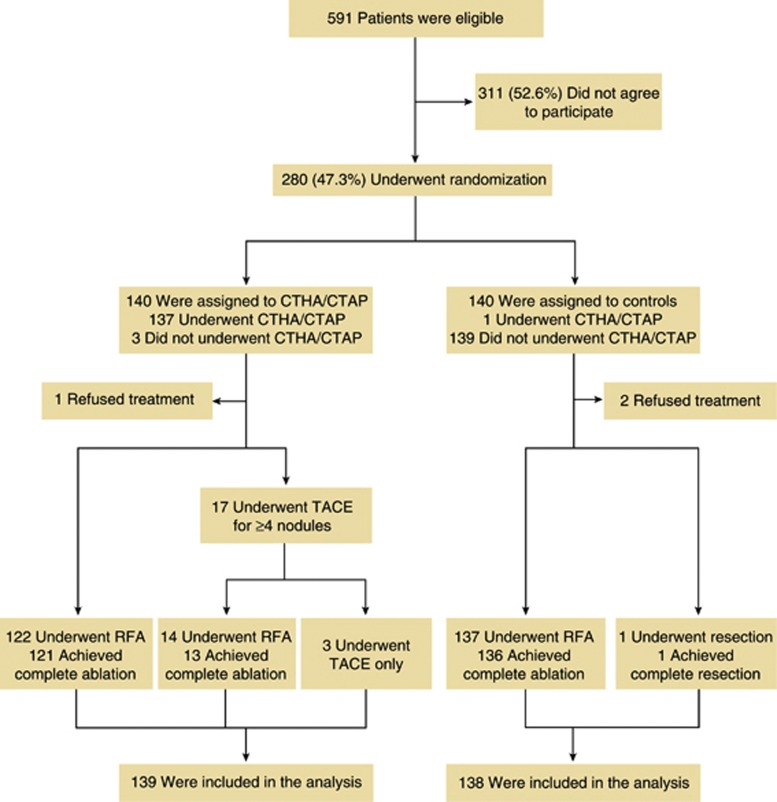
In this single-center, randomized, open-label, controlled trial, we randomly assigned 280 patients who were diagnosed as having HCC by conventional dynamic CT, and eligible for radiofrequency ablation (RFA), to undergo CTHA/CTAP before treatment, or to the control group. Newly detected HCC nodules by CTHA/CTAP were intended to be ablated completely. The primary end point was recurrence-free survival and the key secondary end point was overall survival. The analysis was conducted on an intention-to-treat basis. Those with nonablated nodules were treated as for recurrence.
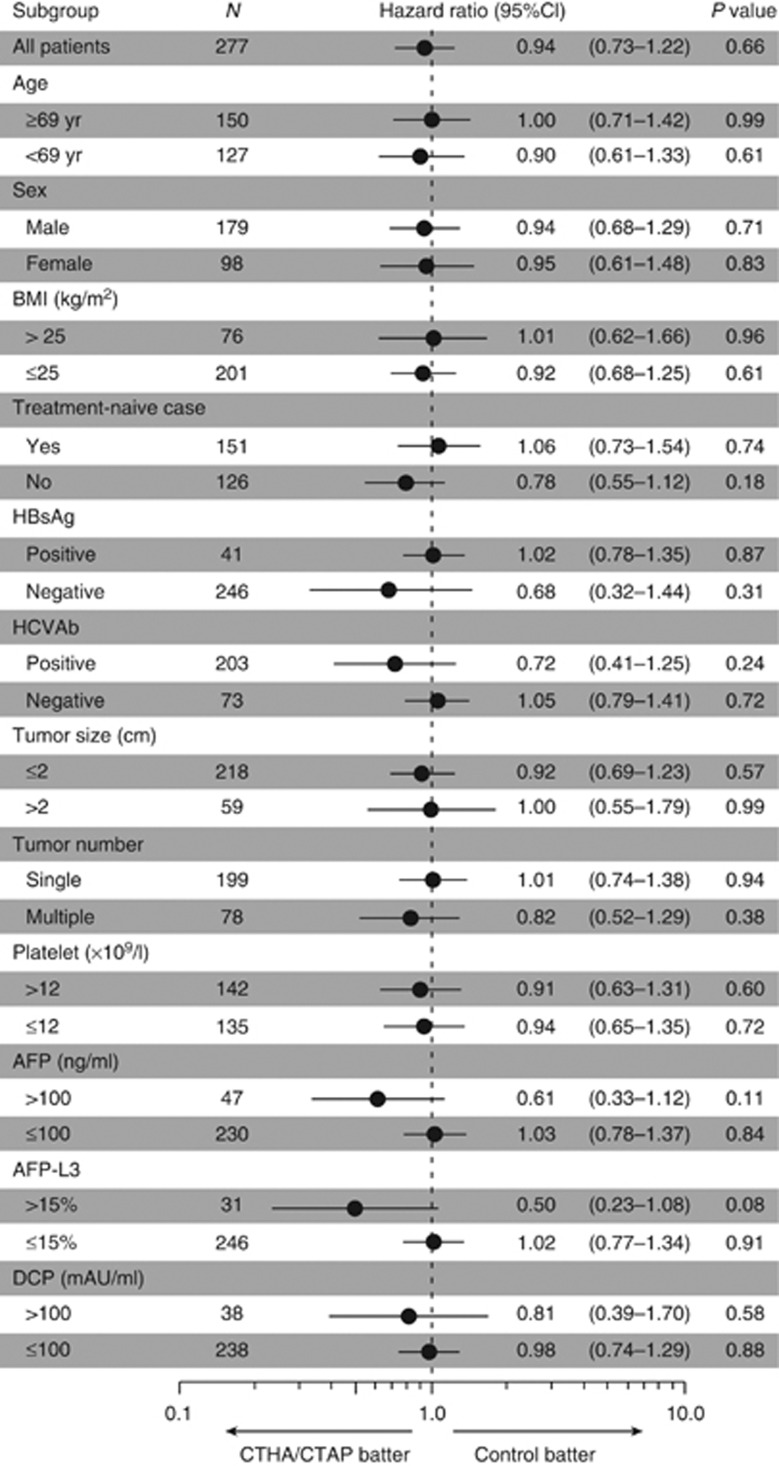
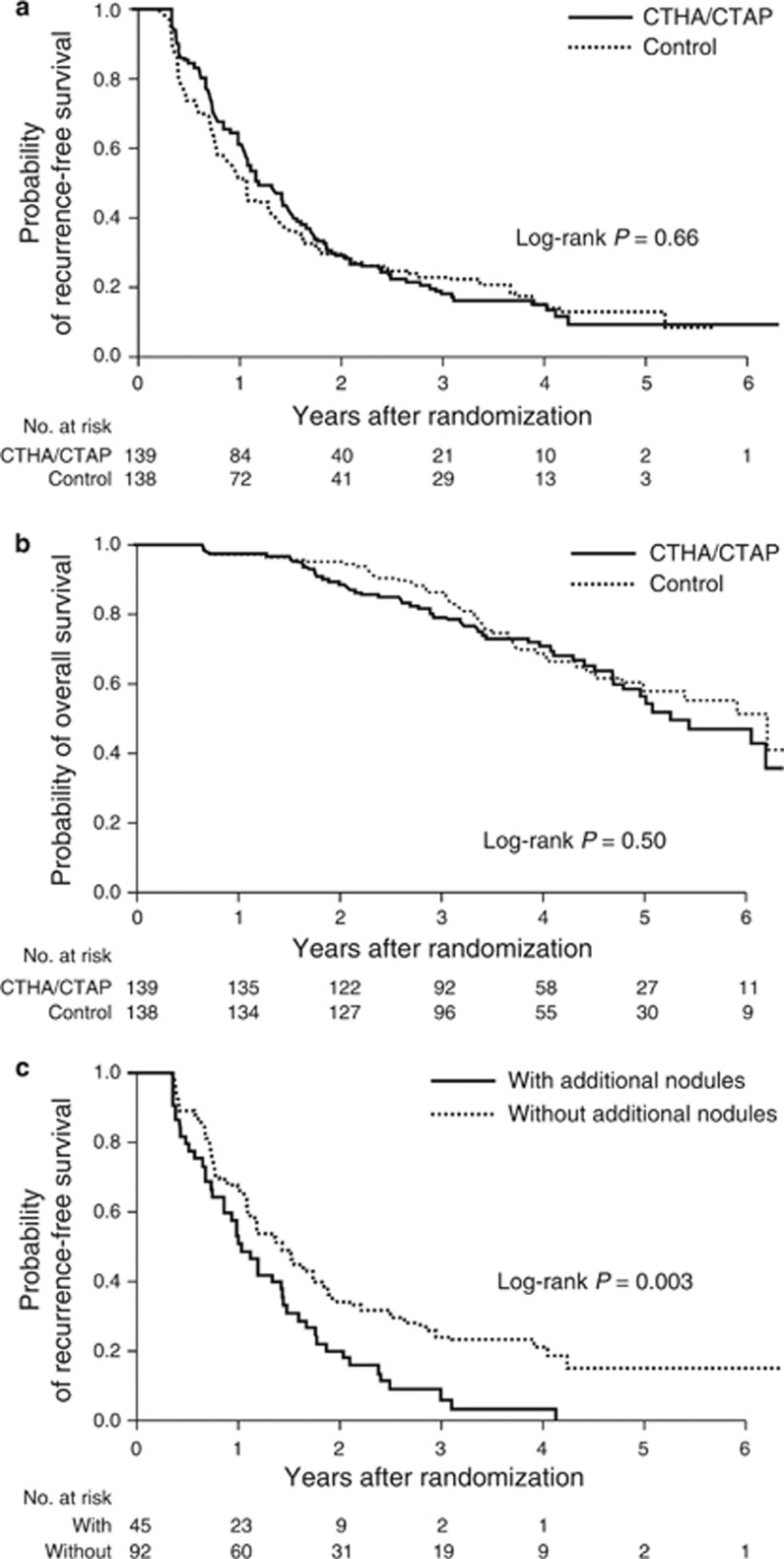
A total of 75 nodules were newly diagnosed as HCC by CTHA/CTAP in 45 patients. Three patients (one in the CTHA/CTAP group and two in the control group) who refused treatment were excluded from all analyses. The cumulative recurrence-free survival rates at 1, 2, and 3 years were 60.1, 29.0, and 18.9% in the CTHA/CTAP group and 52.2, 29.7, and 23.1% in the control group, respectively (P=0.66 by log-rank test; hazard ratio, 0.94 for CTHA/CTAP vs. control; 95% confidence interval (CI), 0.73-1.22). The cumulative overall survival rates at 3 and 5 years were 79.7 and 56.4% in the CTHA/CTAP group and 86.8 and 60.1% in the control group, respectively (P=0.50; hazard ratio, 1.15, 95% CI, 0.77-1.71).
CTHA/CTAP may detect recurrent lesions earlier. However, CTHA/CTAP before RFA did not improve cumulative recurrence-free survival or overall survival.
计算机断层扫描(CT)与肝动脉造影和门静脉造影(CTHA/CTAP)联合应用可发现常规动态 CT 未能检出的肝细胞癌(HCC)结节。
在这项单中心、随机、开放标签、对照临床试验中,我们将 280 例经常规动态 CT 诊断为 HCC 且适合射频消融(RFA)的患者随机分为 CTHA/CTAP 治疗组或对照组。CTHA/CTAP 新检出的 HCC 结节拟行完全消融。主要终点为无复发生存,关键次要终点为总生存。分析采用意向治疗原则。对未完全消融的结节视为复发。
45 例患者共新诊断出 75 个 HCC 结节。3 例患者(CTHA/CTAP 组 1 例,对照组 2 例)拒绝治疗,均从所有分析中排除。CTHA/CTAP 组和对照组患者的 1、2、3 年无复发生存率分别为 60.1%、29.0%和 18.9%和 52.2%、29.7%和 23.1%(log-rank 检验,P=0.66;CTHA/CTAP 组与对照组相比,危险比为 0.94,95%置信区间[CI]:0.73-1.22)。CTHA/CTAP 组和对照组患者的 3、5 年总生存率分别为 79.7%和 56.4%和 86.8%和 60.1%(P=0.50;危险比为 1.15,95%CI:0.77-1.71)。
CTHA/CTAP 可能更早地发现复发病灶。然而,RFA 前行 CTHA/CTAP 并未改善累积无复发生存或总生存。