Am J Trop Med Hyg. 2013 Jul;89(1):130-137. doi: 10.4269/ajtmh.12-0629. Epub 2013 Apr 29.
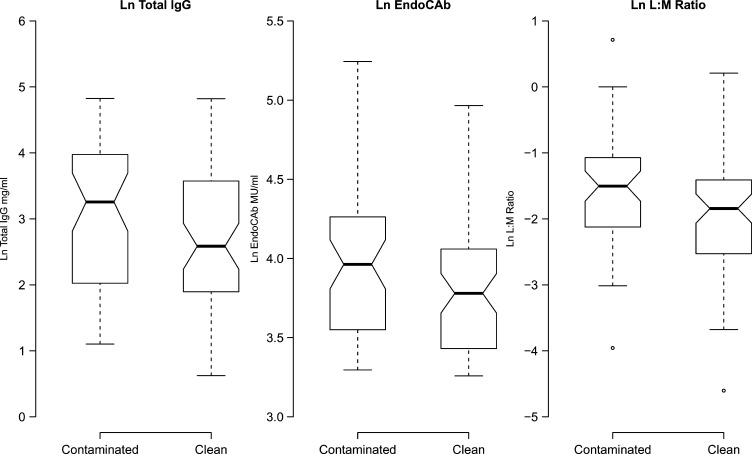
We assessed the relationship of fecal environmental contamination and environmental enteropathy. We compared markers of environmental enteropathy, parasite burden, and growth in 119 Bangladeshi children (≤ 48 months of age) across rural Bangladesh living in different levels of household environmental cleanliness defined by objective indicators of water quality and sanitary and hand-washing infrastructure. Adjusted for potential confounding characteristics, children from clean households had 0.54 SDs (95% confidence interval [CI] = 0.06, 1.01) higher height-for-age z scores (HAZs), 0.32 SDs (95% CI = -0.72, 0.08) lower lactulose:mannitol (L:M) ratios in urine, and 0.24 SDs (95% CI = -0.63, 0.16) lower immunoglobulin G endotoxin core antibody (IgG EndoCAb) titers than children from contaminated households. After adjusting for age and sex, a 1-unit increase in the ln L:M was associated with a 0.33 SDs decrease in HAZ (95% CI = -0.62, -0.05). These results are consistent with the hypothesis that environmental contamination causes growth faltering mediated through environmental enteropathy.
我们评估了粪便环境污染与肠病性肢端皮炎的关系。我们比较了 119 名孟加拉国儿童(≤48 月龄)的肠病性肢端皮炎标志物、寄生虫负担和生长情况,这些儿童来自孟加拉国农村地区,居住在不同环境卫生水平的家庭中,环境卫生水平通过水质和卫生及洗手基础设施的客观指标来定义。在调整了潜在混杂特征后,来自清洁家庭的儿童的身高年龄 z 评分(HAZ)高 0.54 个标准差(95%置信区间[CI] = 0.06,1.01),尿液中的乳果糖:甘露醇(L:M)比值低 0.32 个标准差(95% CI = -0.72,0.08),免疫球蛋白 G 内毒素核心抗体(IgG EndoCAb)滴度低 0.24 个标准差(95% CI = -0.63,0.16)。在调整了年龄和性别后,ln L:M 增加 1 个单位与 HAZ 降低 0.33 个标准差(95% CI = -0.62,-0.05)相关。这些结果与环境污染物通过肠病性肢端皮炎导致生长迟缓的假设一致。