Bortoluzzi Marcelo Carlos, Traebert Jefferson, Lasta Renata, Da Rosa Thaiany Naila, Capella Diogo Lenzi, Presta Andréia Antoniuk
School of Dentistry, Health Bioscience Postgraduate Program, Tissue Aspects for Health Prognosis and Intervention Laboratory (LAPROG), Oeste de Santa Catarina University (UNOESC), Brazil.
Contemp Clin Dent. 2012 Oct;3(4):393-7. doi: 10.4103/0976-237X.107424.
The aim of this study was to observe the tooth loss over age in a sample of Brazilian patients and analyze their ability to chew, relating it to how much is the loss of oral function impact over the quality of life (QoL).
This is a single center, observational study and the data were collected through clinical examination followed of questionnaires to obtain sociodemographic information, the ability to chew (through the index of chewing ability [ICA]) and QoL (through Oral Health Impact Profile, OHIP-14).
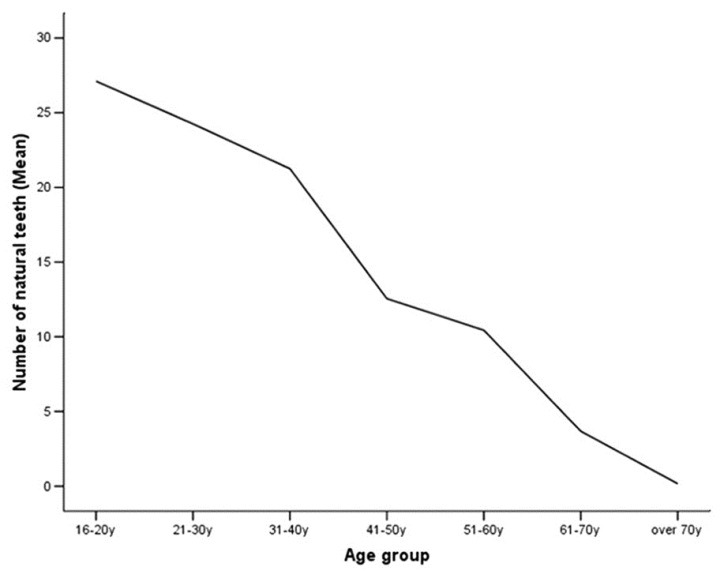
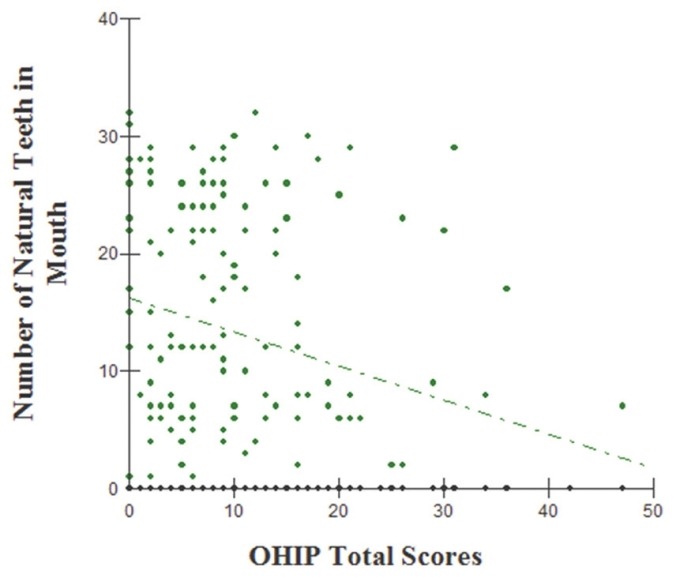
The sample was composed by 171 random volunteers with mean age of 47 (SD 15.2). Low number of natural teeth was associated with an increase of age (Spearman's rho correlation coefficient-0.7, P < 0.001, 2-tailed) and chew disability (ICA: chew's ability vs. disability) (Mann-Whitney U-Test, P < 0.001). Chew disability showed a negative impact over the QoL (overall OHIP; Mann-Whitney U Test P < 0.001) and in five of seven OHIP domains (Functional Limitation, Physical Pain, Psychological Discomfort, Physical Disability, Psychological Disability). Age over than 40 years, was also associated with chewing disability (Pearson Chi-Square P < 0.001) and poorer QoL (Mann-Whitney U test P = 0.01).
This study observed that the chewing disability produces a significant and negative impact over oral-health related QoL and both, poor QoL and chewing disability are related with the decrease of the number of natural teeth.
本研究旨在观察巴西患者样本中牙齿缺失随年龄的变化情况,并分析他们的咀嚼能力,将其与口腔功能丧失对生活质量(QoL)的影响程度相关联。
这是一项单中心观察性研究,数据通过临床检查收集,随后进行问卷调查以获取社会人口统计学信息、咀嚼能力(通过咀嚼能力指数[ICA])和生活质量(通过口腔健康影响量表,OHIP - 14)。
样本由171名随机志愿者组成,平均年龄为47岁(标准差15.2)。天然牙数量少与年龄增长(斯皮尔曼等级相关系数 - 0.7,P < 0.001,双侧)和咀嚼障碍(ICA:咀嚼能力与咀嚼障碍)相关(曼 - 惠特尼U检验,P < 0.001)。咀嚼障碍对生活质量有负面影响(总体OHIP;曼 - 惠特尼U检验P < 0.001),并且在OHIP的七个领域中的五个领域(功能受限、身体疼痛、心理不适、身体残疾、心理残疾)有影响。40岁以上的年龄也与咀嚼障碍(皮尔逊卡方检验P < 0.001)和较差的生活质量相关(曼 - 惠特尼U检验P = 0.01)。
本研究观察到咀嚼障碍对与口腔健康相关的生活质量产生显著负面影响,并且生活质量差和咀嚼障碍都与天然牙数量减少有关。