Srikumar G P V, Varma K Ravi, Shetty K Harish, Kumar Pramod
Department of Conservative Dentistry and Endodontics, Vyas Dental College and Hospital, Jodhpur, India.
Contemp Clin Dent. 2012 Oct;3(4):421-6. doi: 10.4103/0976-237X.107431.
Walking bleach technique uses 30% hydrogen peroxide and sodium perborate, and this paste mixture causes loosening of the coronal temporary restorative materials and thus decreasing its clinical effectiveness and causing irritation to the patients oral tissues. In the present study, sealing ability of hygroscopic coronal temporary restorative materials were compared with the other commonly used temporary restorative materials.
To evaluate the effects of walking bleach material on the marginal sealing ability and coronal microleakage of the hydrophilic temporary restorative materials with that of the other commonly used temporary restorative materials in endodontic practice.
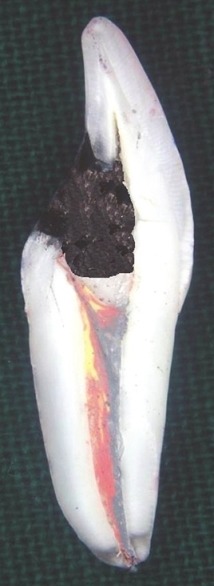
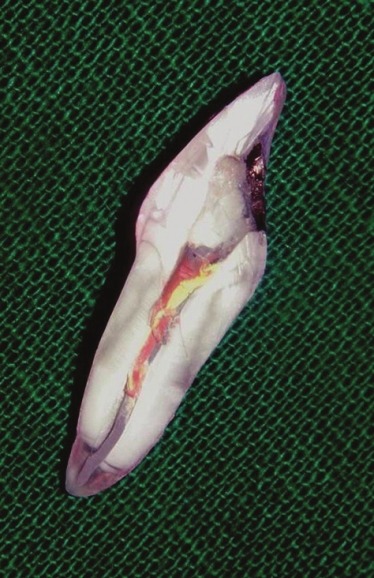
Seventy-five extracted human maxillary central incisor teeth were prepared chemo-mechanically and obturated with gutta-percha in lateral condensation technique. Surface of each tooth was double coated with cyanoacrylate glue. All the teeth were randomly divided in to five groups. Out of 15 teeth in each group, 10 teeth served as experimental specimens, in which bleaching agent was placed in the pulp chamber and 5 teeth served as control, in which no bleaching agent was placed. The access cavities were restored with temporary restorative materials being tested per each group respectively. The specimens were then immersed in 1% India ink dye and subjected to thermo cycling for 7 days. All the teeth were longitudinally sectioned and observed with stereomicroscope and were graded according to the depth of linear dye penetration.
Mann-Whitney U test and Kruskal-Wallis test.
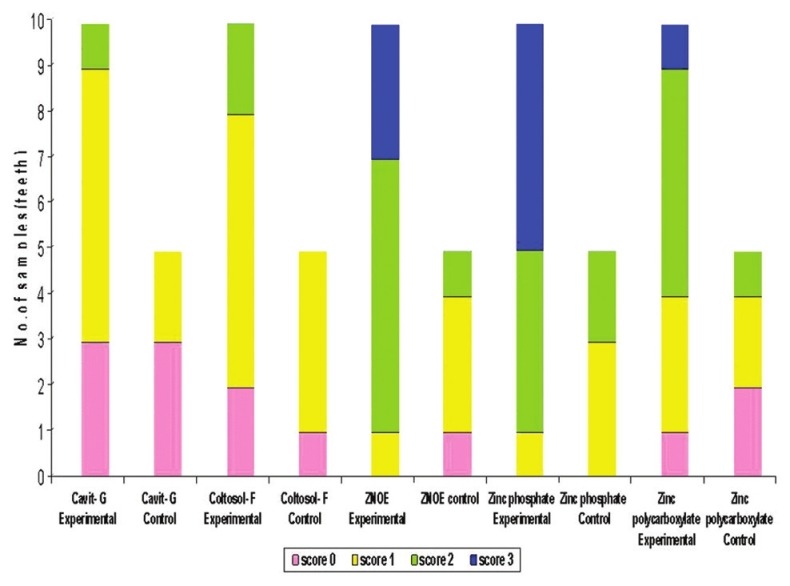
Hydrophilic temporary restorative materials Cavit G and Coltosol F have shown minimal coronal dye leakage with better sealing ability when exposed to walking bleach paste mixture in the dye penetration tests compared to other commonly used temporary restorative materials.
Marginal sealing ability of Cavit G and Coltosol F were not influenced by the effects of bleaching agent compared to other temporary restorative materials used in the study.
“行走漂白”技术使用30%的过氧化氢和过硼酸钠,这种糊剂混合物会导致冠部临时修复材料松动,从而降低其临床效果,并对患者口腔组织造成刺激。在本研究中,将吸湿冠部临时修复材料的封闭能力与其他常用的临时修复材料进行了比较。
评估在牙髓治疗实践中,“行走漂白”材料对亲水性临时修复材料的边缘封闭能力和冠部微渗漏的影响,并与其他常用的临时修复材料进行比较。
选取75颗拔除的人上颌中切牙,进行化学机械预备,采用侧向加压技术用牙胶尖充填。每颗牙齿表面用氰基丙烯酸酯胶水进行双层涂布。所有牙齿随机分为五组。每组15颗牙齿中,10颗作为实验标本,在髓腔中放置漂白剂,5颗作为对照,不放置漂白剂。分别用每组测试的临时修复材料修复开髓洞。然后将标本浸入1%的印度墨水中染色,并进行7天的热循环。所有牙齿纵切后用体视显微镜观察,并根据线性染料渗透深度进行分级。
采用曼-惠特尼U检验和克鲁斯卡尔-沃利斯检验。
在染料渗透试验中,与其他常用的临时修复材料相比,亲水性临时修复材料Cavit G和Coltosol F在暴露于“行走漂白”糊剂混合物时,冠部染料渗漏最小,封闭能力更好。
与本研究中使用的其他临时修复材料相比,Cavit G和Coltosol F的边缘封闭能力不受漂白剂的影响。