Baker IDI Heart and Diabetes Institute, Melbourne, Victoria, Australia.
Diabetes Care. 2013 Sep;36(9):2714-9. doi: 10.2337/DC12-2501. Epub 2013 May 1.
Effective interventions to prevent, delay, or remit diabetes are currently available. However, their impact on the prevalence of diabetes at the population level is unknown. This study aimed to estimate the impact of a range of diabetes interventions on the population prevalence of diabetes for Australian adults between 2010 and 2025.
We used the Australian Diabetes Projection Model to estimate the impact of a population-wide strategy, high-risk prevention, surgical diabetes treatment, and a combination strategy on the future population prevalence of diabetes and to estimate the number of diabetes cases that could be potentially prevented in the year 2025.
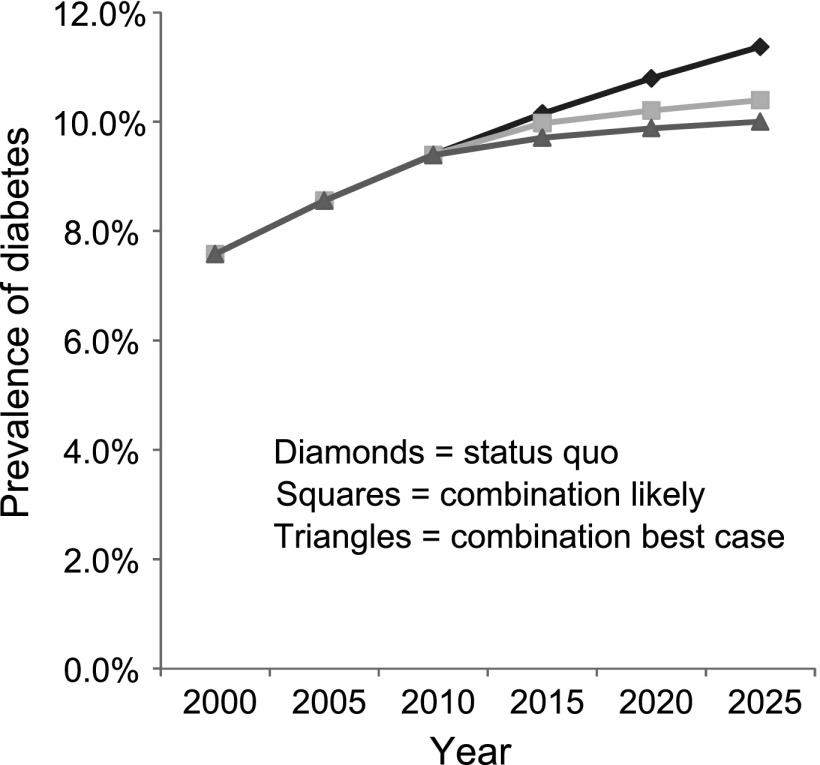
We estimate that a population-wide strategy would reduce the number of diabetes cases by 60,000-85,000 in 2025 from an estimated 2 million cases under the status quo scenario. A high-risk prevention strategy would result in 106,000 to 150,000 fewer cases of diabetes in 2025, and surgically induced weight loss would result in 3,000-6,000 fewer cases. No single intervention, or combination of interventions, reversed the increasing trend in diabetes prevalence over the next 15 years.
To reverse upward trends in diabetes prevalence in future years, it is essential that current approaches to diabetes prevention and treatment are optimized and implemented and that alternative approaches to reduce the prevalence of diabetes at a population level are developed.
目前已有有效干预措施可预防、延缓或缓解糖尿病,但这些措施对人群糖尿病患病率的影响尚不清楚。本研究旨在估算一系列糖尿病干预措施对 2010 年至 2025 年澳大利亚成年人的糖尿病流行率的影响。
我们使用澳大利亚糖尿病预测模型估算了在人群中实施广泛策略、高危预防、手术治疗糖尿病以及联合策略对未来糖尿病流行率的影响,并估算了 2025 年可能预防的糖尿病病例数。
我们估计,与现状情景下预计的 200 万例病例相比,广泛策略将在 2025 年减少 6 万至 8.5 万例糖尿病病例。高危预防策略将导致 2025 年减少 10.6 万至 15 万例糖尿病病例,手术引起的体重减轻将导致减少 3000 至 6000 例病例。没有任何单一干预措施或联合干预措施能够扭转未来 15 年糖尿病患病率的上升趋势。
为了扭转未来几年糖尿病流行率的上升趋势,必须优化和实施当前的糖尿病预防和治疗方法,并开发降低人群糖尿病患病率的替代方法。