Center for Integrative Genomics, Faculty of Biology and Medicine, University of Lausanne, Lausanne, Switzerland.
PLoS Biol. 2013;11(4):e1001546. doi: 10.1371/journal.pbio.1001546. Epub 2013 Apr 30.
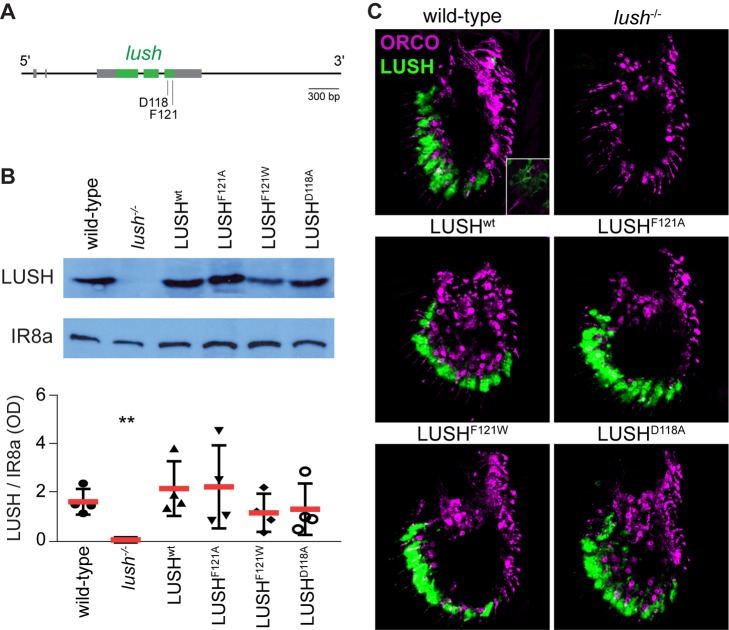
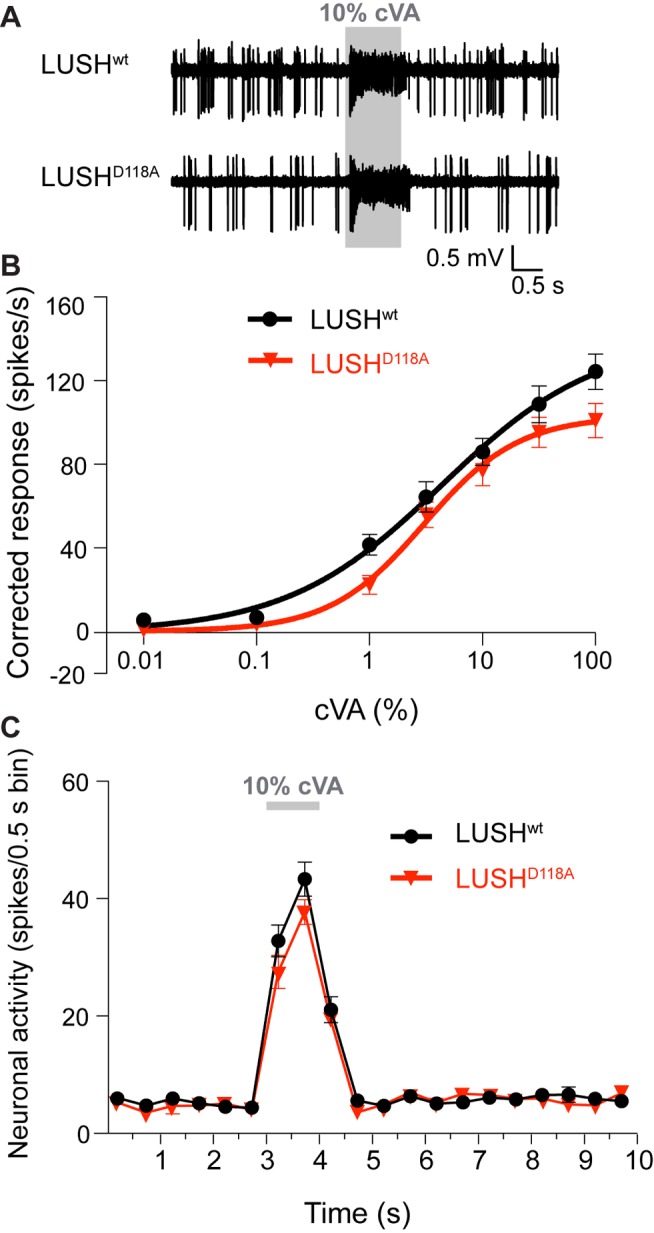
Pheromones form an essential chemical language of intraspecific communication in many animals. How olfactory systems recognize pheromonal signals with both sensitivity and specificity is not well understood. An important in vivo paradigm for this process is the detection mechanism of the sex pheromone (Z)-11-octadecenyl acetate (cis-vaccenyl acetate [cVA]) in Drosophila melanogaster. cVA-evoked neuronal activation requires a secreted odorant binding protein, LUSH, the CD36-related transmembrane protein SNMP, and the odorant receptor OR67d. Crystallographic analysis has revealed that cVA-bound LUSH is conformationally distinct from apo (unliganded) LUSH. Recombinantly expressed mutant versions of LUSH predicted to enhance or diminish these structural changes produce corresponding alterations in spontaneous and/or cVA-evoked activity when infused into olfactory sensilla, leading to a model in which the ligand for pheromone receptors is not free cVA, but LUSH that is "conformationally activated" upon cVA binding. Here we present evidence that contradicts this model. First, we demonstrate that the same LUSH mutants expressed transgenically affect neither basal nor pheromone-evoked activity. Second, we compare the structures of apo LUSH, cVA/LUSH, and complexes of LUSH with non-pheromonal ligands and find no conformational property of cVA/LUSH that can explain its proposed unique activated state. Finally, we show that high concentrations of cVA can induce neuronal activity in the absence of LUSH, but not SNMP or OR67d. Our findings are not consistent with the model that the cVA/LUSH complex acts as the pheromone ligand, and suggest that pheromone molecules alone directly activate neuronal receptors.
信息素在许多动物的种内交流中构成了一种重要的化学语言。嗅觉系统如何以敏感性和特异性来识别信息素信号还不太清楚。这一过程的一个重要体内范例是黑腹果蝇中性信息素(Z)-11-十八碳烯基乙酸酯(顺式-金合欢基乙酸酯[顺式-VA])的检测机制。cVA 诱发的神经元激活需要一种分泌的气味结合蛋白 LUSH、CD36 相关跨膜蛋白 SNMP 和气味受体 OR67d。晶体学分析表明,与 apo(未配位)LUSH 相比,cVA 结合的 LUSH 构象明显不同。重组表达的 LUSH 突变体版本,预测会增强或减弱这些结构变化,当注入嗅觉感受器时,会导致自发和/或 cVA 诱发的活性产生相应的变化,从而产生一种模型,即信息素受体的配体不是游离的 cVA,而是在 cVA 结合后“构象激活”的 LUSH。在这里,我们提出了与该模型相矛盾的证据。首先,我们证明同样的 LUSH 突变体在转基因中表达既不会影响基础活性也不会影响信息素诱发的活性。其次,我们比较了 apo LUSH、cVA/LUSH 和 LUSH 与非信息素配体的复合物的结构,没有发现 cVA/LUSH 的构象特性可以解释其提出的独特激活状态。最后,我们表明,高浓度的 cVA 可以在没有 LUSH 的情况下诱导神经元活性,但不能诱导 SNMP 或 OR67d。我们的发现与 cVA/LUSH 复合物作为信息素配体的模型不一致,并表明信息素分子本身可以直接激活神经元受体。