Department of Physics, Massachusetts Institute of Technology, Cambridge, Massachusetts, USA.
PLoS Biol. 2013;11(4):e1001547. doi: 10.1371/journal.pbio.1001547. Epub 2013 Apr 30.
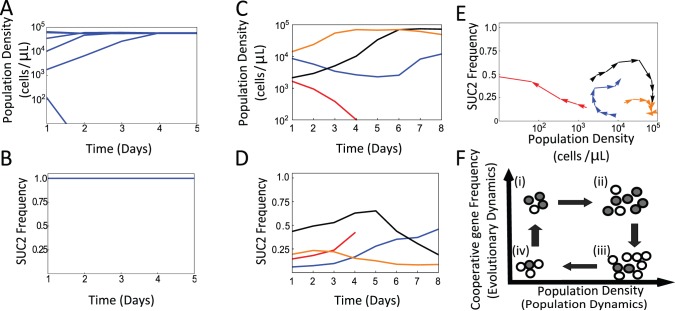
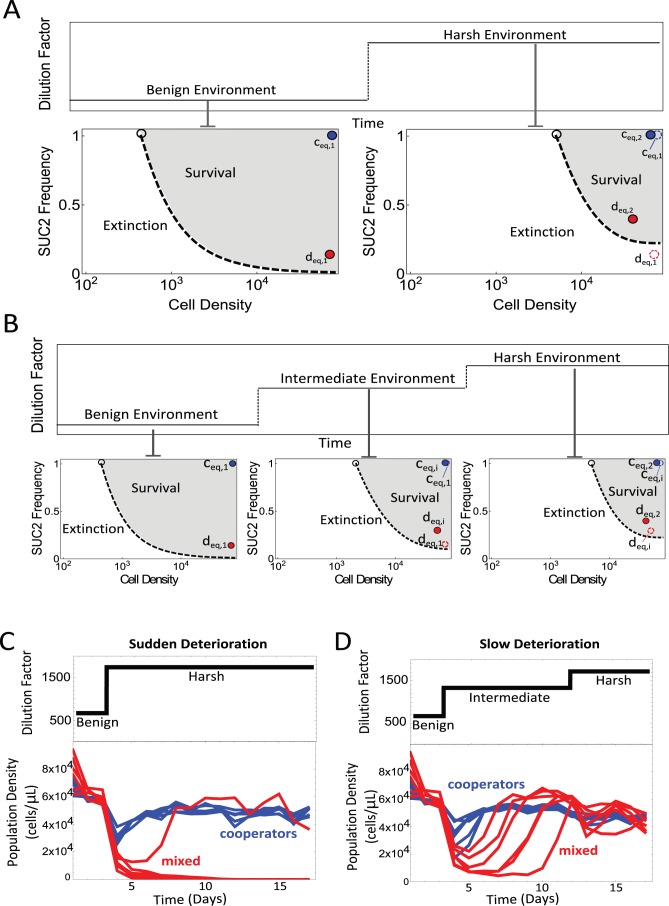
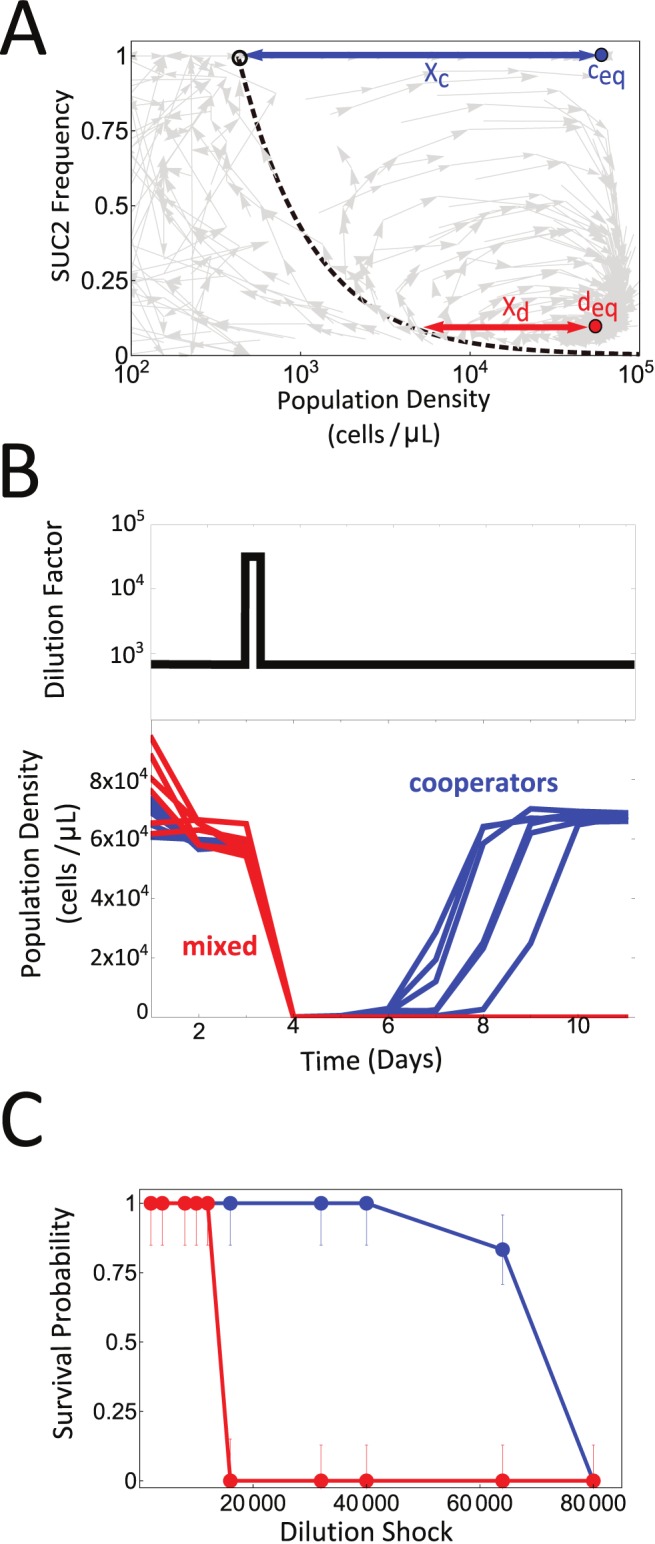
The evolutionary spread of cheater strategies can destabilize populations engaging in social cooperative behaviors, thus demonstrating that evolutionary changes can have profound implications for population dynamics. At the same time, the relative fitness of cooperative traits often depends upon population density, thus leading to the potential for bi-directional coupling between population density and the evolution of a cooperative trait. Despite the potential importance of these eco-evolutionary feedback loops in social species, they have not yet been demonstrated experimentally and their ecological implications are poorly understood. Here, we demonstrate the presence of a strong feedback loop between population dynamics and the evolutionary dynamics of a social microbial gene, SUC2, in laboratory yeast populations whose cooperative growth is mediated by the SUC2 gene. We directly visualize eco-evolutionary trajectories of hundreds of populations over 50-100 generations, allowing us to characterize the phase space describing the interplay of evolution and ecology in this system. Small populations collapse despite continual evolution towards increased cooperative allele frequencies; large populations with a sufficient number of cooperators "spiral" to a stable state of coexistence between cooperator and cheater strategies. The presence of cheaters does not significantly affect the equilibrium population density, but it does reduce the resilience of the population as well as its ability to adapt to a rapidly deteriorating environment. Our results demonstrate the potential ecological importance of coupling between evolutionary dynamics and the population dynamics of cooperatively growing organisms, particularly in microbes. Our study suggests that this interaction may need to be considered in order to explain intraspecific variability in cooperative behaviors, and also that this feedback between evolution and ecology can critically affect the demographic fate of those species that rely on cooperation for their survival.
骗子策略的进化传播可能会破坏参与社会合作行为的群体,从而表明进化变化对群体动态具有深远的影响。同时,合作特征的相对适应性通常取决于种群密度,从而导致种群密度与合作特征进化之间可能存在双向耦合。尽管这些生态进化反馈回路在社会性物种中具有潜在的重要性,但它们尚未在实验中得到证明,其生态意义也知之甚少。在这里,我们证明了在实验室酵母种群中,种群动态与社会微生物基因 SUC2 的进化动态之间存在强烈的反馈环,该基因介导了酵母的合作生长。我们直接观察了数百个种群在 50-100 代中的生态进化轨迹,从而能够描述该系统中进化与生态学相互作用的相空间。尽管不断进化以增加合作等位基因频率,但小种群仍会崩溃;具有足够数量合作者的大种群“螺旋式”发展,达到合作者和骗子策略之间稳定共存的状态。骗子的存在不会显著影响平衡种群密度,但会降低种群的恢复力及其适应快速恶化环境的能力。我们的研究结果表明,在合作生长的生物体中,进化动态与种群动态之间的耦合具有潜在的生态重要性,特别是在微生物中。我们的研究表明,为了解释同种内合作行为的变异性,可能需要考虑这种相互作用,而且这种进化与生态之间的反馈可能会严重影响那些依赖合作生存的物种的人口命运。