Ito Hiromu, Yamamichi Masato
Department of International Health and Medical Anthropology, Institute of Tropical Medicine, Nagasaki University, Nagasaki 852-8523, Japan.
Center for Frontier Research, National Institute of Genetics, 1111 Yata, Mishima, Shizuoka 411-8540, Japan.
PNAS Nexus. 2024 Oct 10;3(11):pgae455. doi: 10.1093/pnasnexus/pgae455. eCollection 2024 Nov.
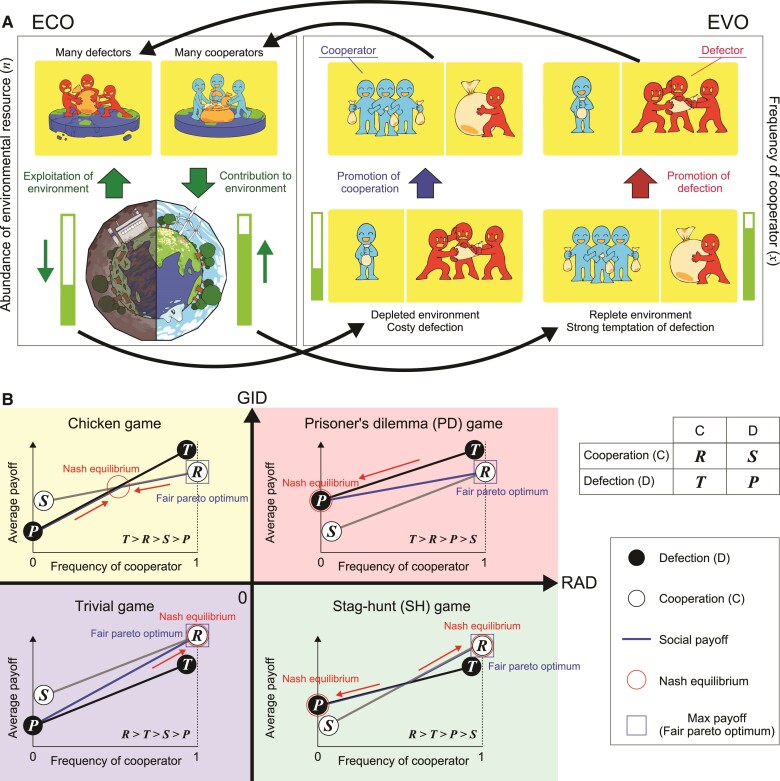
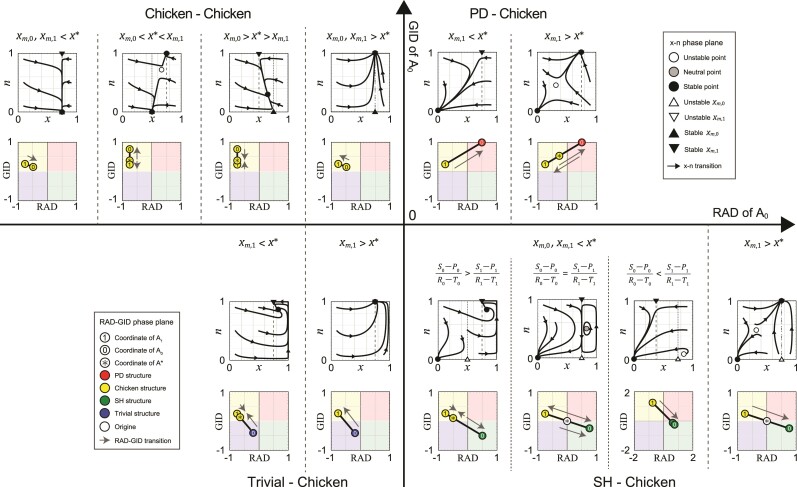
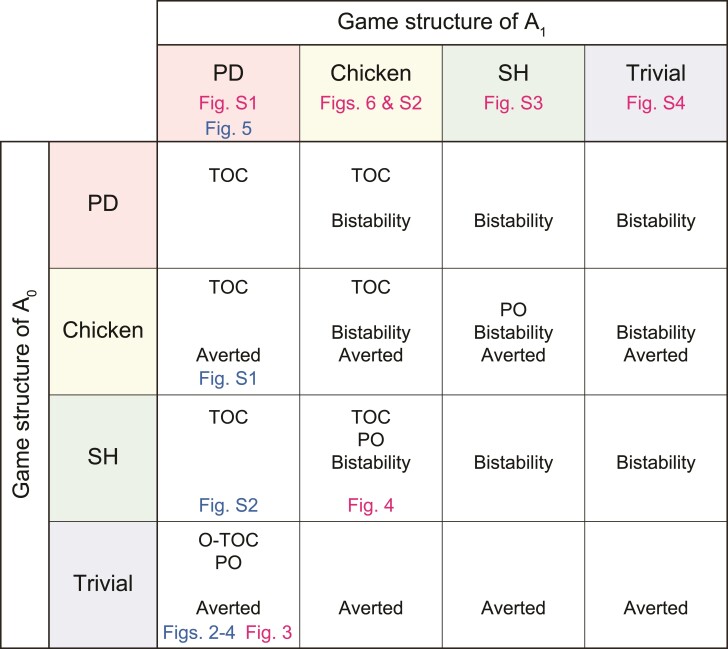
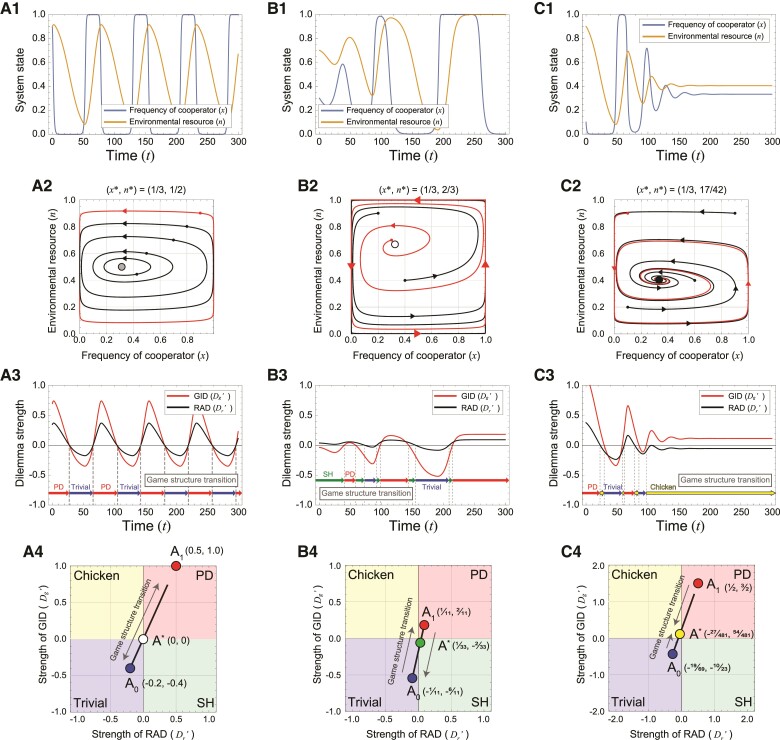
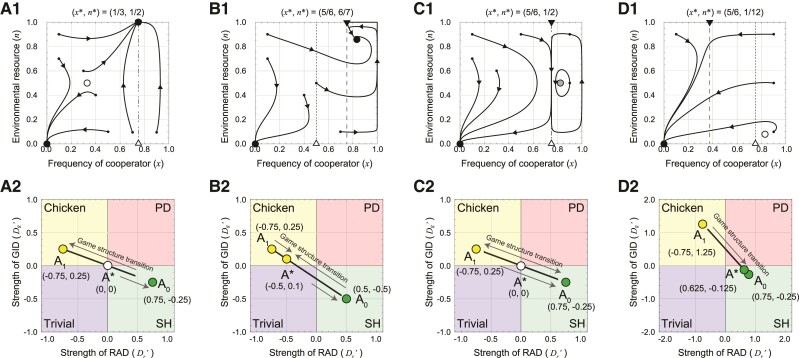
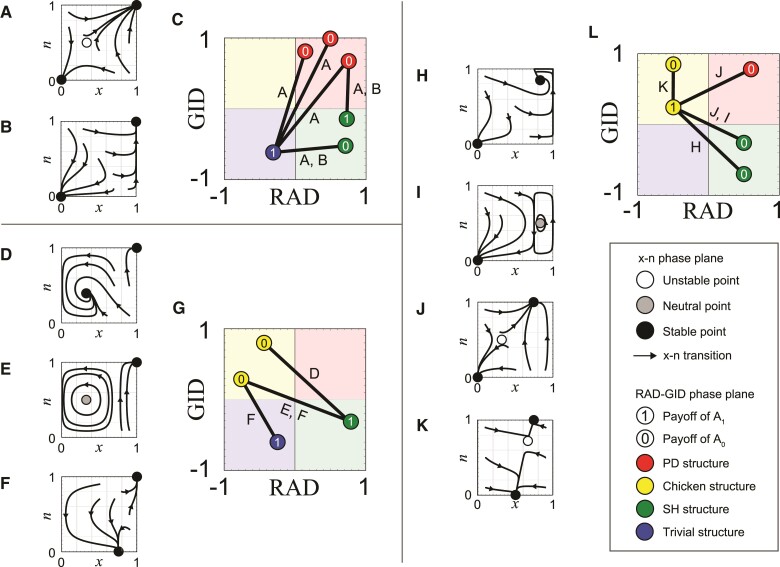
A tragedy of the commons, in which rational behavior of individuals to maximize their own payoffs depletes common resources, is one of the most important research topics in game theory. To better understand the social dilemma problem, recent studies have developed a theoretical framework of feedback-evolving game where individual behavior affects an environmental (renewable) resource and the environmental resource changes individual payoffs. While previous studies assumed that the frequency of defectors increases (prisoner's dilemma [PD] game) when the environmental resource is abundant to investigate an oscillating tragedy of the commons, it is also possible for other types of game to produce the social dilemma. In this paper, we extend the feedback-evolving game by considering not only PD game, but also the other three game structures when the environmental resource is replete for a reasonably complete classification. The three games are Chicken game where defectors and cooperators coexist through minority advantage, Stag-Hunt (SH) game with minority disadvantage, and Trivial game where the frequency of cooperators increases. In addition, we utilize a dilemma phase plane to visually track (transient) dynamics of game structure changes. We found that an emergent initial condition dependence (i.e. bistability) is pervasive in the feedback-evolving game when the three games are involved. We also showed that persistent oscillation dynamics arise even with Chicken or SH games in replete environments. Our generalized analysis will be an important step to further extend the theoretical framework of feedback-evolving game to various game situations with environmental feedback.
公地悲剧是博弈论中最重要的研究课题之一,在公地悲剧中,个体为实现自身收益最大化的理性行为会耗尽公共资源。为了更好地理解社会困境问题,最近的研究建立了一个反馈演化博弈的理论框架,其中个体行为会影响环境(可再生)资源,而环境资源又会改变个体收益。虽然之前的研究假设当环境资源丰富时背叛者的频率会增加(囚徒困境[PD]博弈),以研究公地悲剧的振荡情况,但其他类型的博弈也可能产生社会困境。在本文中,我们扩展了反馈演化博弈,不仅考虑了PD博弈,还考虑了环境资源充足时的其他三种博弈结构,以进行合理完整的分类。这三种博弈分别是:通过少数派优势使背叛者和合作者共存的斗鸡博弈、存在少数派劣势的猎鹿(SH)博弈,以及合作者频率增加的平凡博弈。此外,我们利用困境相平面直观地跟踪博弈结构变化的(瞬态)动态。我们发现,当涉及这三种博弈时,反馈演化博弈中普遍存在一种突发的初始条件依赖性(即双稳态)。我们还表明,即使在资源充足的环境中,斗鸡博弈或SH博弈也会产生持续的振荡动态。我们的广义分析将是进一步将反馈演化博弈的理论框架扩展到各种具有环境反馈的博弈情况的重要一步。