Department of Mathematics, Emmanuel College, Boston, Massachusetts, USA.
PLoS Biol. 2013;11(4):e1001549. doi: 10.1371/journal.pbio.1001549. Epub 2013 Apr 30.
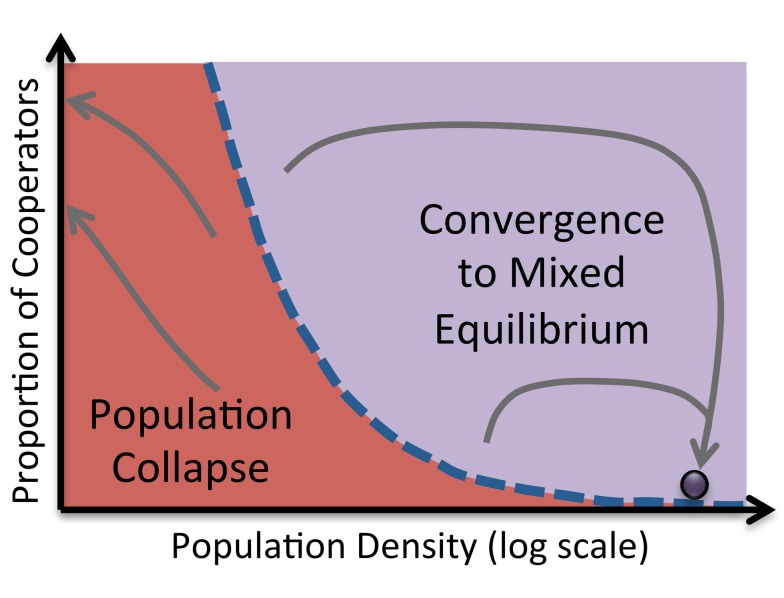
Microorganisms have been cooperating with each other for billions of years: by sharing resources, communicating with each other, and joining together to form biofilms and other large structures. These cooperative behaviors benefit the colony as a whole; however, they may be costly to the individuals performing them. This raises the question of how such cooperation can arise from natural selection. Mathematical modeling is one important avenue for exploring this question. Evolutionary experiments are another, providing us with an opportunity to see evolutionary dynamics in action and allowing us to test predictions arising from mathematical models. A new study in this issue of PLOS Biology investigates the evolution of a cooperative resource-sharing behavior in yeast. Examining the competition between cooperating and "cheating" strains of yeast, the authors find that, depending on the initial mix of strains, this yeast society either evolves toward a stable coexistence or collapses for lack of cooperation. Using a simple mathematical model, they show how these dynamics arise from eco-evolutionary feedback, where changes in the frequencies of strains are coupled with changes in population size. This study and others illustrate the combined power of modeling and experiment to elucidate the origins of cooperation and other fundamental questions in evolutionary biology.
它们通过共享资源、相互交流以及形成生物膜和其他大型结构来进行合作。这些合作行为使整个群体受益,但对执行这些行为的个体来说可能代价高昂。这就提出了一个问题,即这种合作如何能够通过自然选择产生。数学建模是探索这个问题的一个重要途径。进化实验则是另一种途径,为我们提供了观察进化动态的机会,并允许我们检验数学模型产生的预测。本期《PLOS 生物学》中的一项新研究调查了酵母中一种合作的资源共享行为的进化。研究人员在这项研究中考察了合作和“欺骗”酵母菌株之间的竞争,发现取决于初始菌株的混合情况,这种酵母社会要么朝着稳定共存进化,要么由于缺乏合作而崩溃。他们使用一个简单的数学模型,展示了这些动态如何由生态进化反馈产生,其中菌株频率的变化与种群规模的变化相关联。这项研究和其他研究说明了模型和实验的结合力量,可用于阐明合作和进化生物学中其他基本问题的起源。