Department of Geriatric Endocrinology, The Chinese People's Liberation Army General Hospital, Beijing, China.
PLoS One. 2013 Apr 24;8(4):e61598. doi: 10.1371/journal.pone.0061598. Print 2013.
To investigate the relationship between sex hormones and the risk of vascular disease in elderly men and to evaluate the advantages and disadvantages of testosterone replacement.
A total of 337 men, aged 60 to 91 years, were enrolled in this single-center, cross-sectional study, and their sex hormone levels were assessed. Linear and logistic regression analyses were utilized to compare the sex hormone levels between patients with and without vascular disease. The nonparametric K-sample test was used for inter-group comparisons.
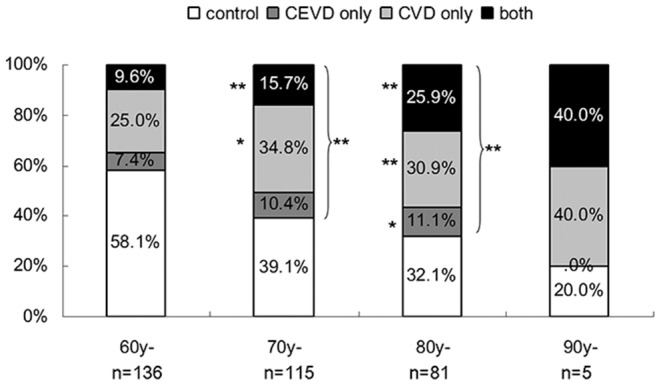
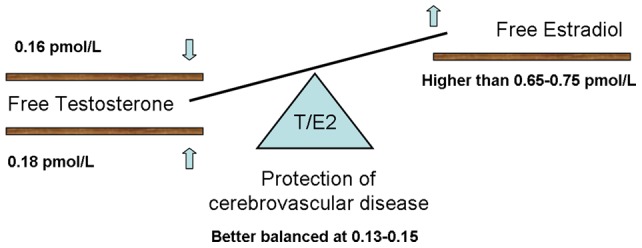
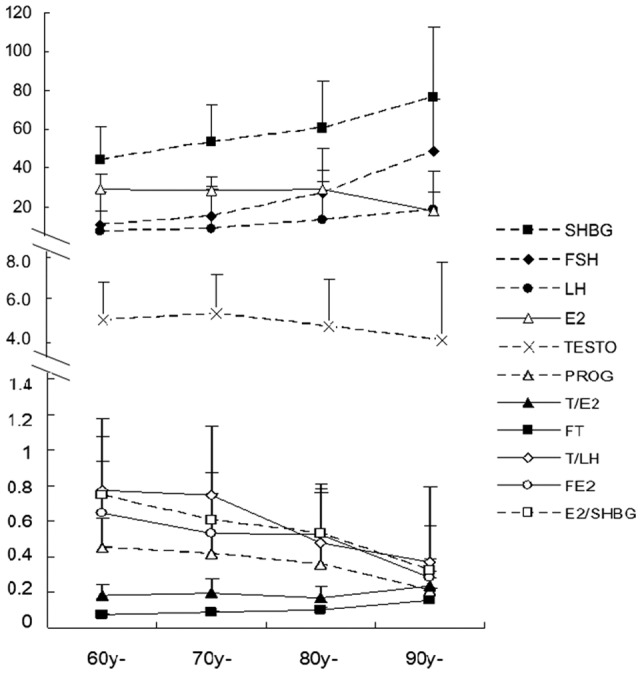
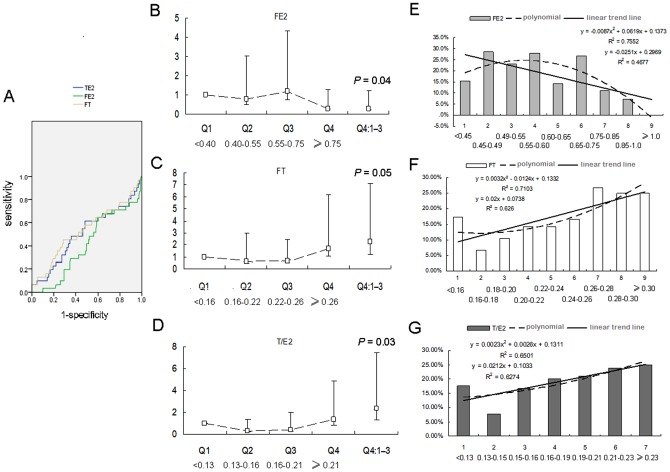
Aging and abnormal metabolism were both significantly associated with an increased risk of vascular diseases and changes in sex hormone levels. Primary linear and logistic regression analyses showed no significant differences in sex hormone concentrations between patients with and without vascular diseases after adjusting for age. Logistic regression with abnormal metabolism as categorical variable showed that free testosterone (FT) and free estradiol (FE2) had significant relationships with CEVD risk (P<0.05). In further regression with all metabolic continuous variables included, the testosterone/estradiol (T/E2) ratio replaced FT and FE2 (P<0.05). Trend line analyses showed that T/E2 actually had a binomial linear correlation with the risk of cerebrovascular disease; its best protective effect occurred at values of 0.13-0.15, with an OR value extremely close to those of FT and FE2 (0.23 vs. 0.24-0.25).
T/E2 balance plays a key role in the relationship between sex hormones and the risk of cerebrovascular disease. The balance between T and E2 may be more important than their absolute quantities. Extremely low T/E2 and inappropriately high T/E2 ratio can both harm the brain blood vessels. Careful consideration should be given before beginning testosterone replacement treatment, and supplementing with estrogen seems to be a good way to protect blood vessels of the brain in elderly men.
探讨老年男性血管疾病风险与性激素的关系,并评估睾酮替代治疗的优缺点。
本单中心横断面研究共纳入 337 名年龄 60-91 岁的男性,评估其性激素水平。采用线性和逻辑回归分析比较血管疾病患者与无血管疾病患者的性激素水平。采用非参数 K 样本检验进行组间比较。
衰老和异常代谢均与血管疾病风险增加和性激素水平变化显著相关。经过年龄调整后,原发性线性和逻辑回归分析显示,血管疾病患者与无血管疾病患者的性激素浓度无显著差异。以异常代谢为分类变量的逻辑回归显示,游离睾酮(FT)和游离雌二醇(FE2)与 CEVD 风险呈显著相关(P<0.05)。在进一步将所有代谢连续变量纳入回归分析后,睾酮/雌二醇(T/E2)比值取代了 FT 和 FE2(P<0.05)。趋势线分析显示,T/E2 实际上与脑血管疾病风险呈二项线性相关;其最佳保护作用发生在 0.13-0.15 时,OR 值与 FT 和 FE2 非常接近(0.23 对 0.24-0.25)。
T/E2 平衡在性激素与脑血管疾病风险之间的关系中起着关键作用。T 和 E2 的平衡可能比它们的绝对数量更重要。极低的 T/E2 和过高的 T/E2 比值都会损害脑血管。在开始睾酮替代治疗之前应谨慎考虑,并补充雌激素似乎是保护老年男性大脑血管的一种好方法。