Bioscience Division, Los Alamos National Laboratory Los Alamos, NM, USA.
Front Microbiol. 2013 Apr 9;4:78. doi: 10.3389/fmicb.2013.00078. eCollection 2013.
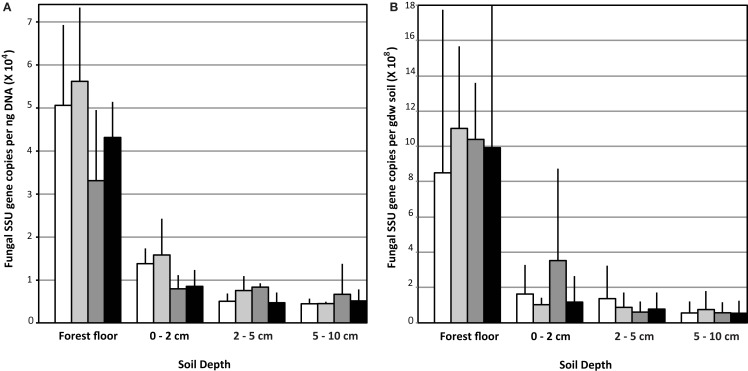
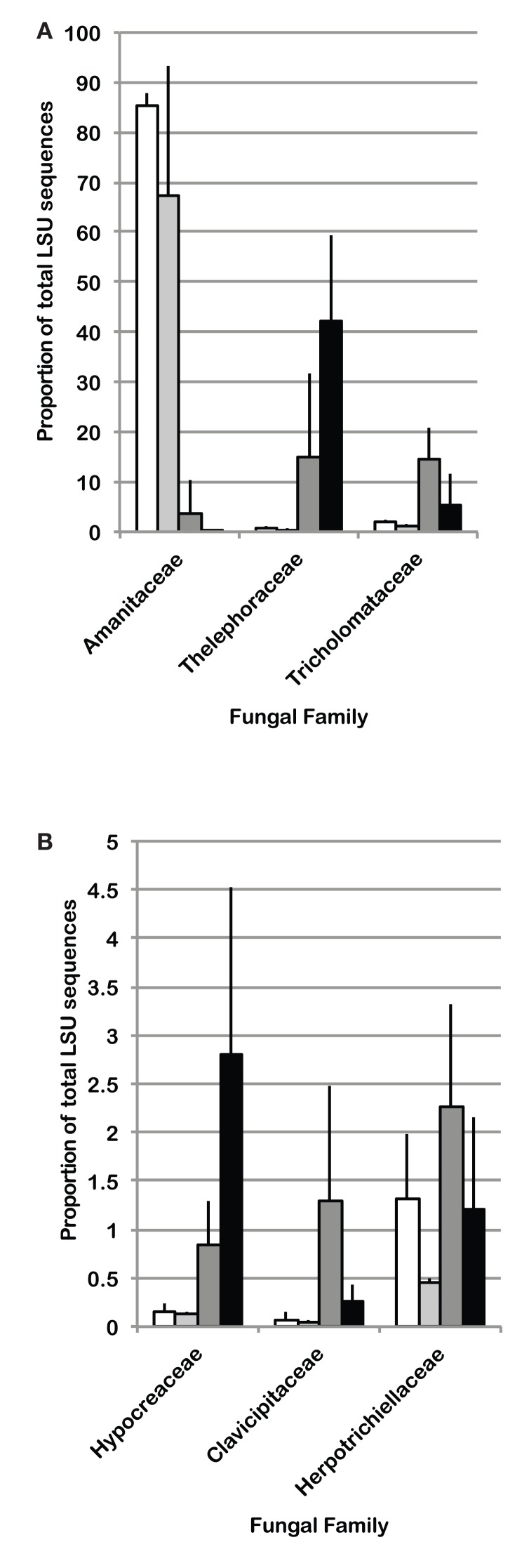
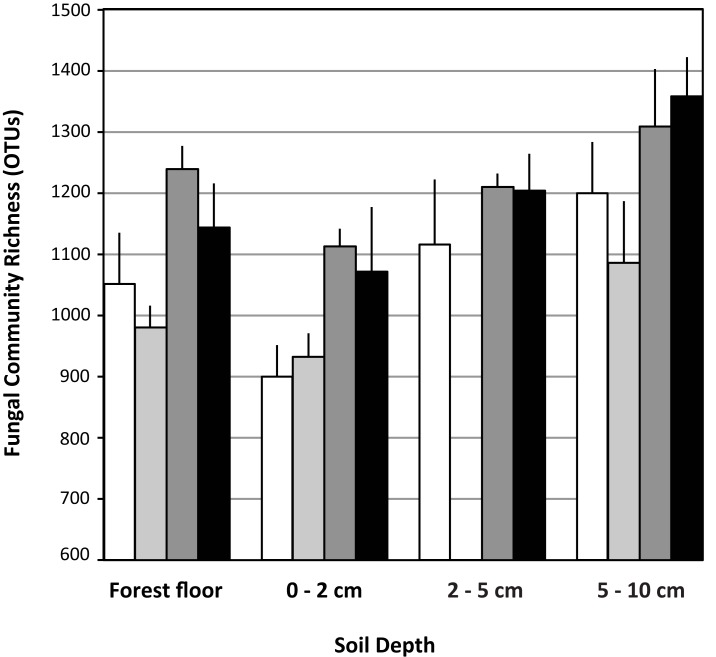
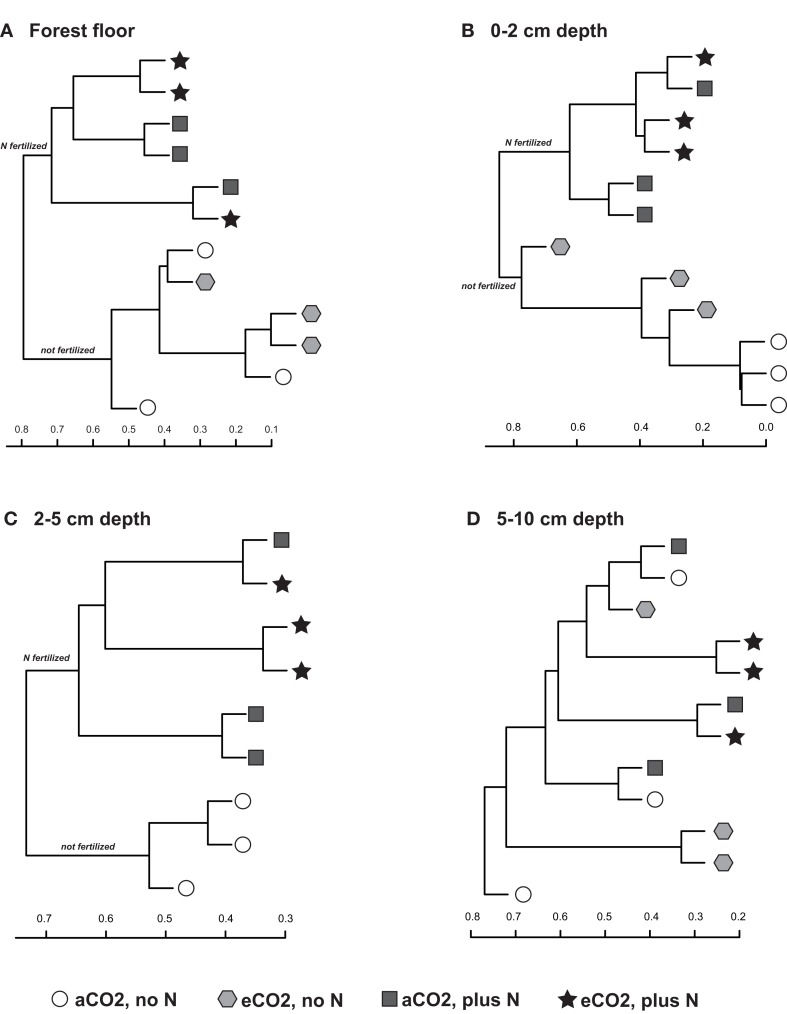
Increasing levels of atmospheric carbon dioxide (CO2) and rates of nitrogen (N)-deposition to forest ecosystems are predicted to alter the structure and function of soil fungal communities, but the spatially heterogeneous distribution of soil fungi has hampered investigations aimed at understanding such impacts. We hypothesized that soil physical and chemical properties and fungal community composition would be differentially impacted by elevated atmospheric CO2 (eCO2) and N-fertilization in spatially separated field samples, in the forest floor, 0-2, 2-5, and 5-10 cm depth intervals in a loblolly pine Free-Air Carbon Dioxide Enrichment (FACE) experiment. In all soils, quantitative PCR-based estimates of fungal biomass were highest in the forest floor. Fungal richness, based on pyrosequencing of the fungal ribosomal large subunit gene, increased in response to N-fertilization in 0-2 cm and forest floor intervals. Composition shifted in forest floor, 0-2 and 2-5 cm intervals in response to N-fertilization, but the shift was most distinct in the 0-2 cm interval, in which the largest number of statistically significant changes in soil chemical parameters (i.e., phosphorus, organic matter, calcium, pH) was also observed. In the 0-2 cm interval, increased recovery of sequences from the Thelephoraceae, Tricholomataceae, Hypocreaceae, Clavicipitaceae, and Herpotrichiellaceae families and decreased recovery of sequences from the Amanitaceae correlated with N-fertilization. In this same depth interval, Amanitaceae, Tricholomataceae, and Herpotriciellaceae sequences were recovered less frequently from soils exposed to eCO2 relative to ambient conditions. These results demonstrated that vertical stratification should be taken into consideration in future efforts to elucidate environmental impacts on fungal communities and their feedbacks on ecosystem processes.
大气二氧化碳(CO2)水平的增加和氮(N)沉降速率预测会改变森林生态系统土壤真菌群落的结构和功能,但土壤真菌的空间异质性分布阻碍了对这些影响的理解。我们假设,在林分地面、0-2、2-5 和 5-10 cm 深度的土壤物理和化学性质以及真菌群落组成,在空间分离的野外样本中,会因大气 CO2 升高(eCO2)和 N 施肥而受到不同的影响,在火炬松自由空气 CO2 增浓(FACE)实验中。在所有土壤中,基于定量 PCR 的真菌生物量估计值在林分地面最高。基于真菌核糖体大亚基基因的焦磷酸测序的真菌丰富度,在 0-2 cm 和林分地面间隔内,对 N 施肥的响应增加。在林分地面、0-2 和 2-5 cm 间隔内,组成发生了变化,对 N 施肥的响应,但在 0-2 cm 间隔内变化最为明显,在该间隔内,还观察到土壤化学参数(即磷、有机质、钙、pH 值)的最大数量的统计上显著变化。在 0-2 cm 间隔内,从 Thelephoraceae、 Tricholomataceae、Hypocreaceae、Clavicipitaceae 和 Herpotrichiellaceae 科中回收的序列增加,以及从 Amanitaceae 科中回收的序列减少,与 N 施肥有关。在同一深度间隔内,从暴露于 eCO2 条件下的土壤中回收的 Amanitaceae、Tricholomataceae 和 Herpotriciellaceae 序列比从环境条件下回收的序列更频繁。这些结果表明,在未来阐明环境对真菌群落的影响及其对生态系统过程的反馈的努力中,应该考虑垂直分层。