Hanif Ammar W, Dyson Whitney D, Bowers Holly A, Pitula Joseph S, Messick Gretchen A, Jagus Rosemary, Schott Eric J
Institute of Marine and Environmental Technology, University of Maryland Center for Environmental Science, Baltimore, MD, 21202, USA.
Aquat Biosyst. 2013 May 4;9(1):11. doi: 10.1186/2046-9063-9-11.
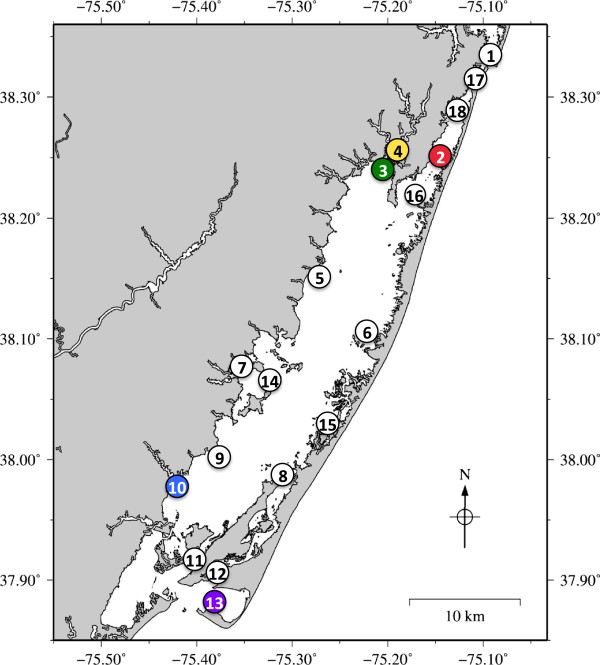
Hematodinium perezi, a parasitic dinoflagellate, infects and kills blue crabs, Callinectes sapidus, along the Atlantic and Gulf coasts of the United States. The parasite proliferates within host hemolymph and tissues, and also produces free-swimming biflagellated dinospores that emerge from infected crabs. Infections in C. sapidus recur annually, and it is not known if biotic or environmental reservoirs contribute to reinfection and outbreaks. To address this data gap, a quantitative PCR assay based on the internal transcribed spacer 2 (ITS2) region of H. perezi rRNA genes was developed to asses the temporal and spatial incidence of the parasite in Delaware and Maryland coastal bays.
A previously-used PCR assay for H. perezi, based on the small subunit rRNA gene sequence, was found to lack adequate species specificity to discriminate non-Hematodinium sp. dinoflagellate species in environmental samples. A new ITS2-targeted assay was developed and validated to detect H. perezi DNA in sediment and water samples using E. coli carrying the H. perezi rDNA genes. Application of the method to environmental samples identified potential hotspots in sediment in Indian River Inlet, DE and Chincoteague Bay, MD and VA. H. perezi DNA was not detected in co-occurring shrimp or snails, even during an outbreak of the parasite in C. sapidus.
H. perezi is present in water and sediment samples in Maryland and Delaware coastal bays from April through November with a wide spatial and temporal variability in incidence. Sampling sites with high levels of H. perezi DNA in both bays share characteristics of silty, organic sediments and low tidal currents. The environmental detection of H. perezi in spring, ahead of peak prevalence in crabs, points to gaps in our understanding of the parasite's life history prior to infection in crabs as well as the mode of environmental transmission. To better understand the H. perezi life cycle will require further monitoring of the parasite in habitats as well as hosts. Improved understanding of potential environmental transmission to crabs will facilitate the development of disease forecasting.
派氏血卵涡鞭虫(Hematodinium perezi)是一种寄生性甲藻,在美国大西洋和墨西哥湾沿岸感染并杀死蓝蟹(Callinectes sapidus)。该寄生虫在宿主血淋巴和组织内增殖,还会产生从受感染螃蟹体内逸出的自由游动的双鞭毛动孢子。蓝蟹的感染每年都会复发,目前尚不清楚生物或环境宿主是否会导致再次感染和疫情爆发。为了填补这一数据空白,开发了一种基于派氏血卵涡鞭虫rRNA基因内部转录间隔区2(ITS2)区域的定量PCR检测方法,以评估特拉华州和马里兰州沿海湾中该寄生虫的时间和空间发生率。
发现先前用于检测派氏血卵涡鞭虫的基于小亚基rRNA基因序列的PCR检测方法缺乏足够的物种特异性,无法区分环境样本中的非血卵涡鞭虫属甲藻物种。开发并验证了一种新的靶向ITS2的检测方法,使用携带派氏血卵涡鞭虫rDNA基因的大肠杆菌来检测沉积物和水样中的派氏血卵涡鞭虫DNA。将该方法应用于环境样本,确定了特拉华州印第安河河口、马里兰州和弗吉尼亚州钦科蒂格湾沉积物中的潜在热点区域。即使在蓝蟹爆发寄生虫感染期间,在共生的虾或蜗牛中也未检测到派氏血卵涡鞭虫DNA。
4月至11月期间,马里兰州和特拉华州沿海湾的水和沉积物样本中存在派氏血卵涡鞭虫,其发生率在时间和空间上存在很大差异。两个海湾中派氏血卵涡鞭虫DNA含量高的采样点具有粉质、有机沉积物和弱潮流的特征。春季在螃蟹感染高峰期之前在环境中检测到派氏血卵涡鞭虫,这表明我们对该寄生虫在感染螃蟹之前的生活史以及环境传播方式的理解存在差距。为了更好地了解派氏血卵涡鞭虫的生命周期,需要进一步监测该寄生虫在栖息地以及宿主体内的情况。更好地了解向螃蟹的潜在环境传播将有助于疾病预测的发展。