School of Botany, University of Melbourne, Melbourne, Victoria, Australia.
PLoS One. 2013 Dec 6;8(12):e82774. doi: 10.1371/journal.pone.0082774. eCollection 2013.
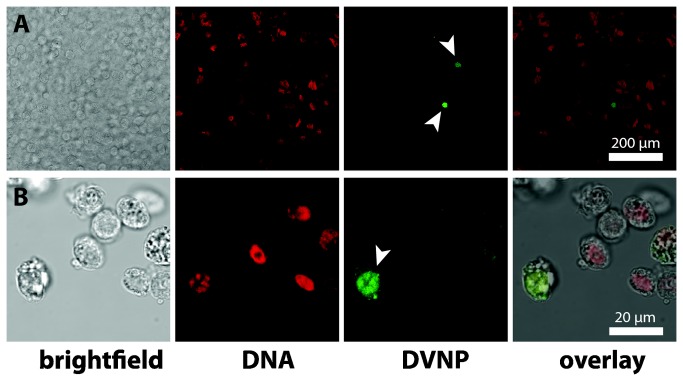
Hematodinium is a parasitic dinoflagellate and emerging pathogen of crustaceans. It preferably manifests in haemolymph of marine decapod crustaceans, killing a large variety of genera with significant impacts on fisheries worldwide. There is, however, evidence that some crustacean stocks harbor high prevalence, low intensity infections that may not result in widespread host mortality and are therefore hard to detect. The most widely used methods for detection of Hematodinium are conventional blood smears and polymerase chain reaction (PCR) against ribosomal RNAs. Blood smears demand a trained investigator, are labor intensive and not readily scalable for high-throughput sampling. PCRs only detect parasite DNA and can also suffer from false negatives and positives. In order to develop alternative detection tools for Hematodinium cells in decapod crustaceans we employed an immunological approach against a newly identified, abundant dinoflagellate-specific nuclear protein--Dinoflagellate/Viral NucleoProtein (DVNP). Both immunofluorescence assay (IFA) and Western blot methods against DVNP showed high sensitivity of detection. The Western blot detects Hematodinium parasites to levels of 25 parasites per milliliter of crustacean haemolymph, with the potential for sample pooling and screening of large samples. Using both PCR and these new tools, we have identified Hematodinium cells present in three new host crab taxa, at high prevalence but with no sign of pathogenesis. This extends the known range of Hematodinium to southern Australia.
血居虫是一种寄生性甲藻,也是甲壳类动物的新兴病原体。它主要在海洋十足目甲壳动物的血淋巴中表现出来,杀死了大量的属,对全球渔业造成了重大影响。然而,有证据表明,一些甲壳类动物种群携带高流行率、低强度的感染,这些感染可能不会导致广泛的宿主死亡,因此很难被发现。检测血居虫最常用的方法是传统的血涂片和针对核糖体 RNA 的聚合酶链反应 (PCR)。血涂片需要经过训练的调查人员,劳动强度大,不适用于高通量采样。PCR 只能检测寄生虫 DNA,也可能出现假阴性和假阳性。为了开发用于检测十足目甲壳类动物中血居虫细胞的替代检测工具,我们采用了针对新鉴定的丰富甲藻特异性核蛋白——甲藻/病毒核蛋白 (DVNP) 的免疫学方法。针对 DVNP 的免疫荧光检测 (IFA) 和 Western blot 方法均显示出很高的检测灵敏度。Western blot 可以检测到每毫升甲壳动物血淋巴中有 25 个寄生虫,具有样本混合和大量样本筛选的潜力。使用 PCR 和这些新工具,我们在三个新的宿主蟹类中发现了存在高流行率但没有发病迹象的血居虫细胞。这将血居虫的已知范围扩展到了澳大利亚南部。