
重新描述来自意大利撒丁岛一只犬的拜氏猴丝虫(Cercopithifilaria bainae Almeida & Vicente,1984年)(旋尾目,盘尾丝虫科)
Redescription of Cercopithifilaria bainae Almeida & Vicente, 1984 (Spirurida, Onchocercidae) from a dog in Sardinia, Italy.
作者信息
Otranto Domenico, Varcasia Antonio, Solinas Cinzia, Scala Antonio, Brianti Emanuele, Dantas-Torres Filipe, Annoscia Giada, Martin Coralie, Mutafchiev Yasen, Bain Odile
出版信息
Parasit Vectors. 2013 May 4;6:132. doi: 10.1186/1756-3305-6-132.
BACKGROUND
Three species of the genus Cercopithifilaria have been morphologically and molecularly characterized in dog populations in southern Europe: Cercopithifilaria grassii (Noè, 1907), Cercopithifilaria sp. sensu Otranto et al., 2011 (reported as Cercopithifilaria sp. I), and Cercopithifilaria sp. II sensu Otranto et al., 2012. The adults of Cercopithifilaria sp. I have remained unknown until the present study.
METHODS
The material originated from a dog from Sardinia (Italy) diagnosed with dermal microfilariae of Cercopithifilaria sp. I. The holotype and three paratypes of Cercopithifilaria bainae Almeida & Vicente, 1984, described from dogs in Brazil, were studied as comparative material. A cox1 (689 bp) and 12S (330 bp) gene fragments were amplified and phylogenetic analysis carried out.
RESULTS
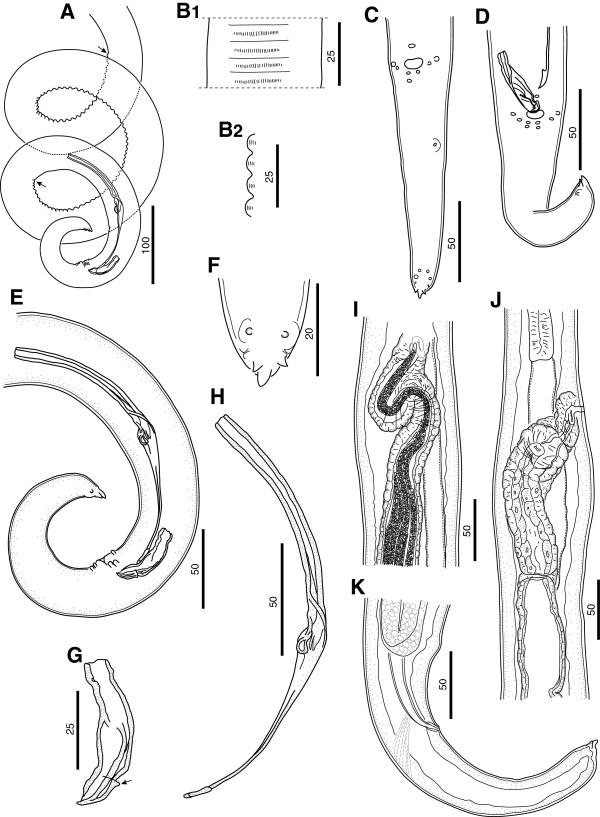
The highest numbers of adult nematodes (82%) were collected in the sediment of the subcutaneous tissues of the trunk (n = 37) and forelimbs (n = 36). The morphology of the adult nematodes and microfilariae collected from the dog in Sardinia corresponded to those of C. bainae. All cox1 and 12S gene sequences showed a high homology (99-100%) with sequences from microfilariae of Cercopithifilaria sp.
I CONCLUSIONS
The morphological and molecular identity of the microfilariae of C. bainae overlap those described previously as Cercopithifilaria sp. sensu Otranto et al., 2011 (=Cercopithifilaria sp. I). Therefore, the present study reports the occurrence of C. bainae in Europe, for the first time after its description and the single record in Brazil. C. bainae appears to be highly diffused in dog populations in southern Europe. The phylogenetic analyses based on cox1 and 12S do not reveal the three species of Cercopithifilaria parasitizing dogs as a monophyletic group, which suggests that they have derived independently by host switching.
背景
在欧洲南部的犬类种群中,已对三种环尾丝虫属物种进行了形态学和分子特征鉴定:格拉西环尾丝虫(Cercopithifilaria grassii,Noè,1907)、奥兰特等(Otranto et al.)于2011年描述的环尾丝虫属某种(报道为环尾丝虫属I种)以及奥兰特等(Otranto et al.)于2012年描述的环尾丝虫属II种。直到本研究开展之前,环尾丝虫属I种的成虫一直不为人所知。
方法
材料来源于一只来自撒丁岛(意大利)的犬,该犬被诊断感染了环尾丝虫属I种的皮肤微丝蚴。对1984年从巴西犬类中描述的拜氏环尾丝虫(Cercopithifilaria bainae Almeida & Vicente)的正模标本和三个副模标本进行了研究,作为比较材料。扩增了细胞色素c氧化酶亚基1(cox1,约689 bp)和12S核糖体RNA(约330 bp)基因片段,并进行了系统发育分析。
结果
在躯干(n = 37)和前肢(n = 36)皮下组织的沉积物中收集到的成虫线虫数量最多(82%)。从撒丁岛的犬身上收集到的成虫线虫和微丝蚴的形态与拜氏环尾丝虫的形态相符。所有的cox1和12S基因序列与环尾丝虫属I种微丝蚴的序列显示出高度同源性(99 - 100%)。
结论
拜氏环尾丝虫微丝蚴的形态和分子特征与之前奥兰特等(Otranto et al.)于2011年描述的环尾丝虫属某种(=环尾丝虫属I种)重叠。因此,本研究首次报道了拜氏环尾丝虫在欧洲的出现,这是其在巴西被描述和单一记录之后的首次报道。拜氏环尾丝虫似乎在欧洲南部的犬类种群中高度扩散。基于cox1和12S的系统发育分析并未揭示寄生于犬类的三种环尾丝虫为单系类群,这表明它们是通过宿主转换独立演化而来的。




 Zotero 插件