Department of Medical and Health Sciences, Football Research Group, Linköping University, Linköping, Sweden.
Br J Sports Med. 2013 Aug;47(12):769-74. doi: 10.1136/bjsports-2012-092092. Epub 2013 May 5.
Owing to the complexity and heterogeneity of muscle injuries, a generally accepted classification system is still lacking.
To prospectively implement and validate a novel muscle injury classification and to evaluate its predictive value for return to professional football.
The recently described Munich muscle injury classification was prospectively evaluated in 31 European professional male football teams during the 2011/2012 season. Thigh muscle injury types were recorded by team medical staff and correlated to individual player exposure and resultant time-loss.
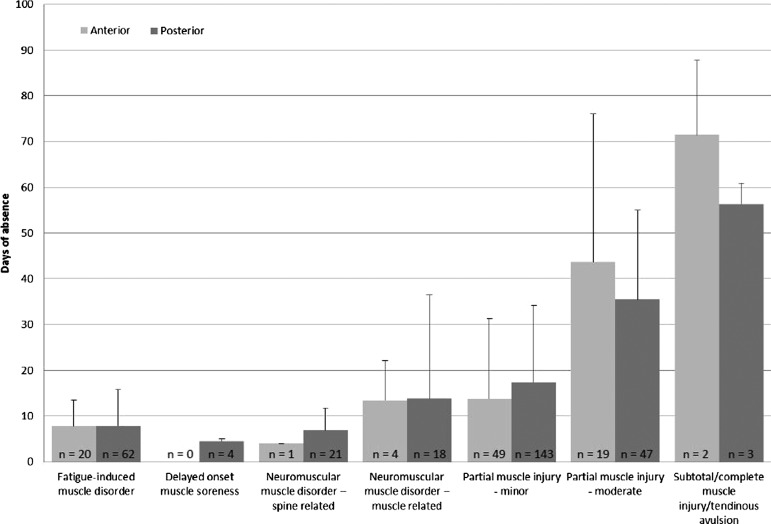
In total, 393 thigh muscle injuries occurred. The muscle classification system was well received with a 100% response rate. Two-thirds of thigh muscle injuries were classified as structural and were associated with longer lay-off times compared to functional muscle disorders (p<0.001). Significant differences were observed between structural injury subgroups (minor partial, moderate partial and complete injuries) with increasing lay-off time associated with more severe structural injury. Median lay-off time of functional disorders was 5-8 days without significant differences between subgroups. There was no significant difference in the absence time between anterior and posterior thigh injuries.
The Munich muscle classification demonstrates a positive prognostic validity for return to play after thigh muscle injury in professional male football players. Structural injuries are associated with longer average lay-off times than functional muscle disorders. Subclassification of structural injuries correlates with return to play, while subgrouping of functional disorders shows less prognostic relevance. Functional disorders are often underestimated clinically and require further systematic study.
由于肌肉损伤的复杂性和异质性,目前仍缺乏一个普遍接受的分类系统。
前瞻性实施和验证一种新的肌肉损伤分类,并评估其对重返职业足球的预测价值。
在 2011/2012 赛季,最近描述的慕尼黑肌肉损伤分类法在 31 支欧洲职业男子足球队中进行了前瞻性评估。由队医记录大腿肌肉损伤类型,并与个别球员的暴露程度和由此导致的伤停时间相关联。
共发生 393 例大腿肌肉损伤。肌肉分类系统的接受程度很高,回复率达到 100%。三分之二的大腿肌肉损伤被归类为结构性损伤,与功能性肌肉紊乱相比,伤停时间更长(p<0.001)。结构性损伤亚组之间存在显著差异(轻度部分、中度部分和完全损伤),随着损伤程度的加重,伤停时间也随之增加。功能性紊乱的平均伤停时间为 5-8 天,亚组之间没有显著差异。前大腿和后大腿损伤的缺席时间没有显著差异。
慕尼黑肌肉分类法对职业男足球员大腿肌肉损伤后重返比赛具有积极的预后价值。结构性损伤的平均伤停时间比功能性肌肉紊乱长。结构性损伤的亚分类与重返比赛相关,而功能性紊乱的亚分类则显示出较少的预后相关性。功能性紊乱在临床上经常被低估,需要进一步进行系统研究。