Mazin Yuriy, Lemos Carolina, Paiva Carolina, Amaral Oliveira Luís, Borges Andre, Lopes Tiago
Physical Medicine and Rehabilitation, Centro de Reabilitação do Norte, Vila Nova de Gaia, PRT.
Population Studies, Instituto de Ciências Biomédicas Abel Salazar, Universidade do Porto, Porto, PRT.
Cureus. 2023 Aug 27;15(8):e44196. doi: 10.7759/cureus.44196. eCollection 2023 Aug.
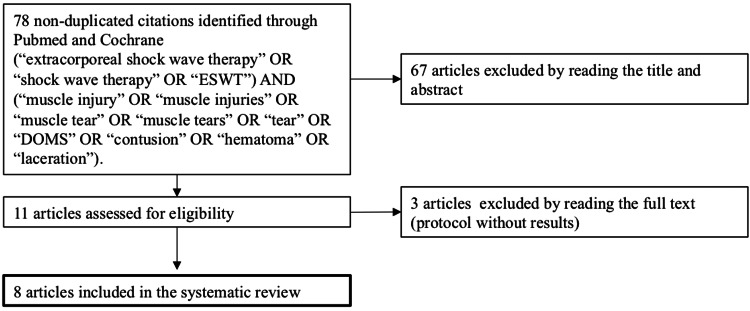
Muscle injuries commonly occur in sports and can be classified as indirect and direct, according to the 2013 Munich Consensus Statement (MCS). Since recent evidence suggests that extracorporeal shock wave therapy (ESWT) improves muscular microcirculation and may increase regeneration after acute muscle injury, we performed a systematic review following the Preferred Reporting Items for Systematic Reviews and Meta-Analyses (PRISMA) statement guidelines to access the efficacy and safety of ESWT in the treatment of patients with muscle injuries. PubMed and Cochrane were searched to screen for potentially relevant articles and the literature search was last updated in June 2023. The inclusion criteria were randomized controlled trials, observational studies, or case controls published in English, Portuguese, or Spanish that studied the effect of ESWT on indirect and direct muscle injuries in individuals aged ≥18, with at least one of the following reported outcomes: pain on the visual analog scale (VAS), functionality assessed either with disability scales or subjectively, time for return to play (RTP), re-injury rate, and ultrasonographic evaluation. The exclusion criteria were literature reviews, systematic reviews, studies in animals, studies in other languages, studies that failed to meet the targeted population or intervention and studies that didn't report any of the outcomes of interest. The quality of the studies was analyzed using the Cochrane Assessment Tool, the Newcastle-Ottawa Quality Assessment Scale, and the JBI Critical Appraisal Checklist. Eight studies were included in the systematic review (two randomized controlled trials, one prospective observational study, two retrospective observational studies, and three case reports), with a total of 143 adult participants. ESWT was associated with less pain on VAS, better function, reduction of size of lesion on ultrasound evaluation, faster RTP and/or lower re-injury rate in patients with indirect and direct muscle injuries and muscular hematomas, a frequent secondary complication of muscle injuries. The evidence regarding the use of ESWT for these types of injuries is therefore promising. Nevertheless, higher-quality studies are needed in the future to prove its efficacy, better comprehend its mechanisms of action and define treatment protocols (timing, type and parameters of ESWT).
根据2013年慕尼黑共识声明(MCS),肌肉损伤在体育运动中很常见,可分为间接损伤和直接损伤。由于最近的证据表明,体外冲击波疗法(ESWT)可改善肌肉微循环,并可能促进急性肌肉损伤后的再生,我们按照系统评价和Meta分析的首选报告项目(PRISMA)声明指南进行了一项系统评价,以评估ESWT治疗肌肉损伤患者的疗效和安全性。检索了PubMed和Cochrane数据库以筛选潜在相关文章,文献检索的最后更新时间为2023年6月。纳入标准为以英文、葡萄牙文或西班牙文发表的随机对照试验、观察性研究或病例对照研究,研究对象为年龄≥18岁的个体,研究ESWT对间接和直接肌肉损伤的影响,且至少报告以下一项结局:视觉模拟量表(VAS)疼痛评分、使用残疾量表或主观评估的功能、恢复比赛时间(RTP)、再损伤率和超声评估。排除标准为文献综述、系统评价、动物研究、其他语言的研究、未符合目标人群或干预措施的研究以及未报告任何感兴趣结局的研究。使用Cochrane评估工具、纽卡斯尔-渥太华质量评估量表和JBI批判性评价清单对研究质量进行分析。系统评价纳入了8项研究(2项随机对照试验、1项前瞻性观察性研究、2项回顾性观察性研究和3项病例报告),共有143名成年参与者。在间接和直接肌肉损伤以及肌肉血肿(肌肉损伤常见的继发性并发症)患者中,ESWT与VAS疼痛减轻、功能改善、超声评估显示的损伤大小减小、RTP加快和/或再损伤率降低相关。因此,关于使用ESWT治疗这类损伤的证据很有前景。然而,未来需要更高质量的研究来证明其疗效,更好地理解其作用机制并确定治疗方案(ESWT的时机、类型和参数)。