Department of Genitourinary Medical Oncology, Unit 1374, The University of Texas MD Anderson Cancer Center, 1155 Pressler Street, Houston, TX 77030-3721, USA.
Cancer Cell Int. 2013 May 6;13(1):40. doi: 10.1186/1475-2867-13-40.
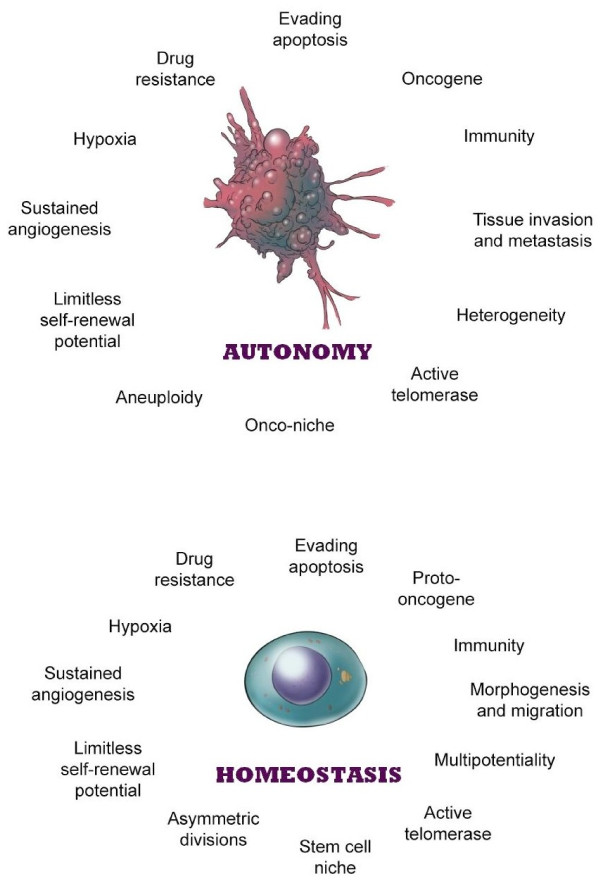
Nowadays, we believe that cancer is a genetic disease. We focus on the genetic targets and epigenetic changes in a tumor. Remarkably, many crucial signal pathways in a malignant cell involve "stem-ness" genes. The prevalence of stem-ness in cancer suggests that cancer has a stem-cell origin and is a stem-cell disease.
The observation that many innate stem-ness properties are easily interchangeable with malignant hallmarks needs to be further elucidated. There appears to be a malignant potential in every stem cell and a stem cell potential in every malignant cell. I hypothesize that cancer is a stem-cell disease rather than a genetic disease.
We will use homeobox genes to endow a certain progenitor cell with specific stem-ness properties and confer different stem-cell phenotypes to the particular cell type in a hierarchical manner. We will demonstrate that an earlier homeobox gene plus a genetic defect (such as Pten loss) tend to form a more virulent tumor, while a later homeobox gene plus the same genetic defect tend to express a more indolent phenotype. Importantly, we will show that in clinically relevant cancer subtypes, those with worse clinical outcomes may paradoxically harbor fewer genetic mutations than those with better outcomes do.
The recognition that cancer is a stem-cell disease will instigate major paradigm shifts in our basic understanding of cancer. Many fundamental principles of oncology, such as multistep carcinogenesis, need to be reconciled. The realization that cancer is a stem-cell disease will also have profound clinical implications on personalized care. Many aspects of our current clinical trials need to be reevaluated.
如今,我们认为癌症是一种遗传性疾病。我们专注于肿瘤中的遗传靶点和表观遗传变化。值得注意的是,恶性细胞中的许多关键信号通路都涉及“干性”基因。癌症中干性的普遍存在表明癌症具有干细胞起源,是一种干细胞疾病。
需要进一步阐明这样一个观察结果,即许多固有干性特性很容易与恶性特征互换。每个干细胞似乎都有恶性潜能,每个恶性细胞都有干细胞潜能。我假设癌症是一种干细胞疾病,而不是遗传疾病。
我们将使用同源盒基因赋予特定祖细胞特定的干性特性,并以分层的方式赋予特定细胞类型不同的干细胞表型。我们将证明,早期同源盒基因加上遗传缺陷(如 Pten 缺失)往往会形成更具侵袭性的肿瘤,而晚期同源盒基因加上相同的遗传缺陷往往会表现出更惰性的表型。重要的是,我们将表明,在临床上相关的癌症亚型中,那些预后较差的亚型可能具有较少的遗传突变,这与预后较好的亚型形成了悖论。
认识到癌症是一种干细胞疾病将引发我们对癌症基本认识的重大范式转变。肿瘤学的许多基本原则,如多步致癌作用,需要协调一致。认识到癌症是一种干细胞疾病也将对个性化治疗产生深远的临床影响。我们当前临床试验的许多方面需要重新评估。