Section of Molecular and Computational Biology, Department of Biological Sciences, University of Southern California, CA, USA.
Mol Biol Evol. 2013 Aug;30(8):1966-74. doi: 10.1093/molbev/mst085. Epub 2013 May 6.
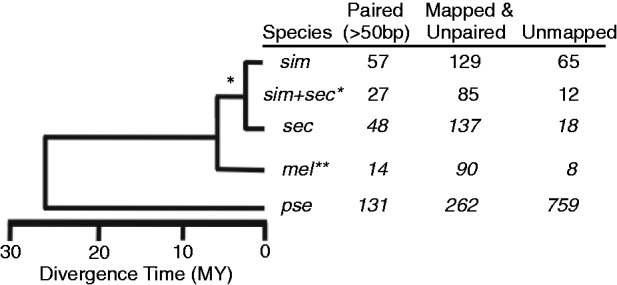
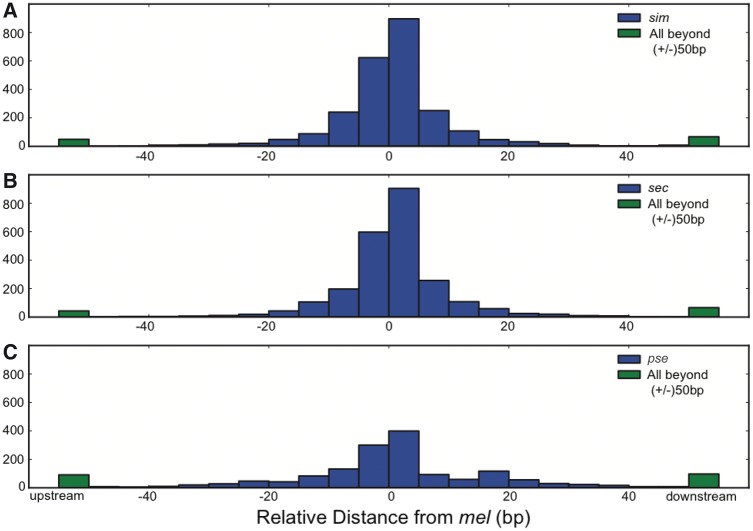
Transcription start site (TSS) evolution remains largely undescribed in Drosophila, likely due to limited annotations in non-melanogaster species. In this study, we introduce a concise new method that selectively sequences from the 5'-end of mRNA and used it to identify TSS in four Drosophila species, including Drosophila melanogaster, D. simulans, D. sechellia, and D. pseudoobscura. For verification, we compared our results in D. melanogaster with known annotations, published 5'-rapid amplification of cDNA ends data, and with RNAseq from the same mRNA pool. Then, we paired 2,849 D. melanogaster TSS with its closest equivalent TSS in each species (likely to be its true ortholog) using the available multiple sequence alignments. Most of the D. melanogaster TSSs were successfully paired with an ortholog in each species (83%, 86%, and 55% for D. simulans, D. sechellia, and D. pseudoobscura, respectively). On the basis of the number and distribution of reads mapped at each TSS, we also estimated promoter-specific expression (PSE) and TSS peak shape, respectively. Among paired TSS orthologs, the location and promoter activity were largely conserved. TSS location appears important as PSE, and TSS peak shape was more frequently divergent among TSS that had moved. Unpaired TSS were surprisingly common in D. pseudoobscura. An increased mutation rate upstream of TSS might explain this pattern. We found an enrichment of ribosomal protein genes among diverged TSS, suggesting that TSS evolution is not uniform across the genome.
转录起始位点 (TSS) 的进化在果蝇中很大程度上仍未被描述,这可能是由于非黑腹果蝇物种中的注释有限。在这项研究中,我们引入了一种简洁的新方法,该方法选择性地从 mRNA 的 5' 端测序,并将其用于鉴定包括黑腹果蝇、D. simulans、D. sechellia 和 D. pseudoobscura 在内的四个果蝇物种中的 TSS。为了验证,我们将在 D. melanogaster 中的结果与已知注释、已发表的 5' 快速扩增 cDNA 末端数据以及来自相同 mRNA 池的 RNAseq 进行了比较。然后,我们使用可用的多序列比对将 2,849 个 D. melanogaster TSS 与其在每个物种中的最接近的等效 TSS(可能是其真正的同源物)配对。大多数 D. melanogaster TSS 都成功地与每个物种中的一个同源物配对(分别为 83%、86%和 55%,用于 D. simulans、D. sechellia 和 D. pseudoobscura)。基于在每个 TSS 处映射的读取数量和分布,我们分别估计了启动子特异性表达 (PSE) 和 TSS 峰形状。在配对的 TSS 同源物中,位置和启动子活性在很大程度上是保守的。TSS 位置似乎很重要,因为 PSE,并且在移动的 TSS 中 TSS 峰形状更频繁地发散。在 D. pseudoobscura 中,未配对的 TSS 非常常见。TSS 上游突变率的增加可能解释了这种模式。我们发现核糖体蛋白基因在分化的 TSS 中富集,这表明 TSS 进化在整个基因组中并不均匀。