Department of Nephrology, Medical University of Vienna, Vienna, Austria.
Diabetes Care. 2013 Sep;36(9):2763-71. doi: 10.2337/dc12-2441. Epub 2013 May 8.
We determined prevalence, risk factors, phenotype, and pathophysiological mechanism of new-onset diabetes after transplantation (NODAT) to generate strategies for optimal pharmacological management of hyperglycemia in NODAT patients.
Retrospective cohort study comparing demographics, laboratory data, and oral glucose tolerance test (OGTT)-derived metabolic parameters from kidney transplant recipients versus subjects not receiving transplants.
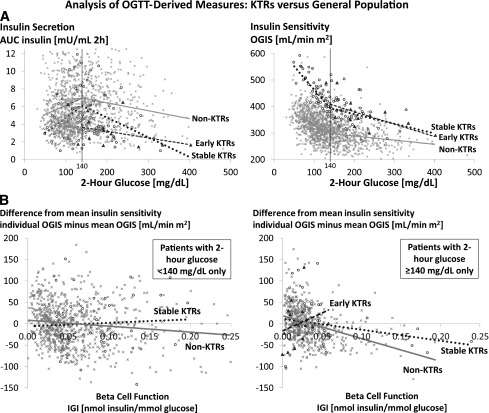
Among 1,064 stable kidney transplant recipients (≥ 6 months posttransplantation), 113 (11%) had a history of NODAT and 132 (12%) had pretransplant diabetes. In the remaining patients, randomly assigned OGTTs showed a high prevalence of abnormal glucose metabolism (11% diabetes; 32% impaired fasting glucose, impaired glucose tolerance, or both), predominantly in older patients who received tacrolimus as the primary immunosuppressant. Compared with 1,357 nontransplant subjects, stable kidney transplant recipients had lower basal glucose, higher glycated hemoglobin, lower insulin secretion, and greater insulin sensitivity in each of the three subgroups, defined by OGTT 2-h glucose (<140, 140-199, ≥ 200 mg/dL). These findings were reinforced in linear spline interpolation models of insulin secretion and sensitivity (all P < 0.001) and in another regression model in which the estimated oral glucose insulin sensitivity index was substantially higher (by 79-112 mL/min m(2)) for transplant versus nontransplant subjects despite adjustments for age, sex, and BMI (all P < 0.001).
Glucose metabolism differs substantially between kidney transplant recipients and nontransplant controls. Because impaired insulin secretion appears to be the predominant pathophysiological feature after renal transplantation, early therapeutic interventions that preserve, maintain, or improve β-cell function are potentially beneficial in this population.
我们旨在确定新发移植后糖尿病(NODAT)的患病率、风险因素、表型和病理生理学机制,从而为 NODAT 患者的高血糖最佳药物治疗提供策略。
我们进行了一项回顾性队列研究,比较了肾脏移植受者与未接受移植者的人口统计学资料、实验室数据以及口服葡萄糖耐量试验(OGTT)衍生的代谢参数。
在 1064 例稳定的肾脏移植受者(移植后≥6 个月)中,113 例(11%)有 NODAT 病史,132 例(12%)有移植前糖尿病。在其余患者中,随机分配的 OGTT 显示异常葡萄糖代谢的患病率较高(11%为糖尿病;32%为空腹血糖受损、葡萄糖耐量受损或两者兼有),这主要见于接受他克莫司作为主要免疫抑制剂的老年患者。与 1357 例非移植受者相比,稳定的肾脏移植受者在每个 OGTT 2 小时血糖亚组(<140、140-199、≥200mg/dL)中均具有较低的基础血糖、较高的糖化血红蛋白、较低的胰岛素分泌和更高的胰岛素敏感性。在胰岛素分泌和敏感性的线性样条插值模型中(所有 P <0.001)以及在另一个回归模型中,尽管对年龄、性别和 BMI 进行了调整,移植与非移植受者的估计口服葡萄糖胰岛素敏感性指数仍显著更高(高 79-112mL/min·m2)(所有 P <0.001),这些发现得到了进一步证实。
肾脏移植受者与非移植对照者的葡萄糖代谢存在显著差异。由于移植后胰岛素分泌受损似乎是主要的病理生理学特征,因此早期的治疗干预措施,可保护、维持或改善β细胞功能,对这一人群可能有益。