
细胞模式从细胞增殖动力学的耦合化学和物理场中出现:拟南芥根作为研究系统。
Cell patterns emerge from coupled chemical and physical fields with cell proliferation dynamics: the Arabidopsis thaliana root as a study system.
机构信息
Instituto de Física, Universidad Nacional Autónoma de México (UNAM), México, Distrito Federal, México.
出版信息
PLoS Comput Biol. 2013;9(5):e1003026. doi: 10.1371/journal.pcbi.1003026. Epub 2013 May 2.
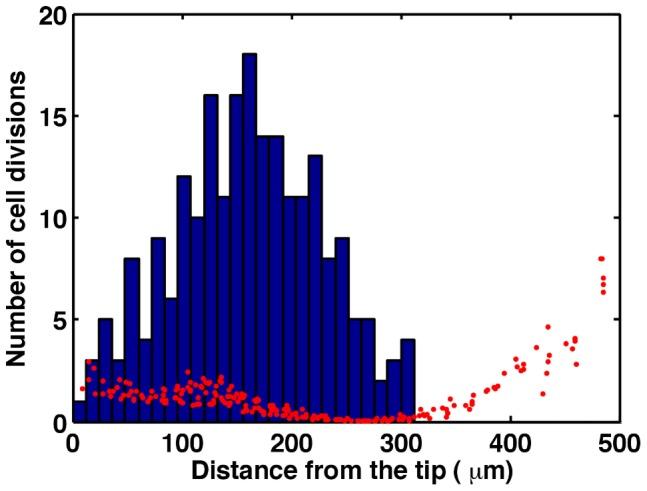
A central issue in developmental biology is to uncover the mechanisms by which stem cells maintain their capacity to regenerate, yet at the same time produce daughter cells that differentiate and attain their ultimate fate as a functional part of a tissue or an organ. In this paper we propose that, during development, cells within growing organs obtain positional information from a macroscopic physical field that is produced in space while cells are proliferating. This dynamical interaction triggers and responds to chemical and genetic processes that are specific to each biological system. We chose the root apical meristem of Arabidopsis thaliana to develop our dynamical model because this system is well studied at the molecular, genetic and cellular levels and has the key traits of multicellular stem-cell niches. We built a dynamical model that couples fundamental molecular mechanisms of the cell cycle to a tension physical field and to auxin dynamics, both of which are known to play a role in root development. We perform extensive numerical calculations that allow for quantitative comparison with experimental measurements that consider the cellular patterns at the root tip. Our model recovers, as an emergent pattern, the transition from proliferative to transition and elongation domains, characteristic of stem-cell niches in multicellular organisms. In addition, we successfully predict altered cellular patterns that are expected under various applied auxin treatments or modified physical growth conditions. Our modeling platform may be extended to explicitly consider gene regulatory networks or to treat other developmental systems.
发育生物学的一个核心问题是揭示干细胞如何维持其再生能力,同时又产生分化的子细胞,并最终成为组织或器官的功能部分。本文提出,在发育过程中,生长器官内的细胞从在细胞增殖时产生于空间的宏观物理场中获得位置信息。这种动态相互作用触发并响应特定于每个生物系统的化学和遗传过程。我们选择拟南芥的根尖分生组织来开发我们的动力学模型,因为这个系统在分子、遗传和细胞水平上都得到了很好的研究,并且具有多细胞干细胞生态位的关键特征。我们构建了一个动力学模型,将细胞周期的基本分子机制与张力物理场和生长素动力学耦合起来,这两者都已知在根发育中发挥作用。我们进行了广泛的数值计算,允许与考虑根尖细胞模式的实验测量进行定量比较。我们的模型恢复了从增殖到过渡和伸长区域的转变,这是多细胞生物中干细胞生态位的特征。此外,我们成功地预测了在各种施加的生长素处理或改变的物理生长条件下预期的改变的细胞模式。我们的建模平台可以扩展到明确考虑基因调控网络或处理其他发育系统。







 Zotero 插件