Department of Medicine, University of Toronto, Toronto, Ontario, Canada.
PLoS One. 2013 May 2;8(5):e61735. doi: 10.1371/journal.pone.0061735. Print 2013.
Medication non-adherence frequently leads to suboptimal patient outcomes. Primary non-adherence, which occurs when a patient does not fill an initial prescription, is particularly important at the time of hospital discharge because new medications are often being prescribed to treat an illness rather than for prevention.
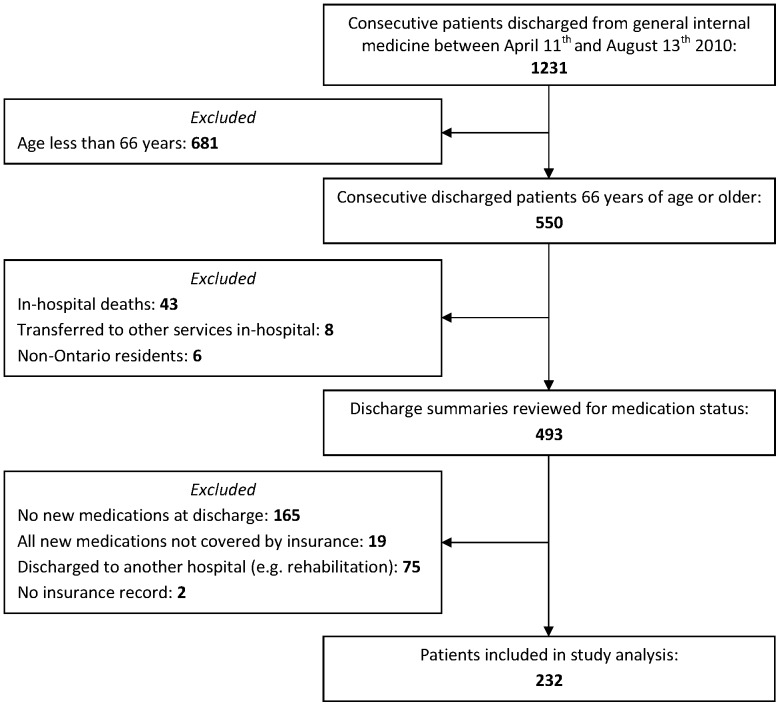
We studied older adults consecutively discharged from a general internal medicine service at a large urban teaching hospital to determine the prevalence of primary non-adherence and identify characteristics associated with primary non-adherence. We reviewed electronic prescriptions, electronic discharge summaries and pharmacy dispensing data from April to August 2010 for drugs listed on the public formulary. Primary non-adherence was defined as failure to fill one or more new prescriptions after hospital discharge. In addition to descriptive analyses, we developed a logistical regression model to identify patient characteristics associated with primary non-adherence.
There were 493 patients eligible for inclusion in our study, 232 of whom were prescribed new medications. In total, 66 (28%) exhibited primary non-adherence at 7 days after discharge and 55 (24%) at 30 days after discharge. Examples of medications to which patients were non-adherent included antibiotics, drugs for the management of coronary artery disease (e.g. beta-blockers, statins), heart failure (e.g. beta-blockers, angiotensin converting enzyme inhibitors, furosemide), stroke (e.g. statins, clopidogrel), diabetes (e.g. insulin), and chronic obstructive pulmonary disease (e.g. long-acting bronchodilators, prednisone). Discharge to a nursing home was associated with an increased risk of primary non-adherence (OR 2.25, 95% CI 1.01-4.95).
Primary non-adherence after medications are newly prescribed during a hospitalization is common, and was more likely to occur in patients discharged to a nursing home.
药物不依从常常导致患者的治疗效果不佳。首次不依从是指患者未开初始处方,在出院时尤其重要,因为新开出的药物常常是为了治疗疾病而不是预防疾病。
我们对从一家大型城市教学医院综合内科连续出院的老年患者进行研究,以确定首次不依从的发生率,并确定与首次不依从相关的特征。我们查阅了 2010 年 4 月至 8 月期间电子处方、电子出院小结和药房配药数据,所查药物均列于公共处方集。首次不依从定义为出院后未能开一种或多种新处方。除了描述性分析,我们还建立了逻辑回归模型,以确定与首次不依从相关的患者特征。
共有 493 名患者符合我们的研究纳入标准,其中 232 名患者开了新的处方。出院后 7 天内,共有 66 名(28%)患者发生首次不依从,30 天内共有 55 名(24%)患者发生首次不依从。患者不依从的药物包括抗生素、冠心病(如β受体阻滞剂、他汀类药物)、心力衰竭(如β受体阻滞剂、血管紧张素转换酶抑制剂、呋塞米)、中风(如他汀类药物、氯吡格雷)、糖尿病(如胰岛素)和慢性阻塞性肺疾病(如长效支气管扩张剂、泼尼松)。出院至疗养院与首次不依从的风险增加相关(比值比 2.25,95%置信区间 1.01-4.95)。
在住院期间新开出的药物首次不依从很常见,出院至疗养院的患者更可能出现这种情况。