School of Pharmaceutical Sciences, University of Geneva, Geneva, Switzerland.
Institute of Pharmaceutical Sciences of Western Switzerland, University of Geneva, Geneva, Switzerland.
BMC Health Serv Res. 2024 May 13;24(1):620. doi: 10.1186/s12913-024-10784-9.
Continuity of care is under great pressure during the transition from hospital to outpatient care. Medication changes during hospitalization may be poorly communicated and understood, compromising patient safety during the transition from hospital to home. The main aims of this study were to investigate the perspectives of patients with type 2 diabetes and multimorbidities on their medications from hospital discharge to outpatient care, and their healthcare journey through the outpatient healthcare system. In this article, we present the results focusing on patients' perspectives of their medications from hospital to two months after discharge.
Patients with type 2 diabetes, with at least two comorbidities and who returned home after discharge, were recruited during their hospitalization. A descriptive qualitative longitudinal research approach was adopted, with four in-depth semi-structured interviews per participant over a period of two months after discharge. Interviews were based on semi-structured guides, transcribed verbatim, and a thematic analysis was conducted.
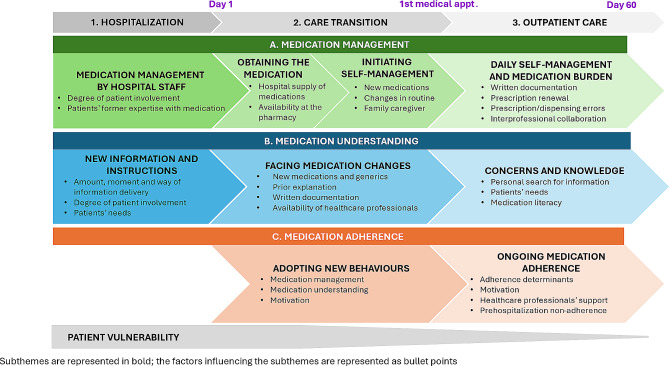
Twenty-one participants were included from October 2020 to July 2021. Seventy-five interviews were conducted. Three main themes were identified: (A) Medication management, (B) Medication understanding, and (C) Medication adherence, during three periods: (1) Hospitalization, (2) Care transition, and (3) Outpatient care. Participants had varying levels of need for medication information and involvement in medication management during hospitalization and in outpatient care. The transition from hospital to autonomous medication management was difficult for most participants, who quickly returned to their routines with some participants experiencing difficulties in medication adherence.
The transition from hospital to outpatient care is a challenging process during which discharged patients are vulnerable and are willing to take steps to better manage, understand, and adhere to their medications. The resulting tension between patients' difficulties with their medications and lack of standardized healthcare support calls for interprofessional guidelines to better address patients' needs, increase their safety, and standardize physicians', pharmacists', and nurses' roles and responsibilities.
从医院过渡到门诊护理时,连续护理面临巨大压力。住院期间的药物变化可能沟通和理解不佳,从而危及患者从医院回家的过渡期间的安全。本研究的主要目的是调查 2 型糖尿病和多种合并症患者对其从出院到门诊护理期间的药物的看法,以及他们通过门诊医疗保健系统的医疗保健之旅。在本文中,我们重点介绍了患者对出院后两个月内从医院到药物的看法的研究结果。
在住院期间招募了 2 型糖尿病患者,至少有两种合并症,并且出院后返回家中。采用描述性定性纵向研究方法,每个参与者在出院后两个月内进行了四次深入的半结构化访谈。访谈基于半结构化指南,逐字记录,并进行了主题分析。
2020 年 10 月至 2021 年 7 月期间共纳入 21 名参与者。共进行了 75 次访谈。确定了三个主要主题:(A)药物管理,(B)药物理解和(C)药物依从性,分为三个时期:(1)住院期间,(2)护理过渡期和(3)门诊护理期。住院期间和门诊护理期间,患者对药物信息的需求程度和参与药物管理的程度有所不同。大多数参与者从医院过渡到自主药物管理都很困难,有些参与者在药物依从性方面遇到困难,很快就恢复了日常生活。
从医院过渡到门诊护理是一个充满挑战的过程,在此期间出院患者很脆弱,愿意采取措施更好地管理,理解和遵守自己的药物。患者在药物方面的困难与缺乏标准化医疗保健支持之间的紧张关系,需要制定跨专业指南,以更好地满足患者的需求,提高他们的安全性,并规范医生,药剂师和护士的角色和责任。