Duke Clinical Research Institute Durham NC.
AstraZeneca Wilmington DE.
J Am Heart Assoc. 2021 Jan 5;10(1):e016215. doi: 10.1161/JAHA.119.016215. Epub 2020 Dec 21.
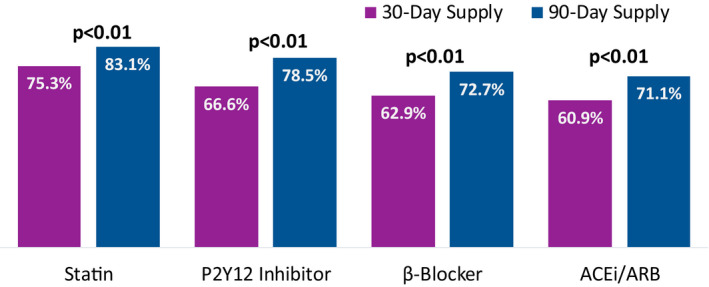
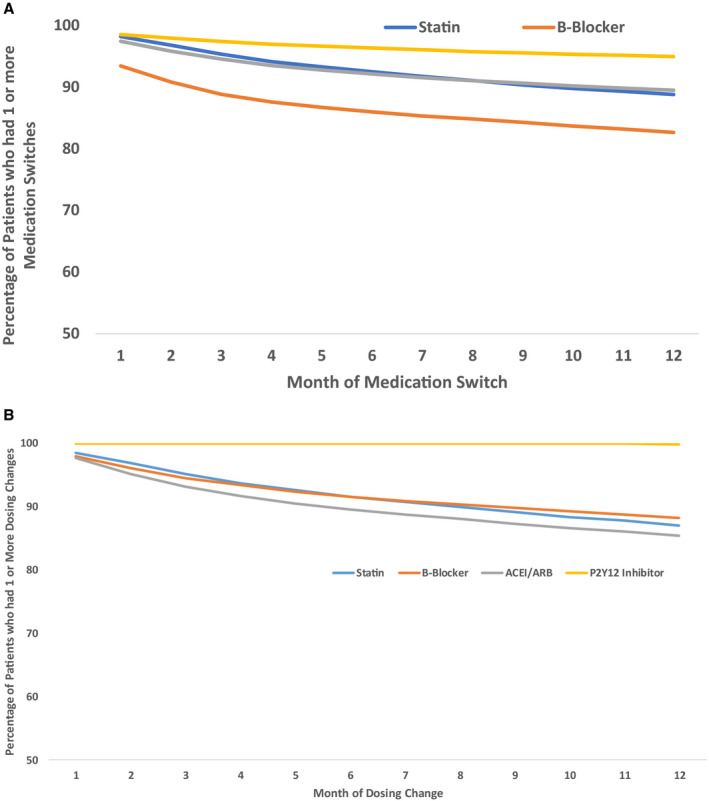
Background Evidence-based medication adherence rates after a myocardial infarction are low. We hypothesized that 90-day prescriptions are underused and may lead to higher evidence-based medication adherence compared with 30-day fills. Methods and Results We examined patients with myocardial infarction treated with percutaneous coronary intervention between 2011 and 2015 in the National Cardiovascular Data Registry. Linking to Symphony Health pharmacy data, we described the prevalence of patients filling 30-day versus 90-day prescriptions of statins, β-blockers, angiotensin-converting enzyme inhibitors/angiotensin receptor blockers, and P2Y inhibitors after discharge. We compared 12-month medication adherence rates by evidence-based medication class and prescription days' supply and rates of medication switches and dosing changes. Among 353 259 patients with myocardial infarction treated with percutaneous coronary intervention, 90-day evidence-based medication fill rates were low: 13.0% (statins), 12.3% (β-blockers), 14.6% (angiotensin-converting enzyme inhibitors/angiotensin receptor blockers), and 9.7% (P2Y inhibitors). Patients filling 90-day prescriptions were more likely older (median 69 versus 62 years) with a history of prior myocardial infarction (25.0% versus 17.9%) or percutaneous coronary intervention (30.3% versus 19.5%; <0.01 for all) than patients filling 30-day prescriptions. The 12-month adherence rates were higher for patients who filled 90-day versus 30-day supplies: statins, 83.1% versus 75.3%; β-blockers, 72.7% versus 62.9%; angiotensin-converting enzyme inhibitors/angiotensin receptor blockers, 71.1% versus 60.9%; and P2Y inhibitors, 78.5% versus 66.6% (<0.01 for all). Medication switches and dosing changes within 12 months were infrequent for patients filling 30-day prescriptions-14.7% and 0.3% for 30-day P2Y inhibitor fills versus 6.3% and 0.2% for 90-day fills, respectively. Conclusions Patients who filled 90-day prescriptions had higher adherence and infrequent medication changes within 1 year after discharge. Ninety-day prescription strategies should be encouraged to improve post-myocardial infarction medication adherence.
经皮冠状动脉介入治疗后的心肌梗死后,基于证据的药物依从率较低。我们假设,与 30 天剂量相比,90 天的处方使用不足,可能会导致更高的基于证据的药物依从率。
我们研究了 2011 年至 2015 年间在国家心血管数据注册中心接受经皮冠状动脉介入治疗的心肌梗死患者。通过与 Symphony Health 药房数据的链接,我们描述了出院后患者 30 天与 90 天剂量的他汀类药物、β受体阻滞剂、血管紧张素转换酶抑制剂/血管紧张素受体阻滞剂和 P2Y 抑制剂的使用情况。我们比较了 12 个月内按证据药物类别和处方天数供应以及药物转换和剂量变化的药物依从率。在 353259 例接受经皮冠状动脉介入治疗的心肌梗死患者中,90 天的证据类药物使用率较低:他汀类药物为 13.0%(13.0%),β受体阻滞剂为 12.3%(12.3%),血管紧张素转换酶抑制剂/血管紧张素受体阻滞剂为 14.6%(14.6%),P2Y 抑制剂为 9.7%(9.7%)。与 30 天剂量相比,使用 90 天剂量的患者年龄更大(中位数为 69 岁 vs 62 岁),既往有心肌梗死(25.0% vs 17.9%)或经皮冠状动脉介入治疗史(30.3% vs 19.5%;所有 P<0.01)。与 30 天剂量相比,使用 90 天剂量的患者在 12 个月内的依从率更高:他汀类药物为 83.1% vs 75.3%;β受体阻滞剂为 72.7% vs 62.9%;血管紧张素转换酶抑制剂/血管紧张素受体阻滞剂为 71.1% vs 60.9%;P2Y 抑制剂为 78.5% vs 66.6%(所有 P<0.01)。在 12 个月内,使用 30 天剂量的患者发生药物转换和剂量变化的情况很少:30 天 P2Y 抑制剂剂量为 14.7%和 0.3%,90 天剂量为 6.3%和 0.2%。
使用 90 天剂量的患者出院后 1 年内依从性更高,药物变化频率更低。应鼓励采用 90 天处方策略,以提高心肌梗死后的药物依从性。