College of Plant Science and Technology, Huazhong Agricultural University, Wuhan, China.
PLoS One. 2013 May 3;8(5):e62700. doi: 10.1371/journal.pone.0062700. Print 2013.
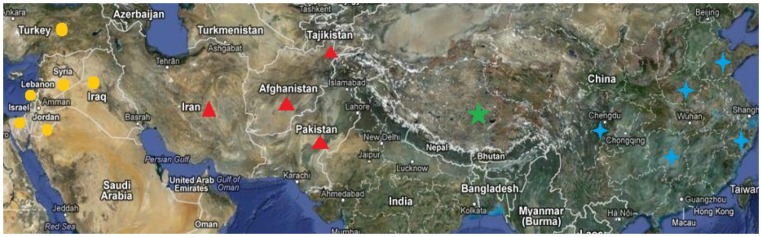
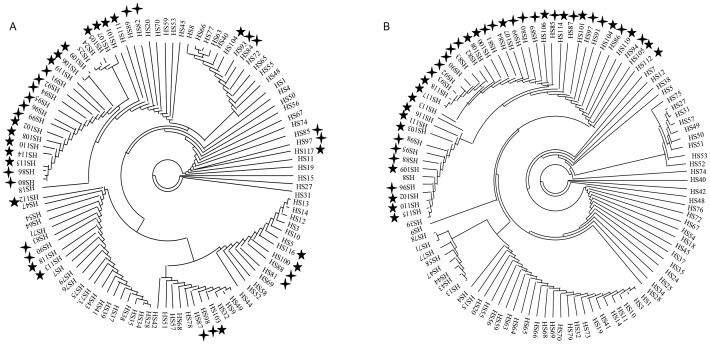
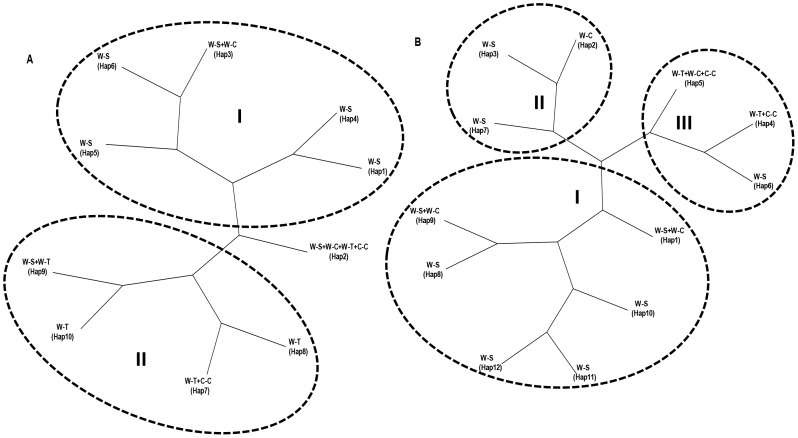
The importance of wild barley from Qinghai-Tibet Plateau in the origin and domestication of cultivated barley has long been underestimated. Population-based phylogenetic analyses were performed to study the origin and genetic diversity of Chinese domesticated barley, and address the possibility that the Tibetan region in China was an independent center of barley domestication. Wild barley (Hordeum vulgare ssp. spontaneum) populations from Southwest Asia, Central Asia, and Tibet along with domesticated barley from China were analyzed using two nuclear genes. Our results showed that Tibetan wild barley distinctly diverged from Southwest Asian (Near East) wild barley, that Central Asian wild barley is related to Southwest Asian wild barley, and that Chinese domesticated barley shares the same haplotypes with Tibetan wild barley. Phylogenetic analysis showed a close relationship between Chinese domesticated barley and the Tibetan wild barley, suggesting that Tibetan wild barley was the ancestor of Chinese domesticated barley. Our results favor the polyphyletic origin for cultivated barley.
青藏高原野生大麦在栽培大麦的起源和驯化中的重要性长期以来被低估了。本研究基于群体的系统发生分析,旨在研究中国栽培大麦的起源和遗传多样性,并探讨中国西藏地区是否是独立的大麦驯化中心。本研究使用两个核基因分析了来自西南亚、中亚和西藏的野生大麦(Hordeum vulgare ssp. spontaneum)种群以及中国的栽培大麦。结果表明,西藏野生大麦与西南亚(近东)野生大麦明显不同,中亚野生大麦与西南亚野生大麦有关,而中国栽培大麦与西藏野生大麦具有相同的单倍型。系统发生分析显示,中国栽培大麦与西藏野生大麦关系密切,提示西藏野生大麦是中国栽培大麦的祖先。我们的结果支持栽培大麦的多起源假说。