University of Massachusetts Medical School, 303 Belmont St., Worcester, MA 01604, USA.
Harv Rev Psychiatry. 2013 May-Jun;21(3):151-62. doi: 10.1097/HRP.0b013e318293749e.
Attention-deficit/hyperactivity disorder (ADHD) is a psychiatric disorder affecting 5% of children. Methylphenidate (MPH) is a common medication for ADHD. Studies examining MPH's effect on pediatric ADHD patients' brain function using functional magnetic resonance imaging (fMRI) have not been compiled. The goals of this systematic review were to determine (1) which areas of the brain in pediatric ADHD patients are modulated by a single dose of MPH, (2) whether areas modulated by MPH differ by task type performed during fMRI data acquisition, and (3) whether changes in brain activation due to MPH relate to clinical improvements in ADHD-related symptoms.
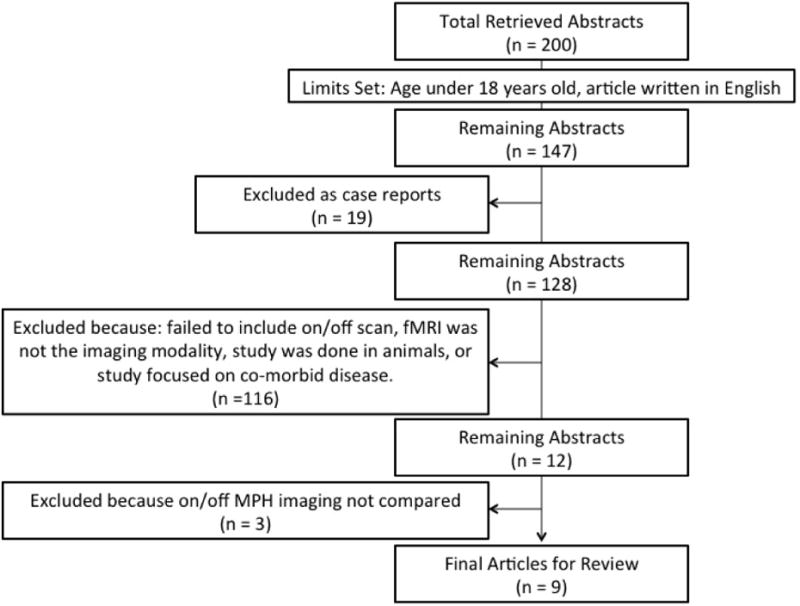
We searched the electronic databases PubMed and PsycINFO (1967-2011) using the following terms: ADHD AND (methylphenidate OR MPH OR ritalin) AND (neuroimaging OR MRI OR fMRI OR BOLD OR event related), and identified 200 abstracts, 9 of which were reviewed based on predefined criteria.
In ADHD patients the middle and inferior frontal gyri, basal ganglia, and cerebellum were most often affected by MPH. The middle and inferior frontal gyri were frequently affected by MPH during inhibitory control tasks. Correlation between brain regions and clinical improvement was not possible due to the lack of symptom improvement measures within the included studies.
Throughout nine task-based fMRI studies investigating MPH's effect on the brains of pediatric patients with ADHD, MPH resulted in increased activation within frontal lobes, basal ganglia, and cerebellum. In most cases, this increase "normalized" activation of at least some brain areas to that seen in typically developing children.
注意缺陷多动障碍(ADHD)是一种影响 5%儿童的精神疾病。哌醋甲酯(MPH)是治疗 ADHD 的常用药物。使用功能磁共振成像(fMRI)研究哌醋甲酯对儿科 ADHD 患者脑功能的影响的研究尚未被汇编。本系统评价的目的是确定(1)儿科 ADHD 患者的哪些脑区被单剂量 MPH 调节,(2)在 fMRI 数据采集期间执行的任务类型是否调节 MPH 调节的脑区,以及(3)由于 MPH 引起的脑激活变化与 ADHD 相关症状的临床改善是否相关。
我们使用以下术语在电子数据库 PubMed 和 PsycINFO(1967-2011)中进行搜索:ADHD 和(哌醋甲酯或 MPH 或利他林)和(神经影像学或 MRI 或 fMRI 或 BOLD 或事件相关),并确定了 200 篇摘要,其中 9 篇根据预定义的标准进行了回顾。
在 ADHD 患者中,中脑和下额回、基底神经节和小脑最常受 MPH 影响。在 ADHD 患者中,中脑和下额回在抑制控制任务中最常受 MPH 影响。由于纳入研究中缺乏症状改善措施,因此无法进行脑区与临床改善之间的相关性。
在九项基于任务的 fMRI 研究中,研究了 MPH 对儿科 ADHD 患者大脑的影响,MPH 导致额叶、基底神经节和小脑的激活增加。在大多数情况下,这种增加使至少一些脑区的激活“正常化”到正常发育儿童的水平。