Osaki Luciana H, Gama Patrícia
Department of Cell and Developmental Biology, Institute of Biomedical Sciences, University of São Paulo, SP 05508-000, Brazil.
Int J Mol Sci. 2013 May 13;14(5):10143-61. doi: 10.3390/ijms140510143.
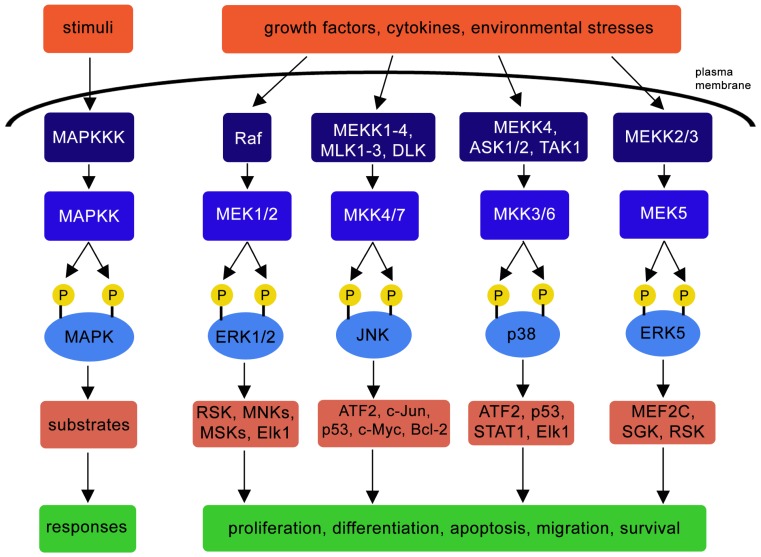
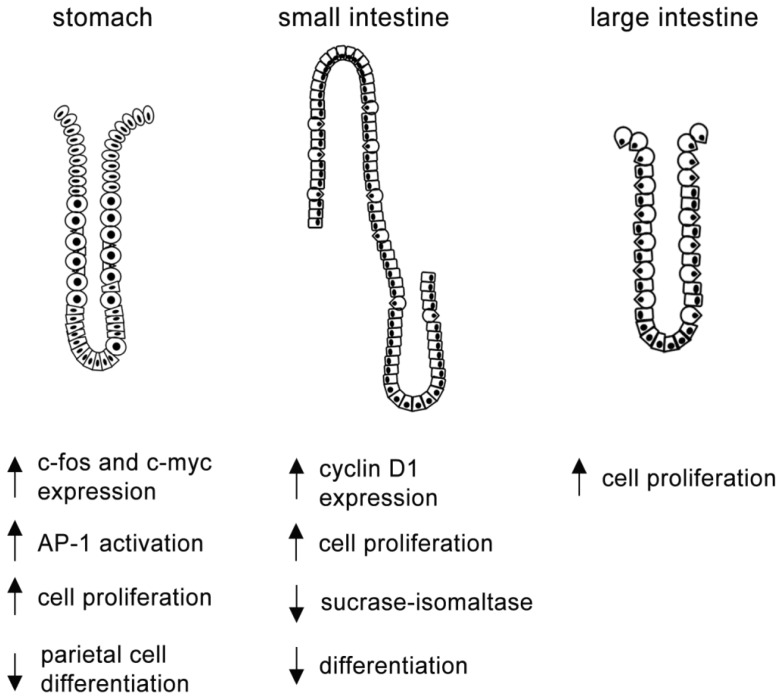
Mitogen-activated protein kinase (MAPK) pathways are activated by several stimuli and transduce the signal inside cells, generating diverse responses including cell proliferation, differentiation, migration and apoptosis. Each MAPK cascade comprises a series of molecules, and regulation takes place at different levels. They communicate with each other and with additional pathways, creating a signaling network that is important for cell fate determination. In this review, we focus on ERK, JNK, p38 and ERK5, the major MAPKs, and their interactions with PI3K-Akt, TGFβ/Smad and Wnt/β-catenin pathways. More importantly, we describe how MAPKs regulate cell proliferation and differentiation in the rapidly renewing epithelia that lines the gastrointestinal tract and, finally, we highlight the recent findings on nutritional aspects that affect MAPK transduction cascades.
丝裂原活化蛋白激酶(MAPK)信号通路可被多种刺激激活,并在细胞内传导信号,产生包括细胞增殖、分化、迁移和凋亡在内的多种反应。每条MAPK级联反应都由一系列分子组成,且在不同水平进行调控。它们相互之间以及与其他信号通路进行通讯,形成一个对细胞命运决定至关重要的信号网络。在本综述中,我们聚焦于主要的MAPK,即细胞外信号调节激酶(ERK)、c-Jun氨基末端激酶(JNK)、p38丝裂原活化蛋白激酶(p38)和ERK5,以及它们与磷脂酰肌醇-3激酶-蛋白激酶B(PI3K-Akt)、转化生长因子β/信号转导分子和转录激活因子(TGFβ/Smad)及Wnt/β-连环蛋白信号通路的相互作用。更重要的是,我们描述了MAPK如何调节胃肠道快速更新上皮中的细胞增殖和分化,最后,我们重点介绍了影响MAPK转导级联反应的营养方面的最新研究发现。