University of Memphis, Department of Biological Sciences, Memphis, Tennessee, United States of America.
PLoS One. 2013 May 6;8(5):e61260. doi: 10.1371/journal.pone.0061260. Print 2013.
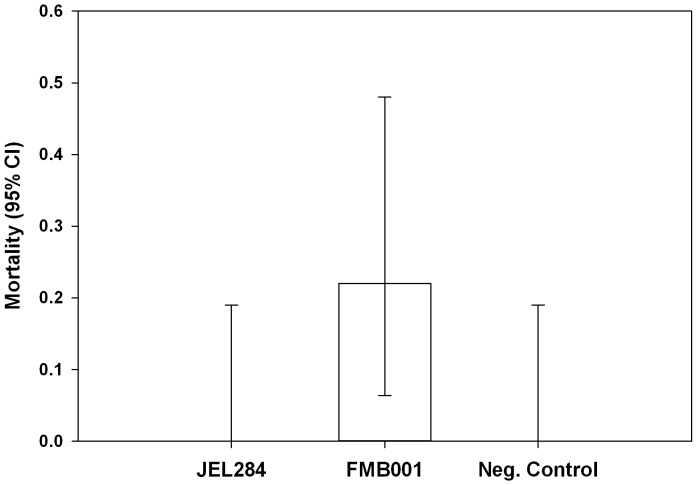
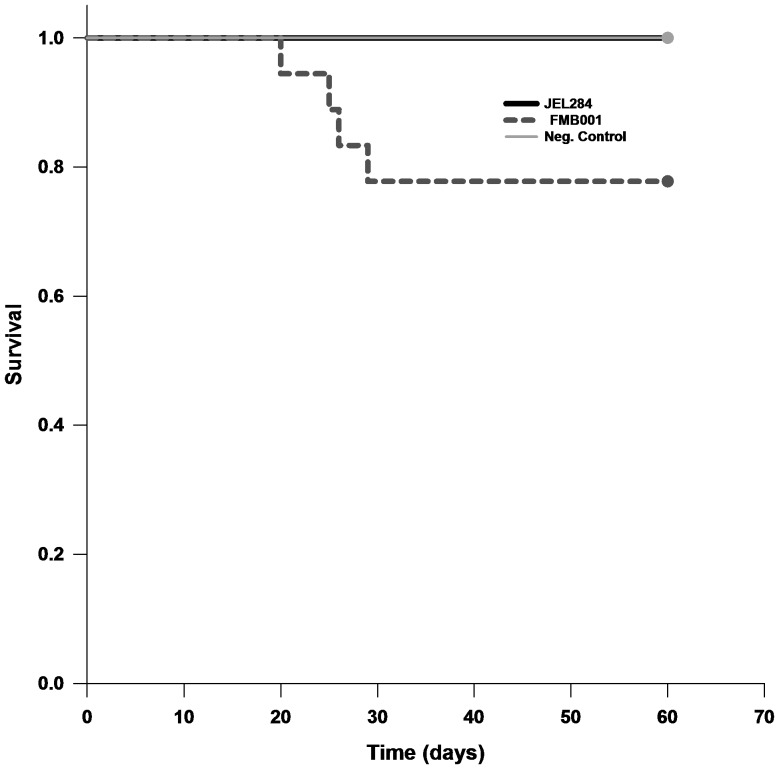
Controlled exposure experiments can be very informative, however, they are based on the assumption that pathogens maintained on artificial media under long-term storage retain the infective and pathogenic properties of the reproducing pathogen as it occurs in a host. We observed that JEL284, an in vitro cultured and maintained isolate of Batrachochytrium dendrobatidis (Bd), was becoming less infectious with successive uses. We hypothesized that passing an isolate propagated on artificial media through an amphibian host would make the isolate more infectious and pathogenic in subsequent exposures. To test our hypothesis, we used two discreet steps, a reisolation step (step 1) and a comparative exposure step (step 2). In step 1, we exposed eastern spadefoot toads, Scaphiopus holbrooki, to JEL284 and JEL197, another isolate that had been maintained in vitro for over six years. We then re-isolated JEL284 only from a successful infection and named this new isolate JEL284(FMBa). JEL197 did not infect any amphibians and, thus, did not proceed to step 2. In step 2, we compared infectivity and pathogenicity (mortality and survival time) of JEL284 and JEL284(FMBa) by exposing 54 naïve S. holbrooki to three treatments (JEL284, JEL284(FMBa), and negative control) with 18 individuals per group. We found that JEL284(FMBa) caused higher mortality and decreased survival time in infected individuals when compared to JEL284 and negative controls. Thus, our data show that pathogenicity of Bd can decrease when cultured successively in media only and can be partially restored by passage through an amphibian host. Therefore, we have demonstrated that pathogenicity shifts can occur rapidly in this pathogen. Given the potential for shifts in pathogenicity demonstrated here, we suspect Bd to have similar potential in natural populations. We suggest that, when possible, the use of freshly isolated or cryopreserved Bd would improve the quality of controlled exposure experiments using this pathogen.
受控暴露实验可以提供非常有价值的信息,然而,这些实验基于这样的假设,即在长期储存的人工培养基上维持的病原体保留了宿主中出现的再生病原体的感染性和致病性。我们观察到,JEL284 是一种在体外培养和维持的蛙壶菌(Batrachochytrium dendrobatidis,Bd)分离株,随着连续使用,其传染性逐渐降低。我们假设,将在人工培养基上繁殖的分离株通过两栖动物宿主传递,会使分离株在随后的暴露中更具传染性和致病性。为了验证我们的假设,我们使用了两个离散的步骤,一个是再分离步骤(步骤 1)和一个比较暴露步骤(步骤 2)。在步骤 1 中,我们将东部铲足蟾(Scaphiopus holbrooki)暴露于 JEL284 和 JEL197,后者是一种在体外维持了六年多的分离株。然后,我们仅从成功感染的样本中重新分离出 JEL284,并将其命名为 JEL284(FMBa)。JEL197 没有感染任何两栖动物,因此没有进入步骤 2。在步骤 2 中,我们通过将 54 只天真的 S. holbrooki 暴露于三种处理(JEL284、JEL284(FMBa)和阴性对照)中,每组 18 只个体,比较了 JEL284 和 JEL284(FMBa)的感染性和致病性(死亡率和存活时间)。我们发现,与 JEL284 和阴性对照相比,JEL284(FMBa)引起的感染个体死亡率更高,存活时间更短。因此,我们的数据表明,Bd 在仅在培养基中连续培养时其致病性会降低,并且可以通过在两栖动物宿主中传递部分恢复。因此,我们证明了这种病原体的致病性可以迅速发生变化。鉴于这里显示的致病性变化的潜力,我们怀疑 Bd 在自然种群中也具有类似的潜力。我们建议,在可能的情况下,使用新分离或冷冻保存的 Bd 可以提高使用该病原体进行受控暴露实验的质量。