Van Rooij Pascale, Martel An, Haesebrouck Freddy, Pasmans Frank
Laboratory of Veterinary Bacteriology and Mycology, Department of Pathology, Bacteriology and Avian Diseases, Faculty of Veterinary Medicine, Ghent University, Merelbeke, Belgium.
Vet Res. 2015 Nov 25;46:137. doi: 10.1186/s13567-015-0266-0.
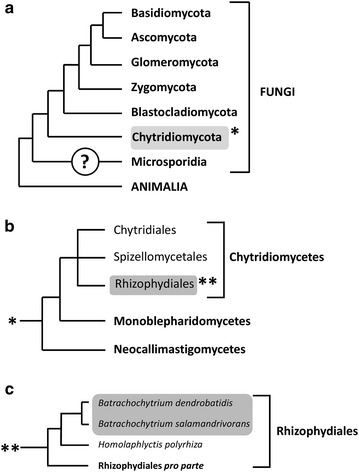
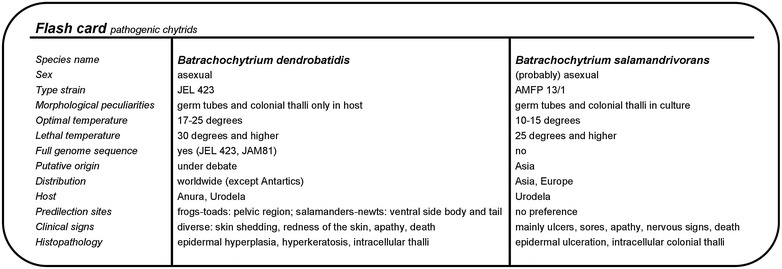
Amphibian declines and extinctions are emblematic for the current sixth mass extinction event. Infectious drivers of these declines include the recently emerged fungal pathogens Batrachochytrium dendrobatidis and Batrachochytrium salamandrivorans (Chytridiomycota). The skin disease caused by these fungi is named chytridiomycosis and affects the vital function of amphibian skin. Not all amphibians respond equally to infection and host responses might range from resistant, over tolerant to susceptible. The clinical outcome of infection is highly dependent on the amphibian host, the fungal virulence and environmental determinants. B. dendrobatidis infects the skin of a large range of anurans, urodeles and caecilians, whereas to date the host range of B. salamandrivorans seems limited to urodeles. So far, the epidemic of B. dendrobatidis is mainly limited to Australian, neotropical, South European and West American amphibians, while for B. salamandrivorans it is limited to European salamanders. Other striking differences between both fungi include gross pathology and thermal preferences. With this review we aim to provide the reader with a state-of-the art of host-pathogen interactions for both fungi, in which new data pertaining to the interaction of B. dendrobatidis and B. salamandrivorans with the host's skin are integrated. Furthermore, we pinpoint areas in which more detailed studies are necessary or which have not received the attention they merit.
两栖动物数量的减少和灭绝是当前第六次物种大灭绝事件的典型代表。导致这些数量减少的传染性因素包括最近出现的真菌病原体——蛙壶菌(Batrachochytrium dendrobatidis)和蝾螈壶菌(Batrachochytrium salamandrivorans,属于壶菌门)。由这些真菌引起的皮肤病被称为壶菌病,会影响两栖动物皮肤的重要功能。并非所有两栖动物对感染的反应都相同,宿主的反应可能从抗性、耐受性到易感性不等。感染的临床结果高度依赖于两栖动物宿主、真菌毒力和环境因素。蛙壶菌感染多种无尾目、有尾目和蚓螈目的皮肤,而迄今为止,蝾螈壶菌的宿主范围似乎仅限于有尾目。到目前为止,蛙壶菌的疫情主要局限于澳大利亚、新热带地区、南欧和美国西部的两栖动物,而蝾螈壶菌的疫情则局限于欧洲蝾螈。这两种真菌之间的其他显著差异包括大体病理学和温度偏好。通过这篇综述,我们旨在为读者提供这两种真菌宿主 - 病原体相互作用的最新情况,其中整合了与蛙壶菌和蝾螈壶菌与宿主皮肤相互作用相关的新数据。此外,我们指出了需要进行更详细研究或尚未得到应有关注的领域。