Voyles Jamie, Johnson Leah R, Briggs Cheryl J, Cashins Scott D, Alford Ross A, Berger Lee, Skerratt Lee F, Speare Rick, Rosenblum Erica Bree
Department of Biology, New Mexico Tech Socorro, New Mexico, 87801.
Department of Integrative Biology, University of South Florida Tampa, Florida, 33620 ; Department of Ecology, Evolution and Marine Biology, University of California Santa Barbara, California, 93106.
Ecol Evol. 2014 Sep;4(18):3633-41. doi: 10.1002/ece3.1199. Epub 2014 Sep 3.
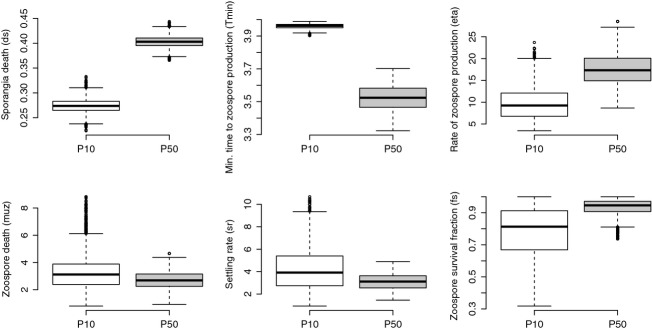
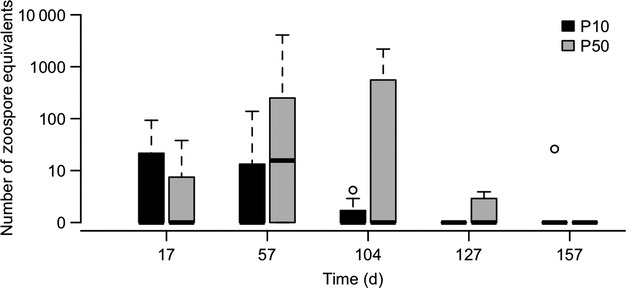
Virulence of infectious pathogens can be unstable and evolve rapidly depending on the evolutionary dynamics of the organism. Experimental evolution can be used to characterize pathogen evolution, often with the underlying objective of understanding evolution of virulence. We used experimental evolution techniques (serial transfer experiments) to investigate differential growth and virulence of Batrachochytrium dendrobatidis (Bd), a fungal pathogen that causes amphibian chytridiomycosis. We tested two lineages of Bd that were derived from a single cryo-archived isolate; one lineage (P10) was passaged 10 times, whereas the second lineage (P50) was passaged 50 times. We quantified time to zoospore release, maximum zoospore densities, and timing of zoospore activity and then modeled population growth rates. We also conducted exposure experiments with a susceptible amphibian species, the common green tree frog (Litoria caerulea) to test the differential pathogenicity. We found that the P50 lineage had shorter time to zoospore production (T min ), faster rate of sporangia death (d s ), and an overall greater intrinsic population growth rate (λ). These patterns of population growth in vitro corresponded with higher prevalence and intensities of infection in exposed Litoria caerulea, although the differences were not significant. Our results corroborate studies that suggest that Bd may be able to evolve relatively rapidly. Our findings also challenge the general assumption that pathogens will always attenuate in culture because shifts in Bd virulence may depend on laboratory culturing practices. These findings have practical implications for the laboratory maintenance of Bd isolates and underscore the importance of understanding the evolution of virulence in amphibian chytridiomycosis.
传染性病原体的毒力可能不稳定,并会根据生物体的进化动态迅速演变。实验进化可用于表征病原体的进化,其潜在目标通常是了解毒力的进化。我们使用实验进化技术(连续传代实验)来研究蛙壶菌(Batrachochytrium dendrobatidis,Bd)的差异生长和毒力,蛙壶菌是一种导致两栖类壶菌病的真菌病原体。我们测试了源自单一冷冻保存菌株的两个Bd谱系;一个谱系(P10)传代10次,而第二个谱系(P50)传代50次。我们对游动孢子释放时间、最大游动孢子密度以及游动孢子活性时间进行了量化,然后对种群增长率进行了建模。我们还对一种易感两栖类物种——绿雨滨蛙(Litoria caerulea)进行了暴露实验,以测试差异致病性。我们发现,P50谱系产生游动孢子的时间更短(T min),孢子囊死亡速度更快(d s),总体内在种群增长率(λ)更高。体外的这些种群增长模式与暴露的绿雨滨蛙中更高的感染率和感染强度相对应,尽管差异不显著。我们的结果证实了一些研究,这些研究表明Bd可能能够相对快速地进化。我们的发现还挑战了病原体在培养中总会减弱的一般假设,因为Bd毒力的变化可能取决于实验室培养方法。这些发现对Bd分离株的实验室保存具有实际意义,并强调了了解两栖类壶菌病中毒力进化的重要性。