Department of Health Policy and Management, University of North Carolina, Chapel Hill, NC, USA.
Med Care. 2013 Jun;51(6):494-502. doi: 10.1097/MLR.0b013e31828d4d0c.
Community Care of North Carolina (CCNC) initiated an innovative medical home program in the 1990 s to improve primary care in Medicaid-insured populations. CCNC has been successful in improving asthma, diabetes, and cardiovascular outcomes but has not been evaluated in the context of cancer care. We explored whether CCNC enrollment was associated with guideline-concordant follow-up care among breast cancer survivors.
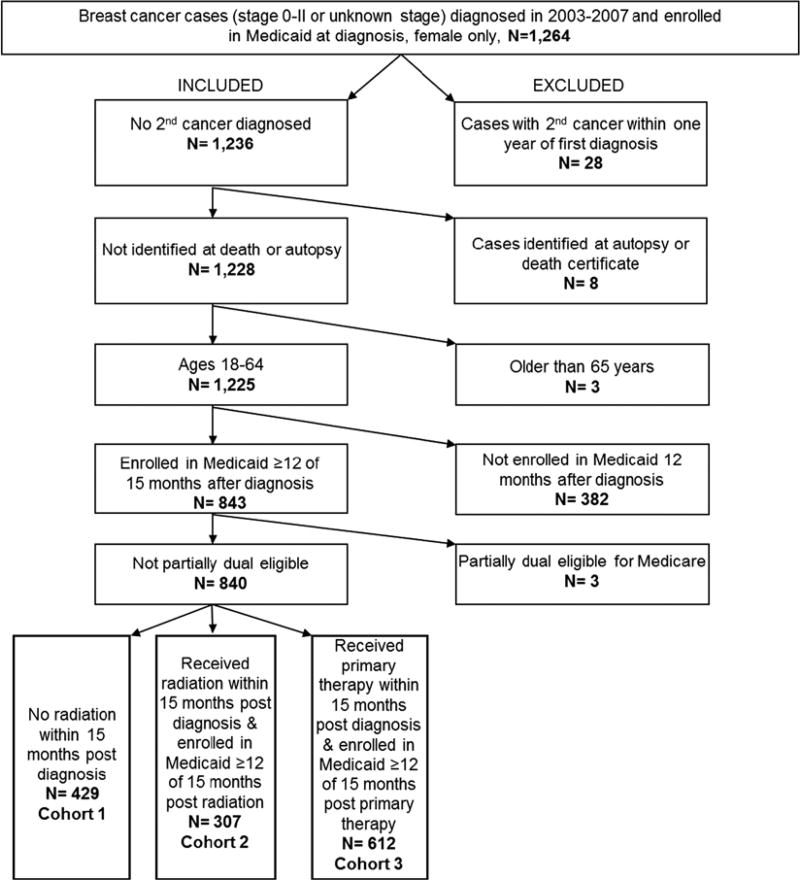
Using state cancer registry records matched to Medicaid claims, we identified women 18 to 64 years old who were diagnosed with stage 0, I, II, or unstaged breast cancer from 2003 to 2007 and tracked their monthly CCNC enrollment. Using published American Society for Clinical Oncology guidelines to define our outcomes, we employed multivariate logistic regressions to examine, as a function of CCNC enrollment, receipt of mammogram and at least 2 physical examinations/history-taking visits within observational windows consistent with the guidelines.
Of the 840 women, approximately half were enrolled into the CCNC for some time during the study period. Between 40% and 85% received follow-up mammogram in accordance with guidelines, with significant variation by CCNC status, and 95% of women received at least 2 physical examinations/history-taking visits. In multivariate models, increasing months of CCNC enrollment was significantly positively associated with receipt of follow-up mammogram but not with physical examinations/history-taking visits.
Results suggest that CCNC enrollment is associated with guideline-concordant follow-up care for Medicaid-insured survivors. Given the growing population of cancer survivors and increased emphasis on primary care medical homes, future studies should explore what factors are associated with medical home participation and whether similar findings are observed with extended follow-up.
北卡罗来纳社区护理(CCNC)在 20 世纪 90 年代发起了一项创新的医疗之家计划,以改善医疗补助保险人群的初级保健。CCNC 在改善哮喘、糖尿病和心血管结果方面取得了成功,但尚未在癌症护理方面进行评估。我们探讨了 CCNC 的注册是否与乳腺癌幸存者的指南一致的后续护理相关。
我们使用州癌症登记记录与医疗补助索赔相匹配,确定了 2003 年至 2007 年间被诊断为 0 期、I 期、II 期或未分期乳腺癌的 18 至 64 岁女性,并跟踪了她们每月的 CCNC 注册情况。我们使用美国临床肿瘤学会发布的指南来定义我们的结果,采用多变量逻辑回归来检查 CCNC 注册的作用,作为功能,在符合指南的观察窗口内,接受乳房 X 光检查和至少 2 次体格检查/病史检查的情况。
在 840 名女性中,大约有一半在研究期间的某个时候被纳入 CCNC。根据 CCNC 状况的不同,有 40%至 85%的人接受了符合指南的后续乳房 X 光检查,而 95%的女性接受了至少 2 次体格检查/病史检查。在多变量模型中,CCNC 注册时间的增加与接受后续乳房 X 光检查显著正相关,但与体格检查/病史检查无关。
结果表明,CCNC 的注册与 Medicaid 保险幸存者的指南一致的后续护理相关。鉴于癌症幸存者人数的增加和对初级保健医疗之家的重视,未来的研究应该探讨是什么因素与医疗之家的参与有关,以及是否在延长随访时观察到类似的发现。