Zhang Xiaobo, Aggarwal Piyush, Li Xiaoming, Oakman Crystale, Wang Zhiping, Rodriguez Ronald
Department of Urology, the First Hospital of LanZhou University, LanZhou, China.
Int J Biomed Sci. 2009 Sep;5(3):215-22.
Urinary Citrate is an inhibitor of Calcium oxalate stone formation. It is reabsorbed in the proximal kidney through sodium dicarboxylate co-transporters (NaDC-1, NaDC-3) present in the renal tubular epithelium. Lithium (Li) is a known potent inhibitor of these transporters. We investigated the effect of lithium carbonate (LiC) and lithium citrate (LiCit) in regulating urinary citrate levels and preventing nephrolithiasis (NL) in the rat model.
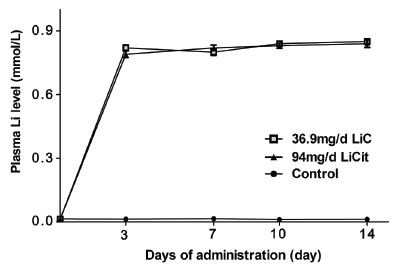
We took 220 Wistar rats and induced nephrolithiasis in 130 of them by administering high doses of 5% ammonium oxalate (AmOx) for seven days and labeled them as Group B. Rest were labeled as Group A. Each group was then divided into 3 subgroups. First sub-group acted as control while other two were treated with either lithium carbonate (LiC) or lithium citrate (LiCit) for 21 days. Ten rats from each of the six sub-groups were randomly selected for sacrifice on 3(rd), 7(th) and 14(th) day and additional 10(th) and 21(st) day from Li treated groups. Blood and urine samples were collected and analyzed on these days. The kidneys of the sacrificed rats were dissected and studied under light microscopy for crystal deposition (left kidney) and histological changes (right kidney).
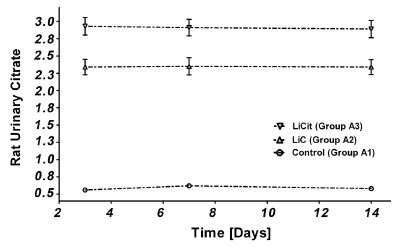
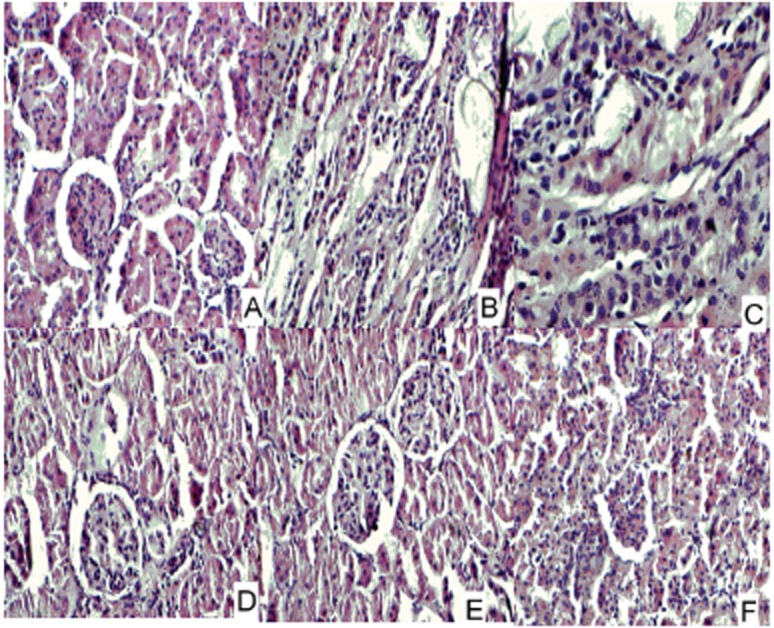
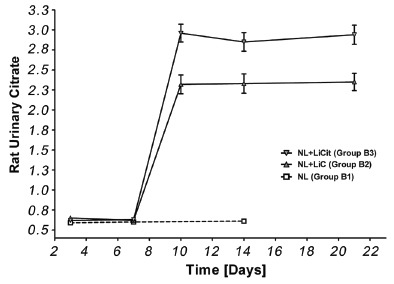
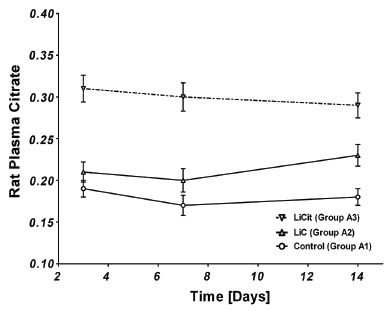
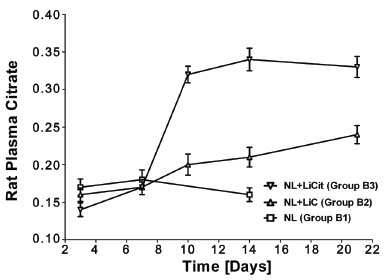
Urinary citrate levels were significantly increased in response to either LiC (p<0.001) or LiCit (p<0.001). Increased urinary citrate levels resulted in the reduction of calcium oxalate (CaOx) crystal deposition, kidney tubular dilatation and infiltration of inflammatory cell in the tubulo-interstitium.
Use of lithium salts might be a potentially useful approach in the prevention of recurrent NL.
尿柠檬酸是草酸钙结石形成的抑制剂。它通过存在于肾小管上皮的二羧酸钠共转运蛋白(NaDC - 1、NaDC - 3)在近端肾被重吸收。锂(Li)是这些转运蛋白已知的强效抑制剂。我们在大鼠模型中研究了碳酸锂(LiC)和柠檬酸锂(LiCit)在调节尿柠檬酸水平及预防肾结石(NL)方面的作用。
我们选取220只Wistar大鼠,其中130只通过给予高剂量5%草酸铵(AmOx)持续7天诱导形成肾结石,并将它们标记为B组。其余的标记为A组。然后每组再分为3个亚组。第一个亚组作为对照,其他两个亚组分别用碳酸锂(LiC)或柠檬酸锂(LiCit)处理21天。从六个亚组中每组随机选取10只大鼠,在第3、7和14天以及锂处理组的第10和21天进行处死。在这些日子采集血液和尿液样本并进行分析。对处死大鼠的肾脏进行解剖,在光学显微镜下研究晶体沉积(左肾)和组织学变化(右肾)。
无论是LiC(p<0.001)还是LiCit(p<0.001)处理后,尿柠檬酸水平均显著升高。尿柠檬酸水平升高导致草酸钙(CaOx)晶体沉积减少、肾小管扩张以及肾小管间质炎症细胞浸润减少。
锂盐的使用可能是预防复发性NL的一种潜在有用方法。