Köhn Carolin, Dubrovska Galyna, Huang Yu, Gollasch Maik
Medical Clinic for Nephrology and Internal Intensive Care, Charité Campus Virchow Klinikum and Experimental and Clinical Research Center (ECRC), Max-Delbrück Center for Molecular Medicine, Berlin, Germany;
Int J Biomed Sci. 2012 Jun;8(2):81-6.
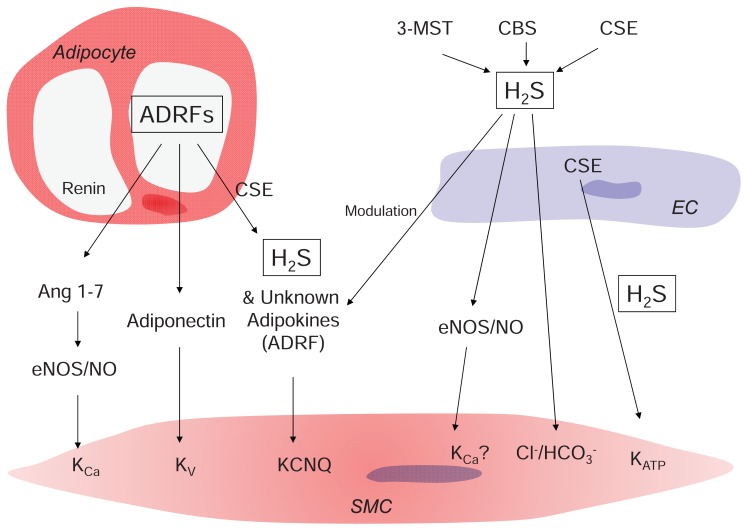
Hydrogen sulfide is the "third" gasotransmitter on the rise in cardiovascular research. Recent studies show that hydrogen sulfide has a great potential in the regulation of vascular tone of systemic arteries and many molecular targets are discussed. However, the complex mechanism of vascular tone regulation by hydrogen sulfide is only incompletely understood. It seems that a potent interaction of hydrogen sulfide with vascular endothelial growth factor (VEGF) becomes important in angiogenesis, in the process of wound healing, but also in tumor angiogenesis. Hydrogen sulfide exerts anti-inflammatory effects and it could be a pharmacological target in vascular dysfunction in association with obesity-related hypertension as well as in tumor development and progression. However, the underlying molecular pathways still need to be revealed. This review primarily focuses on the regulatory role of hydrogen sulfide in controlling vascular tone. We attempt to provide recent insights into mechanisms by which CSE-dependent hydrogen sulfide plays a role in the regulation of vascular tone by perivascular adipose tissue. The role of KCNQ channels and other ionic permeation pathways as key targets will be discussed. Recent findings which are summarized in this paper provide new insights into molecular mechanisms of hydrogen sulfide that are crucial for understanding vascular dysfunction in cardiovascular disease and possibly angiogenesis. Future research will be extended to investigate the therapeutic potential of hydrogen sulfide and their targets such as KCNQ channels in cardiovascular diseases, angiogenesis and tumor genesis.
硫化氢是心血管研究领域中正在兴起的“第三种”气体信号分子。近期研究表明,硫化氢在调节全身动脉血管张力方面具有巨大潜力,并且人们讨论了许多分子靶点。然而,硫化氢调节血管张力的复杂机制目前仅得到部分理解。在血管生成、伤口愈合过程以及肿瘤血管生成中,硫化氢与血管内皮生长因子(VEGF)之间的有效相互作用似乎起着重要作用。硫化氢具有抗炎作用,它可能成为与肥胖相关高血压所致血管功能障碍以及肿瘤发生和发展相关的药理学靶点。然而,其潜在的分子途径仍有待揭示。本综述主要聚焦于硫化氢在控制血管张力方面的调节作用。我们试图提供近期关于胱硫醚-γ-裂解酶(CSE)依赖性硫化氢通过血管周围脂肪组织调节血管张力机制的见解。将讨论钾通道(KCNQ)和其他离子渗透途径作为关键靶点的作用。本文总结的近期研究结果为硫化氢的分子机制提供了新见解,这些机制对于理解心血管疾病中的血管功能障碍以及可能的血管生成至关重要。未来的研究将扩展到探究硫化氢及其靶点(如钾通道(KCNQ))在心血管疾病、血管生成和肿瘤发生中的治疗潜力。