Institute of Medical Microbiology and Hospital Hygiene, Heinrich-Heine-University Düsseldorf, Düsseldorf, Germany.
PLoS One. 2013 May 13;8(5):e63301. doi: 10.1371/journal.pone.0063301. Print 2013.
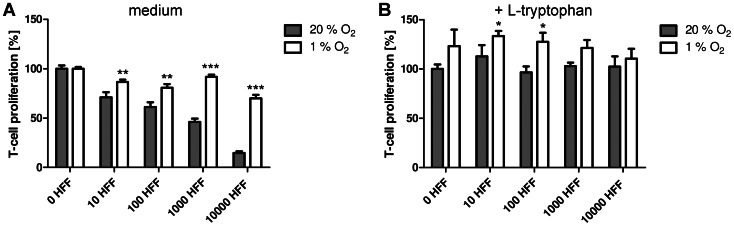
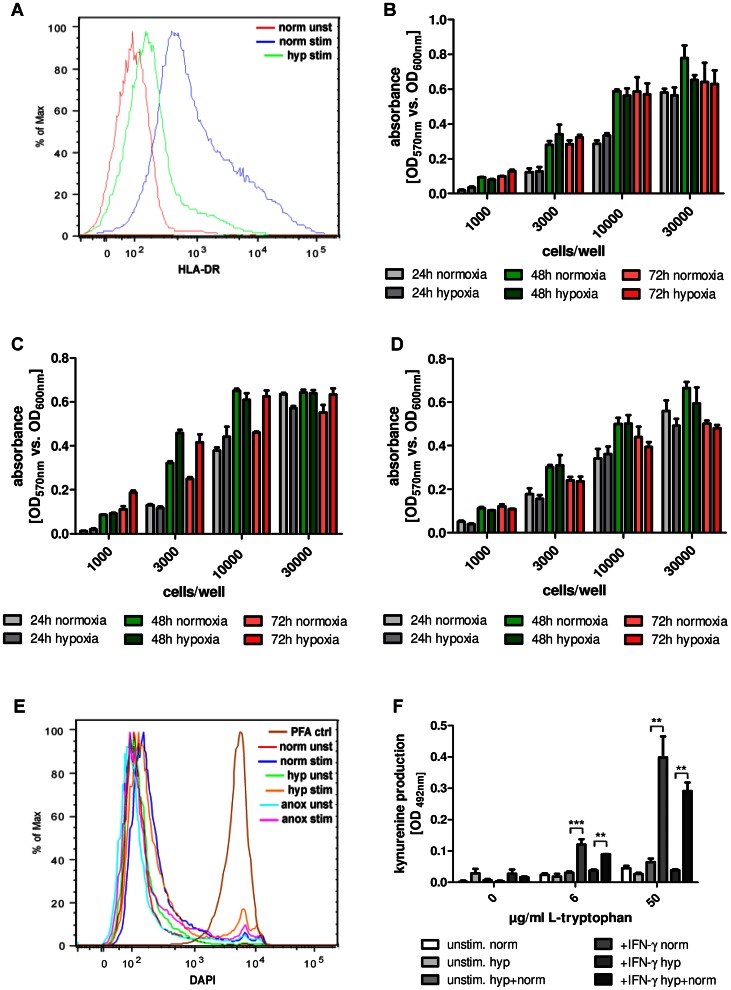
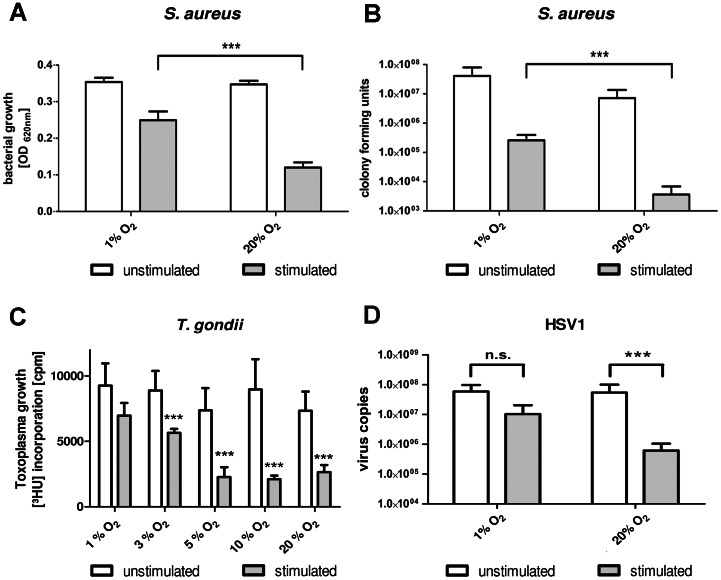
Tryptophan is an essential amino acid for human beings as well as for some microorganisms. In human cells the interferon-γ (IFN-γ) inducible enzyme indoleamine 2,3-dioxygenase (IDO) reduces local tryptophan levels and is therefore able to mediate broad-spectrum effector functions: IDO activity restricts the growth of various clinically relevant pathogens such as bacteria, parasites and viruses. On the other hand, it has been observed that IDO has immunoregulatory functions as it efficiently controls the activation and survival of T-cells. Although these important effects have been analysed in much detail, they have been observed in vitro using cells cultured in the presence of 20% O₂ (normoxia). Such high oxygen concentrations are not present in vivo especially within infected and inflamed tissues. We therefore analysed IDO-mediated effects under lower oxygen concentrations in vitro and observed that the function of IDO is substantially impaired in tumour cells as well as in native cells. Hypoxia led to reduced IDO expression and as a result to reduced production of kynurenine, the downstream product of tryptophan degradation. Consequently, effector functions of IDO were abrogated under hypoxic conditions: in different human cell lines such as tumour cells (glioblastoma, HeLa) but also in native cells (human foreskin fibroblasts; HFF) IDO lost the capacity to inhibit the growth of bacteria (Staphylococcus aureus), parasites (Toxoplasma gondii) or viruses (herpes simplex virus type 1). Additionally, IDO could no longer efficiently control the proliferation of T-cells that have been co-cultured with IDO expressing HFF cells in vitro. In conclusion, the potent antimicrobial as well as immunoregulatory functions of IDO were substantially impaired under hypoxic conditions that pathophysiologically occurs in vivo.
色氨酸是人类和一些微生物必需的氨基酸。在人类细胞中,干扰素-γ(IFN-γ)诱导的酶吲哚胺 2,3-双加氧酶(IDO)降低局部色氨酸水平,因此能够介导广谱效应功能:IDO 活性限制了各种临床相关病原体的生长,如细菌、寄生虫和病毒。另一方面,已经观察到 IDO 具有免疫调节功能,因为它能够有效地控制 T 细胞的激活和存活。尽管这些重要的作用已经被详细分析过,但它们是在体外使用在 20%氧气(常氧)存在下培养的细胞观察到的。这种高氧浓度在体内并不存在,特别是在感染和炎症组织中。因此,我们在体外分析了 IDO 介导的低氧浓度下的效应,观察到 IDO 的功能在肿瘤细胞以及天然细胞中都受到严重损害。缺氧导致 IDO 表达减少,从而导致色氨酸降解的下游产物犬尿氨酸的产生减少。因此,IDO 的效应功能在缺氧条件下被废除:在不同的人类细胞系中,如肿瘤细胞(胶质母细胞瘤、HeLa),以及天然细胞(人包皮成纤维细胞;HFF)中,IDO 失去了抑制细菌(金黄色葡萄球菌)、寄生虫(刚地弓形虫)或病毒(单纯疱疹病毒 1 型)生长的能力。此外,IDO 也不能再有效地控制与表达 IDO 的 HFF 细胞共培养的 T 细胞的增殖。总之,IDO 的强大的抗微生物和免疫调节功能在体内病理发生的缺氧条件下受到严重损害。