Dorothy M. Davis Heart & Lung Research Institute and the Division of Cardiovascular Medicine, The Ohio State University, Columbus, OH 43210, USA.
J Am Heart Assoc. 2013 May 17;2(3):e004879. doi: 10.1161/JAHA.112.004879.
The renin-angiotensin system is well recognized as a mediator of pathophysiological events in atherosclerosis. The benefits of renin inhibition in atherosclerosis, especially when used in combination with angiotensin-converting enzyme inhibitors/angiotensin receptor blockers (ACEIs/ARBs) are currently not known. We hypothesized that treatment with the renin inhibitor aliskiren in patients with established cardiovascular disease will prevent the progression of atherosclerosis as determined by high-resolution magnetic resonance imaging (MRI) measurements of arterial wall volume in the thoracic and abdominal aortas of high-risk patients with preexisting cardiovascular disease.
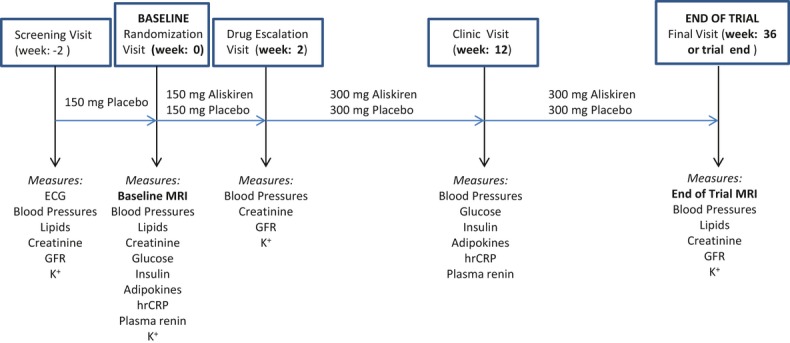
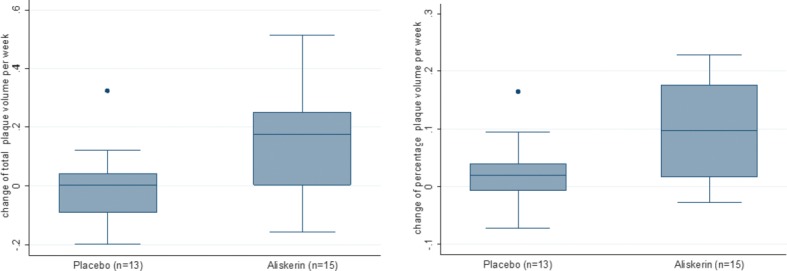
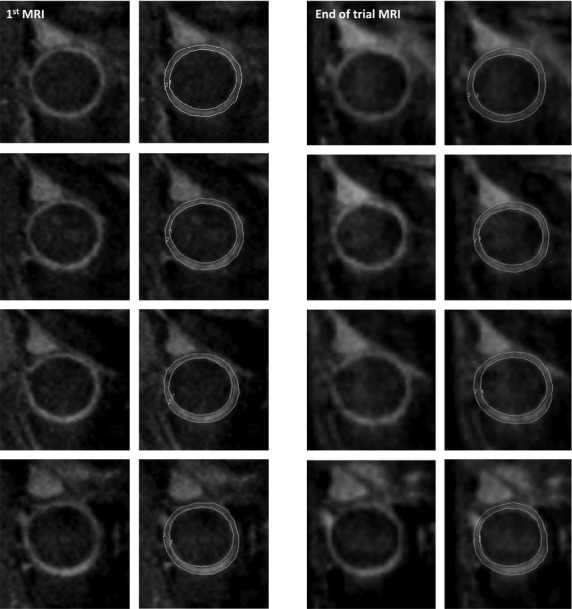
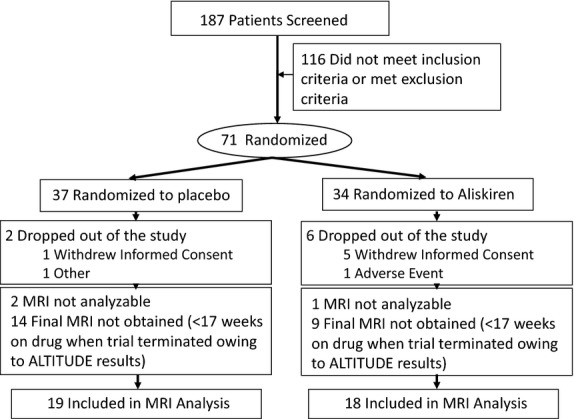
This was a single-center, randomized, double-blind, placebo-controlled trial in patients with established cardiovascular disease. After a 2-week single-blind placebo phase, patients were randomized to receive either placebo (n=37, mean ± SD age 64.5 ± 8.9 years, 3 women) or 150 mg of aliskiren (n=34, mean ± SD age 63.9 ± 11.5 years, 9 women). Treatment dose was escalated to 300 mg at 2 weeks and maintained during the remainder of the study. Patients underwent dark-blood, 3-dimensional MRI assessment of atherosclerotic plaque in the thoracic and abdominal segments at baseline and on study completion or termination (up to 36 weeks of drug or matching placebo). Aliskiren use resulted in significant progression of aortic wall volume (normalized total wall volume 5.31 ± 6.57 vs 0.15 ± 4.39 mm(3), P=0.03, and percentage wall volume 3.37 ± 2.96% vs 0.97 ± 2.02%, P=0.04) compared with placebo. In a subgroup analysis of subjects receiving ACEI/ARB therapy, atherosclerosis progression was observed only in the aliskiren group, not in the placebo group.
MRI quantification of atheroma plaque burden demonstrated that aliskiren use in patients with preexisting cardiovascular disease resulted in an unexpected increase in aortic atherosclerosis compared with placebo. Although preliminary, these results may have implications for the use of renin inhibition as a therapeutic strategy in patients with cardiovascular disease, especially in those receiving ACEI/ARB therapy.
URL: http://ClinicalTrials.gov Unique identifier: NCT01417104.
肾素-血管紧张素系统是动脉粥样硬化病理生理事件的重要介质。目前尚不清楚血管紧张素原抑制剂在动脉粥样硬化中的益处,尤其是与血管紧张素转换酶抑制剂/血管紧张素受体阻滞剂(ACEIs/ARBs)联合使用时的益处。我们假设,在患有已确诊心血管疾病的高危患者中,使用肾素抑制剂阿利克仑治疗可通过高分辨率磁共振成像(MRI)测量胸主动脉和腹主动脉的动脉壁体积来预防动脉粥样硬化进展。
这是一项在患有已确诊心血管疾病的患者中进行的单中心、随机、双盲、安慰剂对照试验。在为期 2 周的单盲安慰剂阶段后,患者随机接受安慰剂(n=37,平均年龄 64.5±8.9 岁,3 名女性)或 150 mg 阿利克仑(n=34,平均年龄 63.9±11.5 岁,9 名女性)。治疗剂量在第 2 周增加至 300 mg,并在研究期间维持不变。患者在基线和研究完成或终止时(最长 36 周的药物或匹配安慰剂)接受黑血、3 维 MRI 评估胸主动脉和腹主动脉的粥样斑块。与安慰剂相比,阿利克仑治疗导致主动脉壁体积明显增加(归一化总壁体积 5.31±6.57 vs 0.15±4.39 mm3,P=0.03,壁体积百分比 3.37±2.96% vs 0.97±2.02%,P=0.04)。在接受 ACEI/ARB 治疗的亚组分析中,仅在阿利克仑组观察到动脉粥样硬化进展,而在安慰剂组未观察到。
磁共振成像定量斑块负荷显示,与安慰剂相比,患有已确诊心血管疾病的患者使用阿利克仑治疗可导致主动脉粥样硬化的意外增加。尽管初步结果,但这些结果可能对心血管疾病患者使用肾素抑制作为治疗策略产生影响,尤其是在接受 ACEI/ARB 治疗的患者中。
网址:http://ClinicalTrials.gov 独特标识符:NCT01417104。