Division of General Medicine and Primary Care, Brigham and Women's-Faulkner Hospitalist Program, Boston, Massachusetts, USA.
PLoS One. 2013 May 14;8(5):e63254. doi: 10.1371/journal.pone.0063254. Print 2013.
We examined associations between neighborhood socioeconomic disadvantage, perceived neighborhood safety and cardiometabolic risk factors, adjusting for health behaviors and socioeconomic status (SES) among African Americans.
Study participants were non-diabetic African Americans (n = 3,909) in the baseline examination (2000-2004) of the Jackson Heart Study. We measured eight risk factors: the metabolic syndrome, its five components, insulin resistance and cardiovascular inflammation. We assessed neighborhood socioeconomic disadvantage with US Census 2000 data. We assessed perceived neighborhood safety, health behaviors and SES via survey. We used generalized estimating equations to estimate associations with a random intercept model for neighborhood effects.
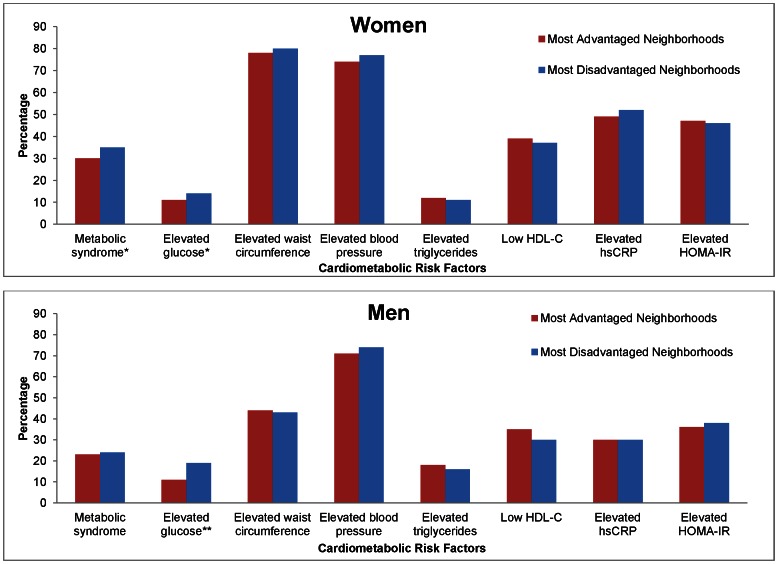
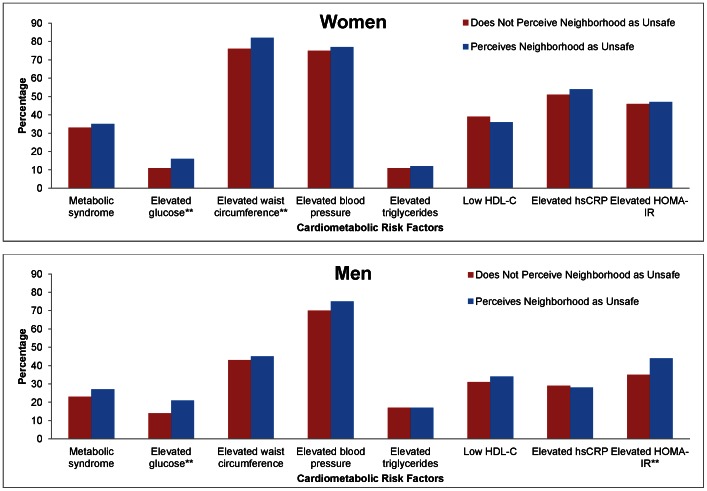
After adjustment for health behaviors and SES, neighborhood socioeconomic disadvantage was associated with the metabolic syndrome in women (PR 1.13, 95% CI 1.01, 1.27). Lack of perceived safety was associated with elevated glucose (OR 1.36, 95% CI 1.03, 1.80) and waist circumference (PR 1.06, 95% CI 1.02, 1.11) among women, and with elevated glucose (PR 1.30, 95% CI 1.02, 1.66) and insulin resistance (PR 1.25, 95% CI 1.08, 1.46) among men.
Neighborhood socioeconomic disadvantage and perceived safety should be considered as targets for intervention to reduce cardiometabolic risks among African Americans.
我们研究了在调整了健康行为和社会经济地位(SES)后,非裔美国人的社区社会经济劣势和感知社区安全与心血管代谢风险因素之间的关联。
研究参与者是非糖尿病的非裔美国人(n=3909),他们参加了杰克逊心脏研究的基线检查(2000-2004 年)。我们测量了八项风险因素:代谢综合征、其五个组成部分、胰岛素抵抗和心血管炎症。我们使用 2000 年美国人口普查数据来评估社区社会经济劣势。我们通过调查来评估感知社区安全、健康行为和 SES。我们使用广义估计方程,通过随机截距模型来估计与社区效应的关联。
在调整了健康行为和 SES 后,社区社会经济劣势与女性的代谢综合征有关(PR 1.13,95%CI 1.01,1.27)。缺乏感知安全与女性的血糖升高(OR 1.36,95%CI 1.03,1.80)和腰围增加(PR 1.06,95%CI 1.02,1.11)有关,与男性的血糖升高(PR 1.30,95%CI 1.02,1.66)和胰岛素抵抗(PR 1.25,95%CI 1.08,1.46)有关。
社区社会经济劣势和感知安全应被视为干预目标,以降低非裔美国人的心血管代谢风险。