CIRAD, UMR LSTM, Montpellier, France.
PLoS One. 2013 May 15;8(5):e63478. doi: 10.1371/journal.pone.0063478. Print 2013.
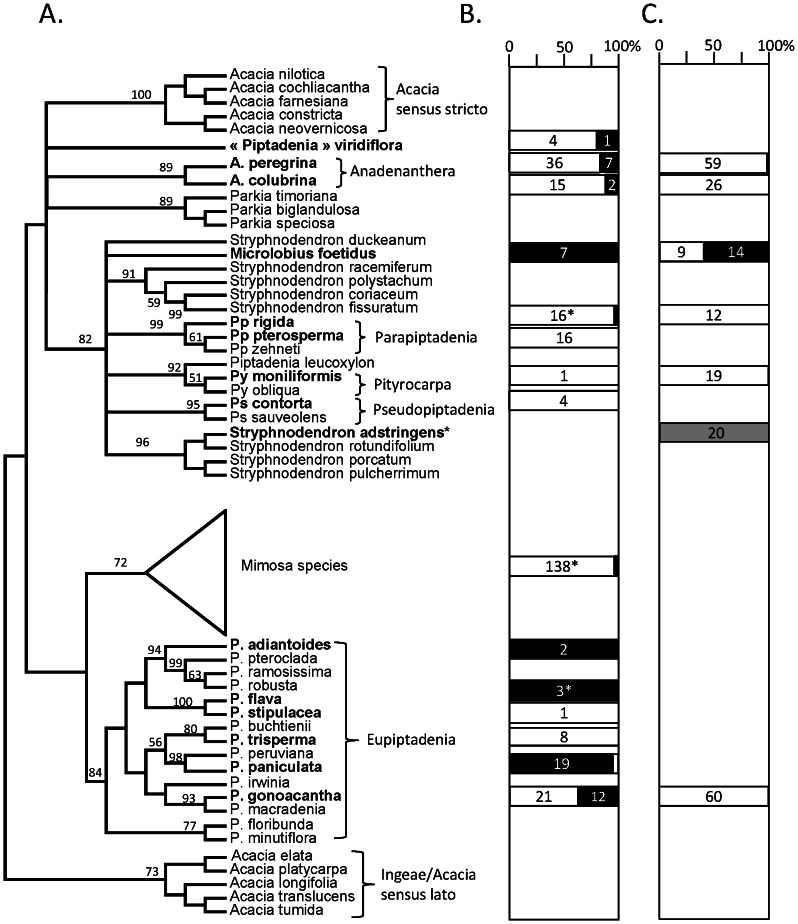
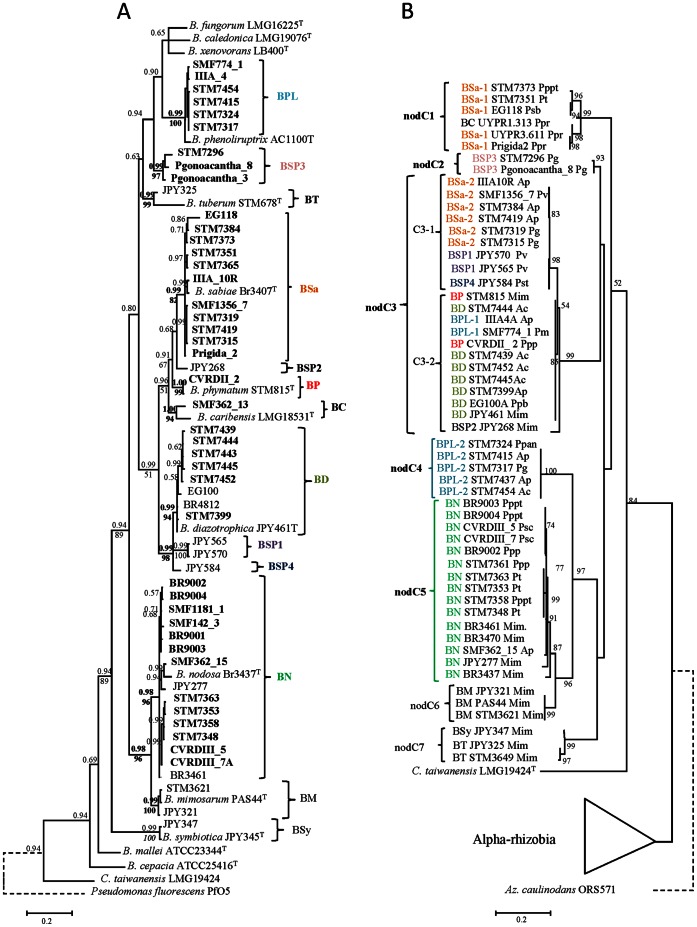
Burkholderia legume symbionts (also called α-rhizobia) are ancient in origin and are the main nitrogen-fixing symbionts of species belonging to the large genus Mimosa in Brazil. We investigated the extent of the affinity between Burkholderia and species in the tribe Mimoseae by studying symbionts of the genera Piptadenia (P.), Parapiptadenia (Pp.), Pseudopiptadenia (Ps.), Pityrocarpa (Py.), Anadenanthera (A.) and Microlobius (Mi.), all of which are native to Brazil and are phylogenetically close to Mimosa, and which together with Mimosa comprise the "Piptadenia group". We characterized 196 strains sampled from 18 species from 17 locations in Brazil using two neutral markers and two symbiotic genes in order to assess their species affiliations and the evolution of their symbiosis genes. We found that Burkholderia are common and highly diversified symbionts of species in the Piptadenia group, comprising nine Burkholderia species, of which three are new ones and one was never reported as symbiotic (B. phenoliruptrix). However, α-rhizobia were also detected and were occasionally dominant on a few species. A strong sampling site effect on the rhizobial nature of symbionts was detected, with the symbiont pattern of the same legume species changing drastically from location to location, even switching from β to α-rhizobia. Coinoculation assays showed a strong affinity of all the Piptadenia group species towards Burkholderia genotypes, with the exception of Mi. foetidus. Phylogenetic analyses of neutral and symbiotic markers showed that symbiosis genes in Burkholderia from the Piptadenia group have evolved mainly through vertical transfer, but also by horizontal transfer in two species.
豆科植物根瘤菌共生体(也称为α-根瘤菌)起源古老,是巴西大含羞草属物种的主要固氮共生体。我们通过研究豆科植物 Piptadenia 属(P.)、Parapiptadenia 属(Pp.)、Pseudopiptadenia 属(Ps.)、Pityrocarpa 属(Py.)、Anadenanthera 属(A.)和 Microlobius 属(Mi.)的共生体,研究了 Burkholderia 与含羞草族物种之间的亲和力程度。这些属都原产于巴西,在系统发育上与含羞草密切相关,与含羞草一起构成了“Piptadenia 组”。我们使用两个中性标记和两个共生基因对从巴西 17 个地点的 18 个种中采集的 196 株菌进行了特征描述,以评估它们的物种归属和共生基因的进化。我们发现,Burkholderia 是 Piptadenia 组物种的常见且高度多样化的共生体,包括 9 个 Burkholderia 种,其中 3 个是新种,1 个从未被报道为共生(B. phenoliruptrix)。然而,也检测到了α-根瘤菌,并且偶尔在一些物种中占主导地位。我们发现,共生菌的种间关系受采样地点的强烈影响,同一豆科植物的共生菌模式在不同地点发生了巨大变化,甚至从β-根瘤菌转变为α-根瘤菌。共接种实验表明,除了 Mi. foetidus 之外,所有 Piptadenia 组物种都与 Burkholderia 基因型具有很强的亲和力。中性和共生标记的系统发育分析表明,Piptadenia 组 Burkholderia 的共生基因主要通过垂直转移进化,但在两个种中也通过水平转移进化。