Kusuma School of Biological Sciences, Indian Institute of Technology, Hauz Khas, New Delhi 110016, India.
Gut Pathog. 2013 May 22;5(1):12. doi: 10.1186/1757-4749-5-12.
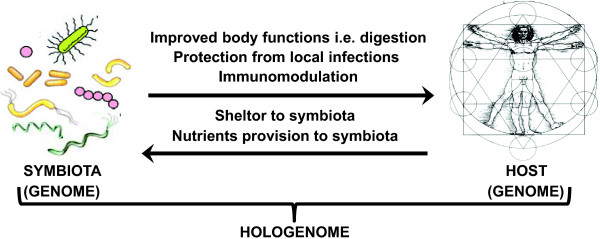
The existence of microbe free animals or plants in nature is virtually impossible as they and plants have a certain degree of symbiotic association with microbes. This symbiotic association leads to the formation of holobiont (host and its symbionts). This mutual coexistence is not merely at the physical or chemical level but also at the genetic level leading to the emergence of the concept of hologenome (gene pool of host and its associated symbionts). The abundance of symbionts with the associated gene diversity contributes to the fitness of the holobiont under varying environmental conditions. The hologenome theory of evolution considers the dynamic holobiont as a single unit for natural selection and provides a more accommodating view of evolution blending Darwinism and Lamarkism. Additionally, holobionts are providing scientific basis to our understanding of the growing importance of probiotics in human health and in disease management.
在自然界中,几乎不可能存在没有微生物的动物或植物,因为它们与微生物存在一定程度的共生关系。这种共生关系导致了后生生物(宿主及其共生体)的形成。这种共存不仅在物理或化学层面上,而且在遗传层面上,导致了全息基因组(宿主及其相关共生体的基因库)概念的出现。共生体的丰富性及其相关的基因多样性有助于后生生物在不同环境条件下的适应性。进化的全息基因组理论将动态的后生生物视为自然选择的单一单位,并为进化提供了一种更具包容性的观点,融合了达尔文主义和拉马克主义。此外,后生生物为我们理解益生菌在人类健康和疾病管理中的重要性提供了科学依据。