Division of Cardiovascular Diseases, Mayo Clinic, Rochester, Minnesota 55905, USA.
G3 (Bethesda). 2013 Jul 8;3(7):1061-8. doi: 10.1534/g3.113.006452.
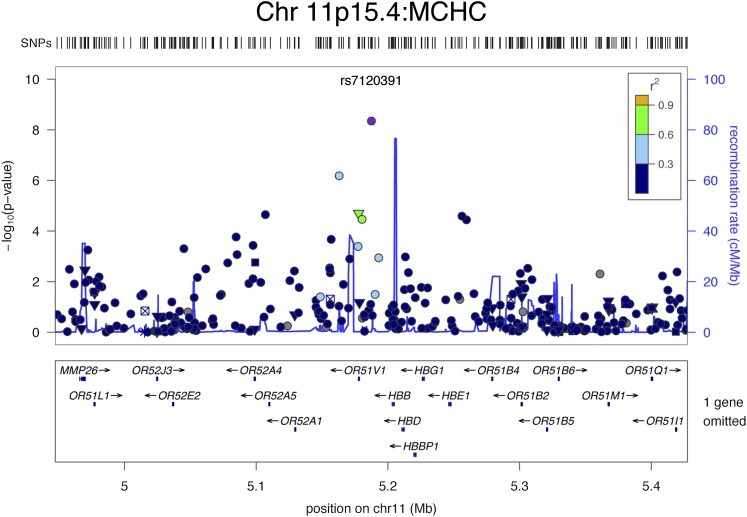
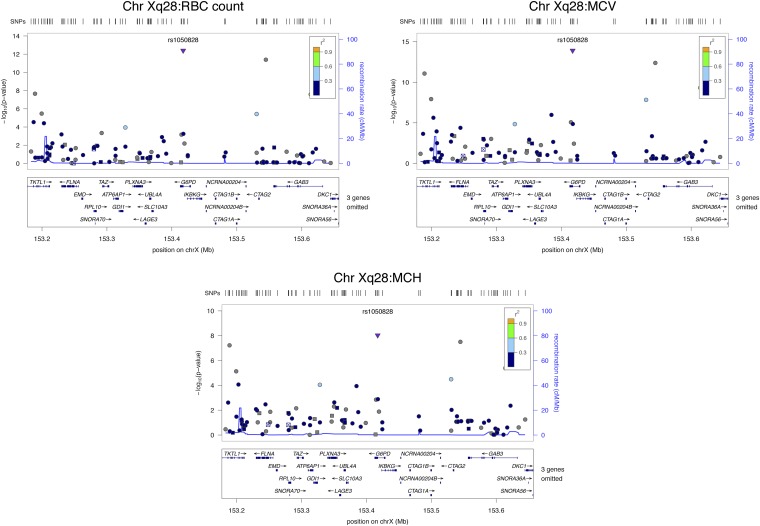
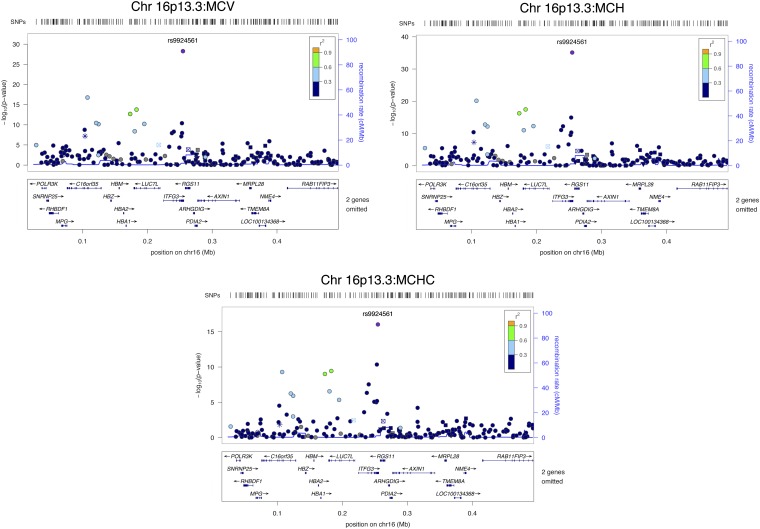
To identify novel genetic loci influencing interindividual variation in red blood cell (RBC) traits in African-Americans, we conducted a genome-wide association study (GWAS) in 2315 individuals, divided into discovery (n = 1904) and replication (n = 411) cohorts. The traits included hemoglobin concentration (HGB), hematocrit (HCT), RBC count, mean corpuscular volume (MCV), mean corpuscular hemoglobin (MCH), and mean corpuscular hemoglobin concentration (MCHC). Patients were participants in the electronic MEdical Records and GEnomics (eMERGE) network and underwent genotyping of ~1.2 million single-nucleotide polymorphisms on the Illumina Human1M-Duo array. Association analyses were performed adjusting for age, sex, site, and population stratification. Three loci previously associated with resistance to malaria-HBB (11p15.4), HBA1/HBA2 (16p13.3), and G6PD (Xq28)-were associated (P ≤ 1 × 10(-6)) with RBC traits in the discovery cohort. The loci replicated in the replication cohort (P ≤ 0.02), and were significant at a genome-wide significance level (P < 5 × 10(-8)) in the combined cohort. The proportions of variance in RBC traits explained by significant variants at these loci were as follows: rs7120391 (near HBB) 1.3% of MCHC, rs9924561 (near HBA1/A2) 5.5% of MCV, 6.9% of MCH and 2.9% of MCHC, and rs1050828 (in G6PD) 2.4% of RBC count, 2.9% of MCV, and 1.4% of MCH, respectively. We were not able to replicate loci identified by a previous GWAS of RBC traits in a European ancestry cohort of similar sample size, suggesting that the genetic architecture of RBC traits differs by race. In conclusion, genetic variants that confer resistance to malaria are associated with RBC traits in African-Americans.
为了鉴定影响非裔美国人红细胞(RBC)特征个体间差异的新遗传位点,我们对 2315 名个体进行了全基因组关联研究(GWAS),将其分为发现(n=1904)和复制(n=411)队列。这些特征包括血红蛋白浓度(HGB)、血细胞比容(HCT)、RBC 计数、平均红细胞体积(MCV)、平均红细胞血红蛋白量(MCH)和平均红细胞血红蛋白浓度(MCHC)。患者是电子医疗记录和基因组学(eMERGE)网络的参与者,接受了 Illumina Human1M-Duo 阵列上约 120 万个单核苷酸多态性的基因分型。关联分析在调整年龄、性别、地点和人群分层后进行。先前与抗疟疾相关的三个位点-HBB(11p15.4)、HBA1/HBA2(16p13.3)和 G6PD(Xq28)-在发现队列中与 RBC 特征相关(P ≤ 1×10(-6))。这些位点在复制队列中得到了复制(P ≤ 0.02),并在合并队列中达到了全基因组显著水平(P < 5×10(-8))。这些显著变异体解释 RBC 特征方差的比例如下:rs7120391(位于 HBB 附近)占 MCHC 的 1.3%,rs9924561(位于 HBA1/A2 附近)占 MCV 的 5.5%,MCH 的 6.9%和 MCHC 的 2.9%,rs1050828(在 G6PD 中)占 RBC 计数的 2.4%,MCV 的 2.9%和 MCH 的 1.4%。我们无法复制在具有相似样本量的欧洲血统队列中进行的 RBC 特征 GWAS 所确定的位点,这表明 RBC 特征的遗传结构因种族而异。总之,赋予抗疟疾能力的遗传变异与非裔美国人的 RBC 特征相关。