Department of Biological Sciences, University at Buffalo, State University of New York, Buffalo, NY, USA.
Section of Genetic Medicine, Department of Medicine, The University of Chicago, Chicago, IL, USA.
Mol Biol Evol. 2022 Mar 2;39(3). doi: 10.1093/molbev/msab313.
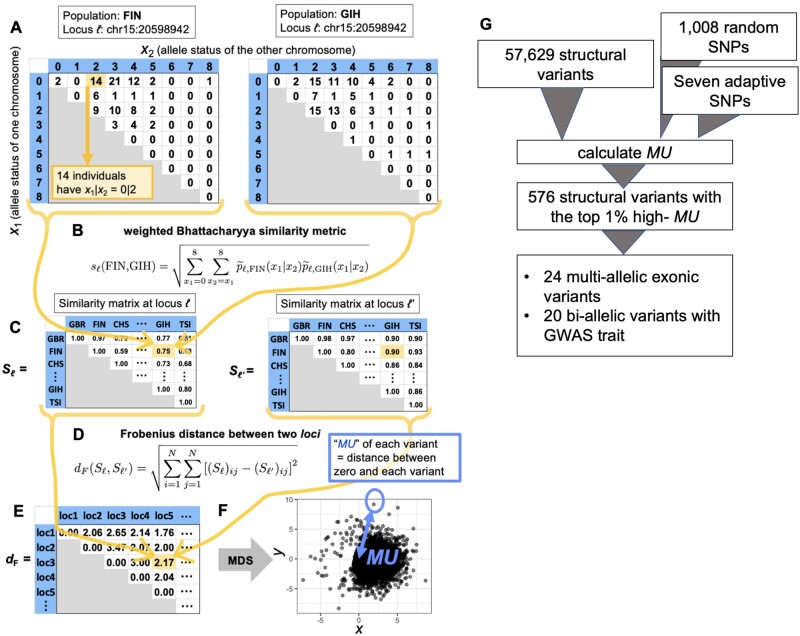
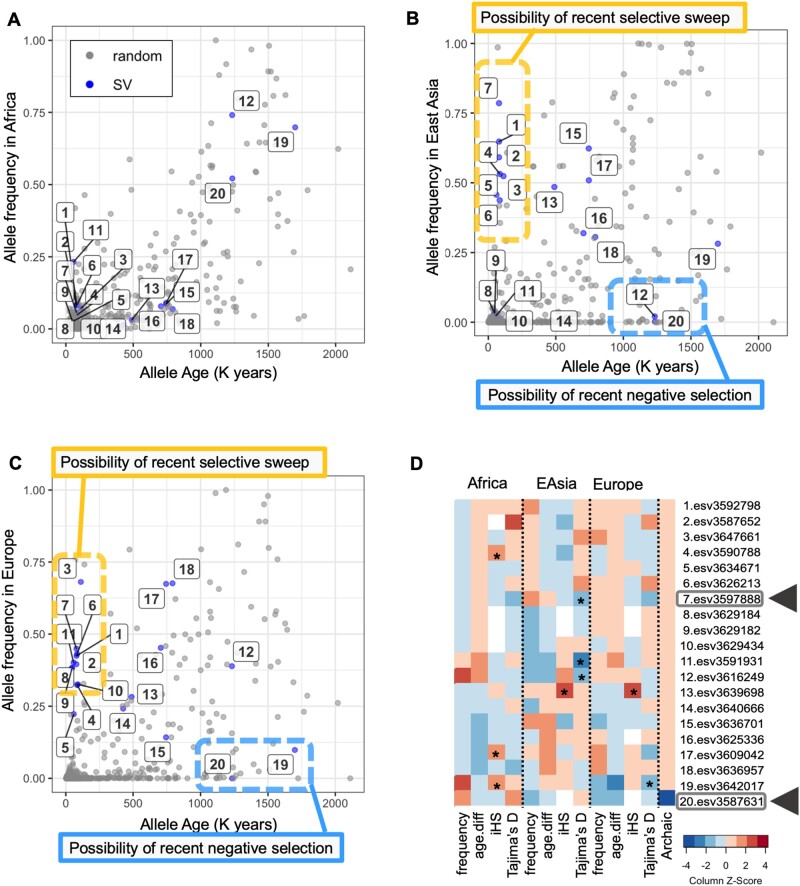
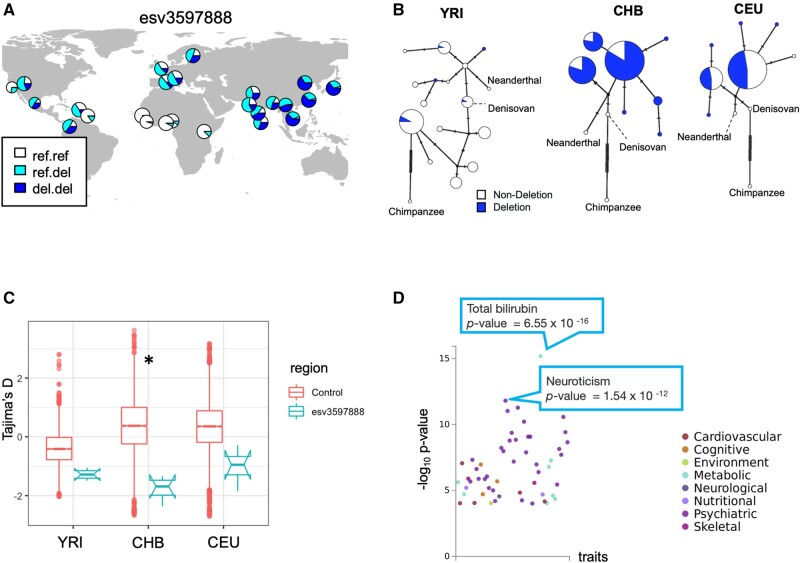
Structural variants have a considerable impact on human genomic diversity. However, their evolutionary history remains mostly unexplored. Here, we developed a new method to identify potentially adaptive structural variants based on a similarity-based analysis that incorporates genotype frequency data from 26 populations simultaneously. Using this method, we analyzed 57,629 structural variants and identified 576 structural variants that show unusual population differentiation. Of these putatively adaptive structural variants, we further showed that 24 variants are multiallelic and overlap with coding sequences, and 20 variants are significantly associated with GWAS traits. Closer inspection of the haplotypic variation associated with these putatively adaptive and functional structural variants reveals deviations from neutral expectations due to: 1) population differentiation of rapidly evolving multiallelic variants, 2) incomplete sweeps, and 3) recent population-specific negative selection. Overall, our study provides new methodological insights, documents hundreds of putatively adaptive variants, and introduces evolutionary models that may better explain the complex evolution of structural variants.
结构变异对人类基因组多样性有很大的影响。然而,它们的进化历史在很大程度上仍未被探索。在这里,我们开发了一种新的方法,基于基于相似性的分析来识别潜在的适应性结构变异,该方法同时整合了来自 26 个群体的基因型频率数据。使用这种方法,我们分析了 57629 个结构变异,鉴定出 576 个表现出异常群体分化的结构变异。在这些推测的适应性结构变异中,我们进一步表明,24 个变体是多等位基因的,并且与编码序列重叠,20 个变体与 GWAS 性状显著相关。对与这些推测的适应性和功能性结构变异相关的单倍型变异的更仔细检查显示,由于以下原因,偏离了中性预期:1)快速进化的多等位基因变体的群体分化,2)不完全清除,3)最近的群体特异性负选择。总的来说,我们的研究提供了新的方法学见解,记录了数百个推测的适应性变体,并引入了可能更好地解释结构变异复杂进化的进化模型。