Zuo Zhicai, Cui Hengmin, Li Mingzhou, Peng Xi, Zhu Ling, Zhang Ming, Ma Jideng, Xu Zhiwen, Gan Meng, Deng Junliang, Li Xuewei, Fang Jing
College of Veterinary Medicine, Sichuan Agricultural University, Ya'an 625014, Sichuan, China.
Int J Mol Sci. 2013 May 21;14(5):10626-60. doi: 10.3390/ijms140510626.
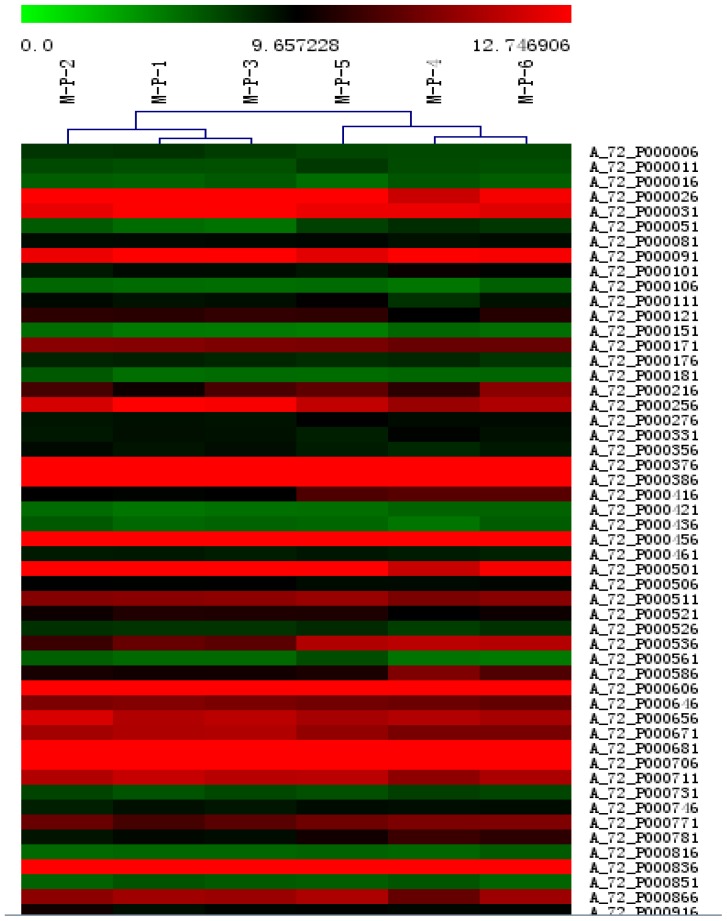
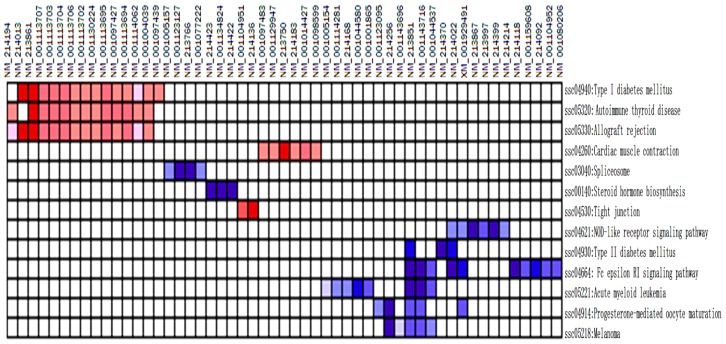
Porcine pleuropneumonia is a highly contagious respiratory disease that causes great economic losses worldwide. In this study, we aimed to explore the underlying relationship between infection and injury by investigation of the whole porcine genome expression profiles of swine lung tissues post-inoculated with experimentally Actinobacillus pleuropneumoniae. Expression profiling experiments of the control group and the treatment group were conducted using a commercially available Agilent Porcine Genechip including 43,603 probe sets. Microarray analysis was conducted on profiles of lung from challenged versus non-challenged swine. We found 11,929 transcripts, identified as differentially expressed at the p ≤0.01 level. There were 1188 genes annotated as swine genes in the GenBank Data Base. GO term analysis identified a total of 89 biological process categories, 82 cellular components and 182 molecular functions that were significantly affected, and at least 27 biological process categories that were related to the host immune response. Gene set enrichment analysis identified 13 pathways that were significantly associated with host response. Many proinflammatory-inflammatory cytokines were activated and involved in the regulation of the host defense response at the site of inflammation; while the cytokines involved in regulation of the host immune response were suppressed. All changes of genes and pathways of induced or repressed expression not only led to a decrease in antigenic peptides presented to T lymphocytes by APCs via the MHC and alleviated immune response injury induced by infection, but also stimulated stem cells to produce granulocytes (neutrophils, eosinophils, and basophils) and monocyte, and promote neutrophils and macrophages to phagocytose bacterial and foreign antigen at the site of inflammation. The defense function of swine infection with Actinobacillus pleuropneumoniae was improved, while its immune function was decreased.
猪胸膜肺炎是一种高度传染性的呼吸道疾病,在全球范围内造成巨大经济损失。在本研究中,我们旨在通过调查实验性接种胸膜肺炎放线杆菌后猪肺组织的全基因组表达谱,探索感染与损伤之间的潜在关系。使用包含43,603个探针集的市售安捷伦猪基因芯片对对照组和治疗组进行表达谱实验。对攻毒猪与未攻毒猪的肺组织谱进行微阵列分析。我们发现11,929个转录本在p≤0.01水平被鉴定为差异表达。在GenBank数据库中有1188个基因被注释为猪基因。GO术语分析确定了总共89个生物过程类别、82个细胞成分和182个分子功能受到显著影响,以及至少27个与宿主免疫反应相关的生物过程类别。基因集富集分析确定了13条与宿主反应显著相关的途径。许多促炎细胞因子被激活并参与炎症部位宿主防御反应的调节;而参与宿主免疫反应调节的细胞因子则受到抑制。诱导或抑制表达的基因和途径的所有变化不仅导致抗原呈递细胞通过MHC呈递给T淋巴细胞的抗原肽减少,减轻感染诱导的免疫反应损伤,还刺激干细胞产生粒细胞(中性粒细胞、嗜酸性粒细胞和嗜碱性粒细胞)和单核细胞,并促进中性粒细胞和巨噬细胞在炎症部位吞噬细菌和外来抗原。感染胸膜肺炎放线杆菌的猪的防御功能得到改善,而其免疫功能则下降。