Singh Rajat
Department of Medicine (Endocrinology), and Molecular Pharmacology; and The Diabetes Research Center; Albert Einstein College of Medicine; Bronx, NY USA.
Adipocyte. 2012 Apr 1;1(2):75-79. doi: 10.4161/adip.18966.
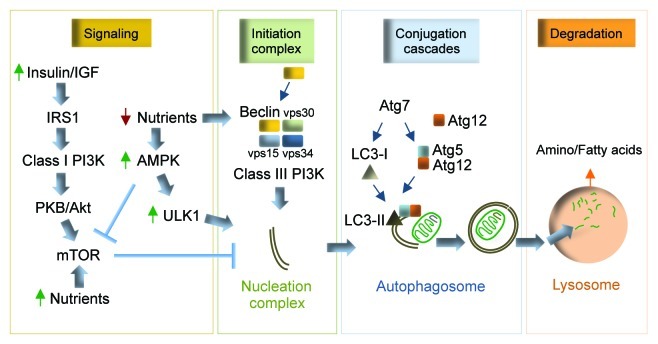
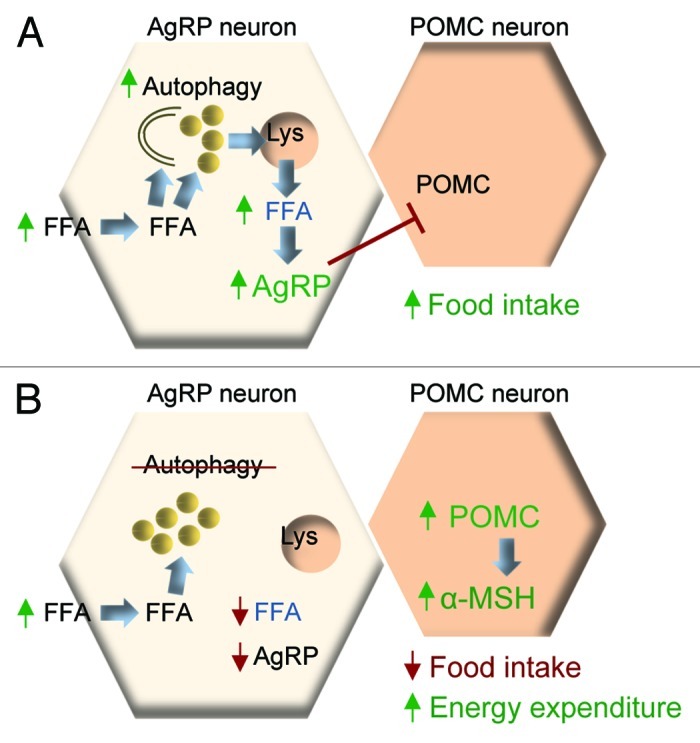
The cellular nutrient sensing apparatus detects nutritional depletion and transmits this information to downstream effectors that generate energy from alternate sources. Autophagy is a crucial catabolic pathway that turns over redundant cytoplasmic components in lysosomes to provide energy to the starved cell. Recent studies have described a role for hypothalamic autophagy in the control of food intake and energy balance. Activated autophagy in hypothalamic neurons during starvation mobilized neuron-intrinsic lipids to generate free fatty acids that increased AgRP levels. AgRP neuron-specific inhibition of autophagy decreased fasting-induced increases in AgRP levels and food intake. Deletion of autophagy in AgRP neurons led to constitutive increases in levels of proopiomelanocortin and its active processed product, α-melanocyte stimulating hormone that contributed to reduced adiposity in these rodents. The current manuscript discusses these new findings and raises additional questions that may help understand how hypothalamic autophagy controls food intake and energy balance. These studies may have implications for designing new therapies against obesity and insulin resistance.
细胞营养感应机制可检测营养物质的消耗,并将此信息传递给下游效应器,这些效应器可从其他来源产生能量。自噬是一种关键的分解代谢途径,它在溶酶体中分解多余的细胞质成分,为饥饿的细胞提供能量。最近的研究描述了下丘脑自噬在控制食物摄入和能量平衡中的作用。饥饿期间下丘脑神经元中被激活的自噬可动员神经元内的脂质生成游离脂肪酸,从而提高刺鼠色蛋白相关肽(AgRP)的水平。对AgRP神经元自噬的特异性抑制可降低禁食诱导的AgRP水平升高和食物摄入量。AgRP神经元中自噬的缺失导致阿黑皮素原及其活性加工产物α-黑素细胞刺激素水平的持续升高,这有助于降低这些啮齿动物的肥胖程度。本手稿讨论了这些新发现,并提出了其他问题,这些问题可能有助于理解下丘脑自噬如何控制食物摄入和能量平衡。这些研究可能对设计抗肥胖和胰岛素抵抗的新疗法具有启示意义。