Division of General Medicine and Primary Care, Brigham and Women's Hospital, and Harvard Medical School, Boston, Massachusetts, USA.
Prev Chronic Dis. 2013 May 23;10:E84. doi: 10.5888/pcd10.120132.
Practice-Based Research Networks (PBRNs) and health systems may provide timely, reliable data to guide the development and distribution of public health resources to promote healthy behaviors, such as quitting smoking. The objective of this study was to determine if PBRN data could be used to make neighborhood-level estimates of smoking prevalence.
We estimated the smoking prevalence in 32 greater Boston neighborhoods (population = 877,943 adults) by using the electronic health record data of adults who in 2009 visited one of 26 Partners Primary Care PBRN practices (n = 77,529). We compared PBRN-derived estimates to population-based estimates derived from 1999-2009 Behavioral Risk Factor Surveillance System (BRFSS) data (n = 20,475).
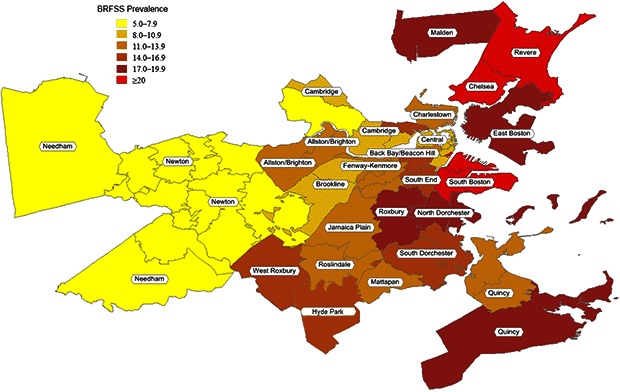
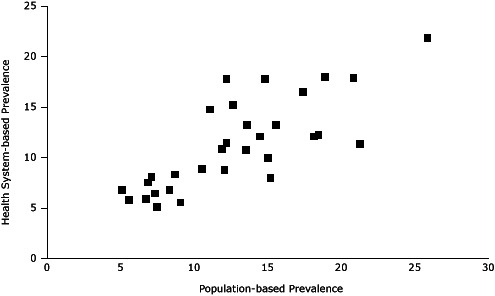
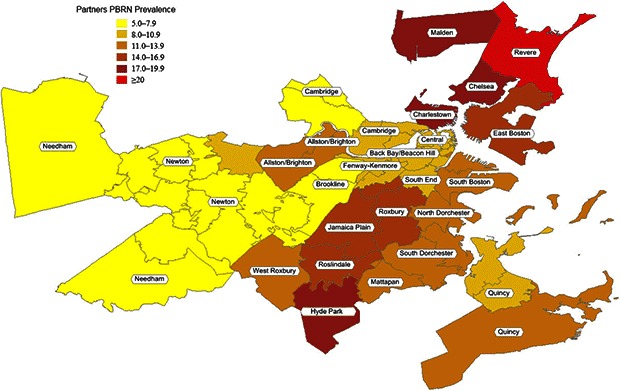
The PBRN estimates of neighborhood smoking status ranged from 5% to 22% and averaged 11%. The 2009 neighborhood-level smoking prevalence estimates derived from the BRFSS ranged from 5% to 26% and averaged 13%. The difference in smoking prevalence between the PBRN and the BRFSS averaged -2 percentage points (standard deviation, 3 percentage points).
Health behavior data collected during routine clinical care by PBRNs and health systems could supplement or be an alternative to using traditional sources of public health data.
实践基础研究网络(PBRN)和卫生系统可以提供及时、可靠的数据,以指导公共卫生资源的开发和分配,促进健康行为,如戒烟。本研究的目的是确定 PBRN 数据是否可用于对社区吸烟率进行估计。
我们利用 2009 年访问 26 个合作伙伴初级保健 PBRN 实践之一的成年人的电子健康记录数据(n=77529),对 32 个大波士顿社区(人口=877943 名成年人)的吸烟率进行了估计。我们将 PBRN 衍生的估计值与来自 1999-2009 年行为风险因素监测系统(BRFSS)数据的基于人群的估计值(n=20475)进行了比较。
PBRN 对社区吸烟状况的估计范围从 5%到 22%,平均为 11%。BRFSS 得出的 2009 年社区吸烟率估计值从 5%到 26%不等,平均为 13%。PBRN 和 BRFSS 之间的吸烟率差异平均为-2 个百分点(标准差为 3 个百分点)。
PBRN 和卫生系统在常规临床护理期间收集的健康行为数据可以补充或替代使用传统公共卫生数据来源。