Laboratory of Systems Biology, National Institute of Allergy and Infectious Diseases, National Institutes of Health, Bethesda, Maryland 20892-0421, USA.
Nature. 2013 Jun 20;498(7454):371-5. doi: 10.1038/nature12175. Epub 2013 May 26.
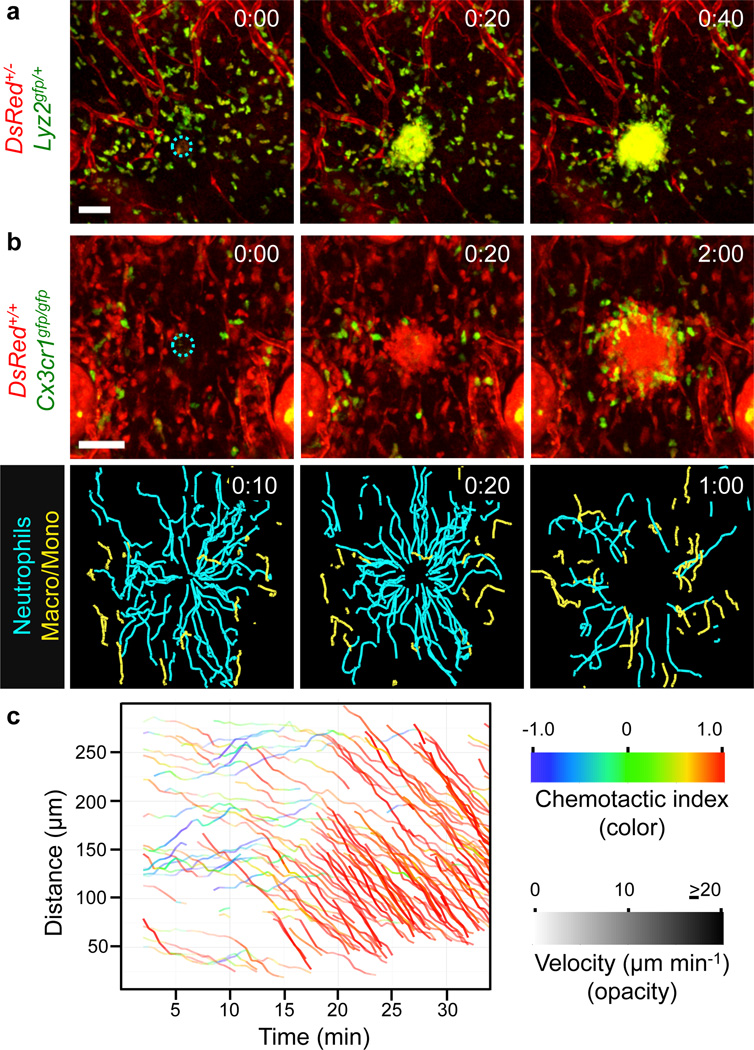
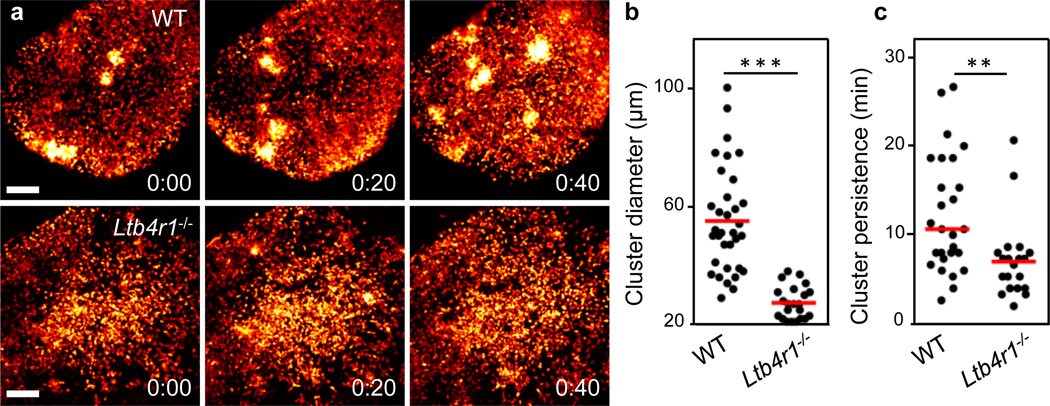
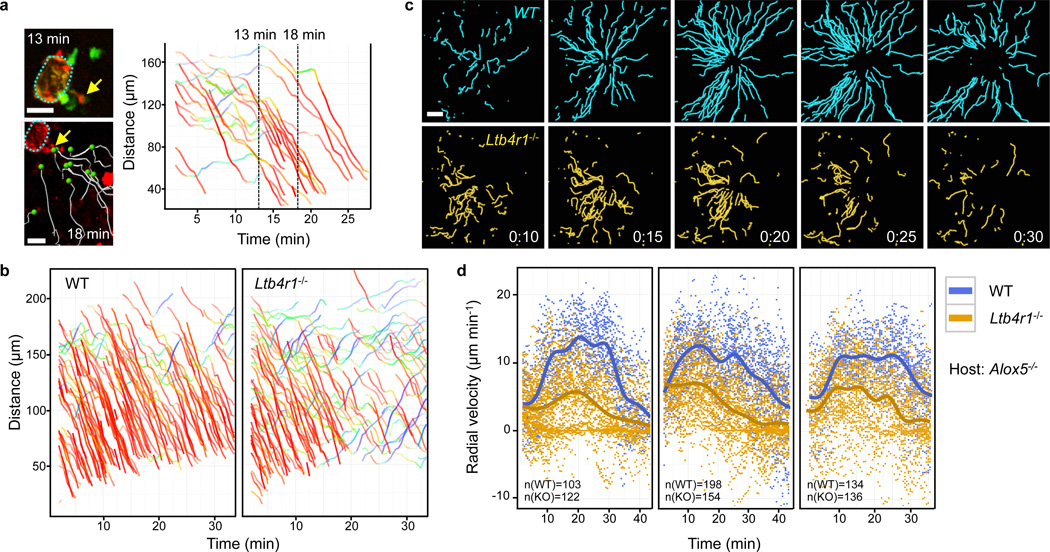
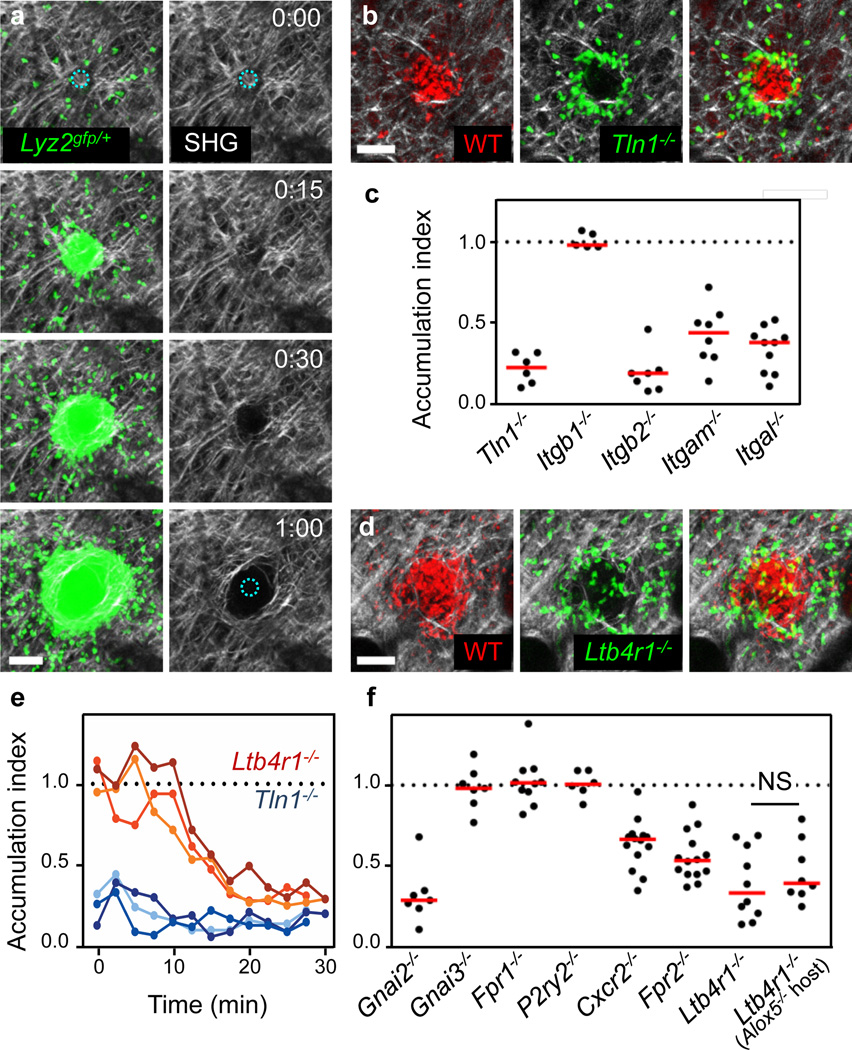
Neutrophil recruitment from blood to extravascular sites of sterile or infectious tissue damage is a hallmark of early innate immune responses, and the molecular events leading to cell exit from the bloodstream have been well defined. Once outside the vessel, individual neutrophils often show extremely coordinated chemotaxis and cluster formation reminiscent of the swarming behaviour of insects. The molecular players that direct this response at the single-cell and population levels within the complexity of an inflamed tissue are unknown. Using two-photon intravital microscopy in mouse models of sterile injury and infection, we show a critical role for intercellular signal relay among neutrophils mediated by the lipid leukotriene B4, which acutely amplifies local cell death signals to enhance the radius of highly directed interstitial neutrophil recruitment. Integrin receptors are dispensable for long-distance migration, but have a previously unappreciated role in maintaining dense cellular clusters when congregating neutrophils rearrange the collagenous fibre network of the dermis to form a collagen-free zone at the wound centre. In this newly formed environment, integrins, in concert with neutrophil-derived leukotriene B4 and other chemoattractants, promote local neutrophil interaction while forming a tight wound seal. This wound seal has borders that cease to grow in kinetic concert with late recruitment of monocytes and macrophages at the edge of the displaced collagen fibres. Together, these data provide an initial molecular map of the factors that contribute to neutrophil swarming in the extravascular space of a damaged tissue. They reveal how local events are propagated over large-range distances, and how auto-signalling produces coordinated, self-organized neutrophil-swarming behaviour that isolates the wound or infectious site from surrounding viable tissue.
中性粒细胞从血液向无感染或无菌组织损伤的血管外部位的募集是早期固有免疫反应的标志,导致细胞离开血流的分子事件已经得到很好的定义。一旦离开血管,单个中性粒细胞通常表现出极其协调的趋化性和簇形成,使人联想到昆虫的群集行为。在炎症组织的复杂性中,指导单细胞和群体水平反应的分子参与者尚不清楚。我们使用无菌损伤和感染的小鼠模型中的双光子活体显微镜,表明细胞间信号中继在中性粒细胞中的关键作用,这种信号中继由脂质白细胞三烯 B4 介导,它急性放大局部细胞死亡信号,以增强高度定向间质中性粒细胞募集的半径。整合素受体对于远距离迁移是可有可无的,但在聚集的中性粒细胞重新排列真皮的胶原纤维网络以在伤口中心形成无胶原区时,对于维持密集的细胞簇具有以前未被认识到的作用。在这个新形成的环境中,整合素与中性粒细胞衍生的白细胞三烯 B4 和其他趋化因子协同作用,促进局部中性粒细胞相互作用,同时形成紧密的伤口密封。这个伤口密封的边界不再生长,与在移位胶原纤维边缘的单核细胞和巨噬细胞的后期募集呈动力学协同。这些数据共同提供了一个初步的分子图谱,说明了导致中性粒细胞在受损组织的血管外空间中聚集的因素。它们揭示了局部事件如何在大范围内传播,以及自信号如何产生协调的、自我组织的中性粒细胞聚集行为,将伤口或感染部位与周围存活组织隔离开来。