Khan A A, Klonizakis M, Shabaan A, Glynne-Jones R
Department of Gastrointestinal Research, Mount Vernon Cancer Treatment and Research Centre, London, UK.
Colorectal Dis. 2013;15(10):1232-7. doi: 10.1111/codi.12307.
The study was carried out to investigate whether pretreatment haemoglobin (Hb) levels act as a biomarker in the management of patients with locally advanced rectal cancer.
We prospectively collected data on all patients within our cancer network with localized low rectal cancer treated with preoperative radiotherapy/chemoradiotherapy at Mount Vernon Centre for Cancer Treatment between March 1994 and July 2008. Pretreatment Hb level was assessed as an independent variable for the whole study sample and dichotomised at a value of 12 g/dl. A multivariate analysis of covariance (MANCOVA) was conducted on parameters that had significant association on univariate analysis of covariance (ANCOVA) and correlational (Kendall tau/Pearson) analyses. Kaplan-Meier survival analysis and Cox proportional hazard models were used to determine significant prognostic markers. Statistical significance was set at 0.05.
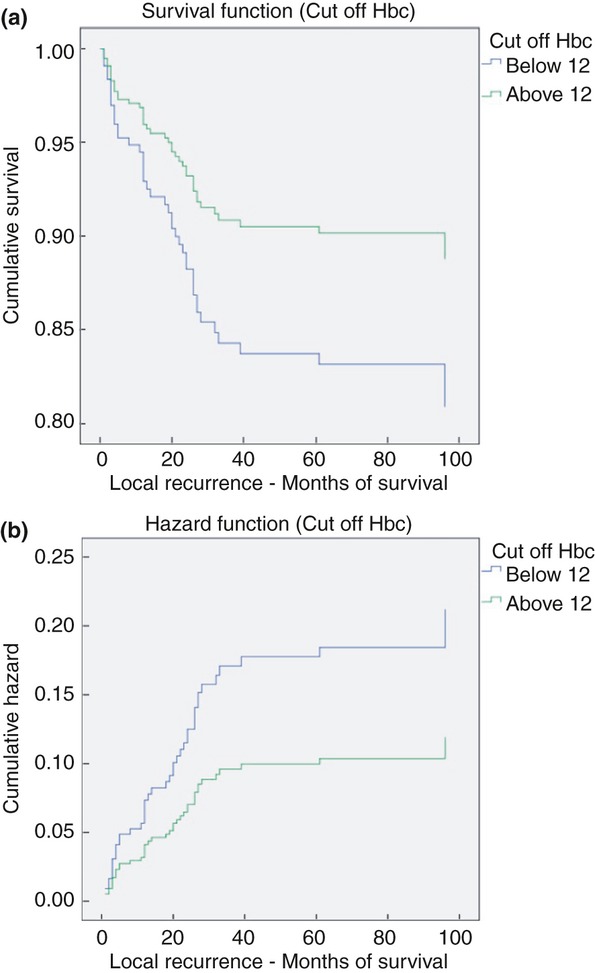
463 patients (male/female 2:1; median age = 66 years, interquartile range = 56.5-73.0) were included in the analysis. There was significant tumour response of T stage (P < 0.001) and N stage (P < 0.001), with 17.6% of patients achieving a pathological complete response. Pretreatment Hb value was inversely related to the craniocaudal vertical tumour length (P = 0.02) and pretreatment T stage of the tumour (P = 0.01). Patients with Hb levels of < 12 g/dl and moderately differentiated adenocarcinoma were less responsive. Local recurrence was more common in patients with a pretreatment Hb of < 12 g/dl (hazard ratio = 1.78) over a median follow up of 24 months, but this was not statistically significant (P = 0.08).
The pretreatment Hb level might be used as a biomarker of rectal tumour morphology, response to neoadjuvant chemoradiation and risk of local recurrence.
本研究旨在调查治疗前血红蛋白(Hb)水平是否可作为局部晚期直肠癌患者管理中的生物标志物。
我们前瞻性收集了1994年3月至2008年7月在弗农山癌症治疗中心接受术前放疗/放化疗的所有局部低位直肠癌患者的数据。将治疗前Hb水平作为整个研究样本的独立变量进行评估,并以12 g/dl的值进行二分法划分。对在单变量协方差分析(ANCOVA)和相关性(肯德尔tau/皮尔逊)分析中有显著关联的参数进行多变量协方差分析(MANCOVA)。采用Kaplan-Meier生存分析和Cox比例风险模型来确定显著的预后标志物。设定统计学显著性为0.05。
463例患者(男/女为2:1;中位年龄 = 66岁,四分位间距 = 56.5 - 73.0)纳入分析。T分期(P < 0.001)和N分期(P < 0.001)有显著的肿瘤反应,17.6%的患者实现了病理完全缓解。治疗前Hb值与肿瘤的头尾垂直长度(P = 0.02)和肿瘤的治疗前T分期(P = 0.01)呈负相关。Hb水平< 12 g/dl且为中分化腺癌的患者反应较差。在中位随访24个月期间,治疗前Hb < 12 g/dl的患者局部复发更常见(风险比 = 1.78),但这无统计学显著性(P = 0.08)。
治疗前Hb水平可作为直肠肿瘤形态、对新辅助放化疗反应及局部复发风险的生物标志物。