Institute of Neuropathology, University of Göttingen Göttingen, Germany.
Front Cell Neurosci. 2013 May 14;7:65. doi: 10.3389/fncel.2013.00065. eCollection 2013.
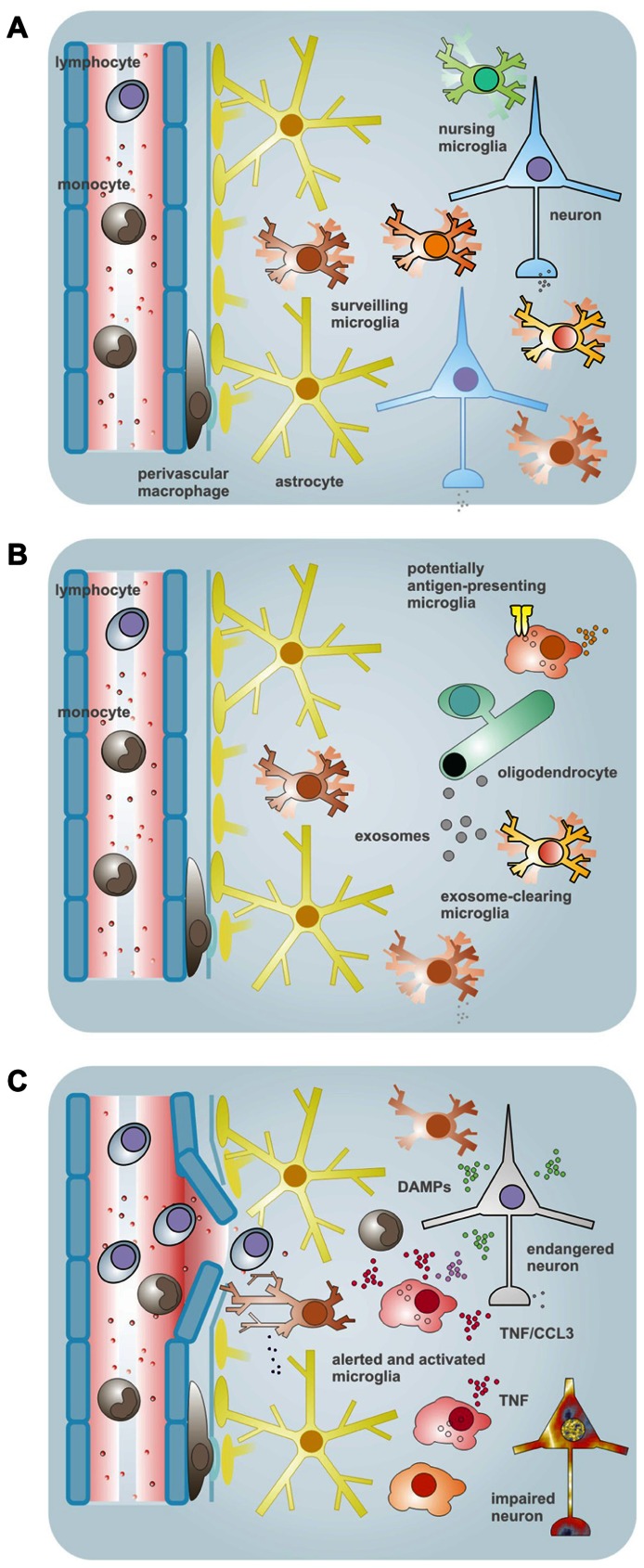
Microglia serve in the surveillance and maintenance, protection and restoration of the central nervous system (CNS) homeostasis. By their parenchymal location they differ from other CNS-associated myeloid cells, and by origin as well as functional characteristics they are also-at least in part-distinct from extraneural tissue macrophages. Nevertheless, microglia themselves may not comprise a uniform cell type. CNS regions vary by cellular and chemical composition, including white matter (myelin) content, blood-brain barrier properties or prevailing neurotransmitters. Such a micromilieu could instruct as well as require local adaptions of microglial features. Yet even cells within circumscribed populations may reveal some specialization by subtypes, regarding house-keeping duties and functional capacities upon challenges. While diversity of reactive phenotypes has been established still little is known as to whether all activated cells would respond with the same program of induced genes and functions or whether responder subsets have individual contributions. Preferential synthesis of a key cytokine could asign a master control to certain cells among a pool of activated microglia. Critical functions could be sequestered to discrete microglial subtypes in order to avoid interference, such as clearance of endogenous material and presentation of antigens. Indeed, several and especially a number of recent studies provide evidence for the constitutive and reactive heterogeneity of microglia by and within CNS regions. While such a principle of "division of labor" would influence the basic notion of "the" microglia, it could come with the practival value of addressing separate microglia types in experimental and therapeutic manipulations.
小胶质细胞在中枢神经系统 (CNS) 内环境的监测、维护、保护和修复中发挥作用。由于其位于实质组织中,与其他 CNS 相关的髓样细胞不同,并且由于起源和功能特征,它们也至少在一定程度上与神经外组织中的巨噬细胞不同。然而,小胶质细胞本身可能并不构成一个统一的细胞类型。CNS 区域的细胞和化学成分不同,包括白质(髓鞘)含量、血脑屏障特性或占主导地位的神经递质。这种微环境不仅可以指导,还可以要求微胶质细胞特征的局部适应。然而,即使在限定的群体内的细胞,也可能通过亚型表现出一些专业化,涉及管家职责和功能能力的挑战。虽然已经确定了反应性表型的多样性,但对于所有激活的细胞是否会对诱导基因和功能产生相同的反应程序,或者反应细胞亚群是否具有个体贡献,仍然知之甚少。关键细胞因子的优先合成可以为激活的小胶质细胞池中的某些细胞赋予主要的控制作用。关键功能可能会被隔离到离散的小胶质细胞亚型中,以避免干扰,例如清除内源性物质和抗原呈递。事实上,许多特别是最近的研究为 CNS 区域内小胶质细胞的组成型和反应性异质性提供了证据。虽然这种“分工”原则会影响“小胶质细胞”的基本概念,但它可能具有在实验和治疗操作中分别针对不同小胶质细胞类型的实际价值。