Department of Plant Physiology, University of Bayreuth Bayreuth, Germany.
Front Plant Sci. 2013 May 14;4:125. doi: 10.3389/fpls.2013.00125. eCollection 2013.
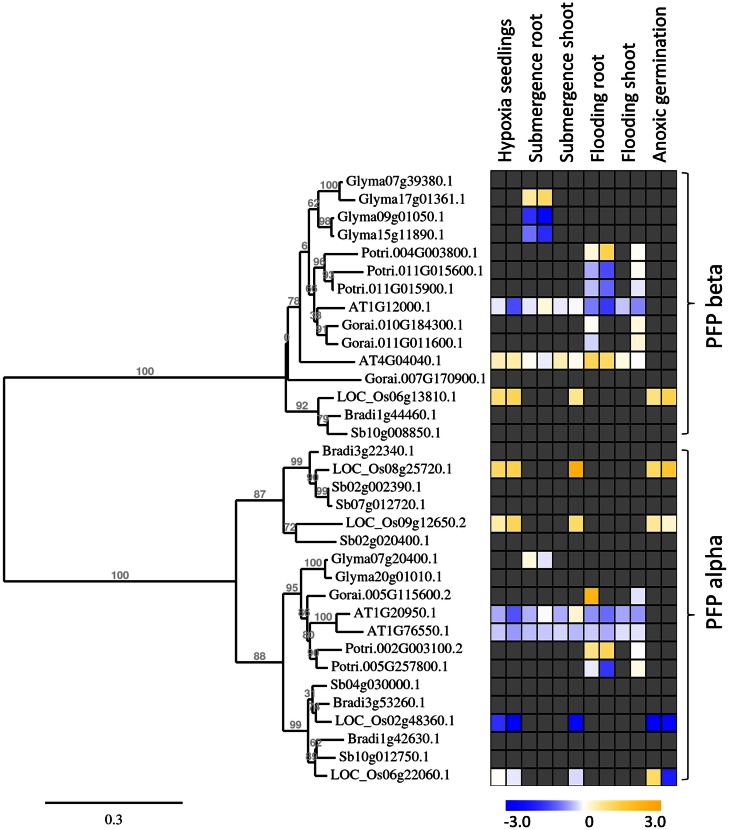
Plants possess two types of phosphofructokinase proteins for phosphorylation of fructose-6-phosphate, the ATP-dependent phosphofructokinase (PFK) and the pyrophosphate-(PPi) dependent pyrophosphate-fructose-6-phosphate-phosphotransferase (PFP). During oxygen deficiency ATP levels in rice seedlings are severely reduced, and it is hypothesized that PPi is used as an alternative energy source for the phosphorylation of fructose-6-phosphate during glycolysis. In this study, we analyzed the expression of 15 phosphofructokinase-encoding genes in roots and aerial tissues of anoxia-tolerant rice seedlings in response to anoxic stress and compared our data with transcript profiles obtained from microarray analyses. Furthermore, the intracellular localization of rice PFK proteins was determined, and the PFK and PFP isoforms were grouped in a phylogenetic tree. Two PFK and two PFP transcripts accumulated during anoxic stress, whereas mRNA levels of four PFK and three PFP genes were decreased. The total specific activity of both PFK and PFP changed only slightly during a 24-h anoxia treatment. It is assumed that expression of different isoforms and their catalytic properties differ during normoxic and anoxic conditions and contribute to balanced glycolytic activity during the low-oxygen stress. These characterizations of phosphofructokinase genes and the comparison to other plant species allowed us to suggest candidate rice genes for adaptation to anoxic stress.
植物拥有两种磷酸果糖激酶蛋白,用于磷酸化果糖-6-磷酸,即依赖于 ATP 的磷酸果糖激酶 (PFK) 和依赖于焦磷酸 (PPi) 的焦磷酸-果糖-6-磷酸-磷酸转移酶 (PFP)。在水稻幼苗缺氧时,ATP 水平严重降低,据推测,在糖酵解过程中,PPi 被用作果糖-6-磷酸磷酸化的替代能源。在这项研究中,我们分析了耐缺氧水稻幼苗根部和地上组织中 15 种磷酸果糖激酶编码基因对缺氧胁迫的表达,并将我们的数据与微阵列分析获得的转录谱进行了比较。此外,还确定了水稻 PFK 蛋白的细胞内定位,并将 PFK 和 PFP 同工型分组在系统发育树中。在缺氧胁迫期间,两种 PFK 和两种 PFP 转录本积累,而四种 PFK 和三种 PFP 基因的 mRNA 水平降低。在 24 小时缺氧处理过程中,两种 PFK 和 PFP 的总比活性仅略有变化。据推测,不同同工型的表达及其催化特性在常氧和缺氧条件下不同,有助于在低氧胁迫下保持平衡的糖酵解活性。这些磷酸果糖激酶基因的特性描述以及与其他植物物种的比较使我们能够为适应缺氧胁迫提出候选水稻基因。